📑 Table of Contents
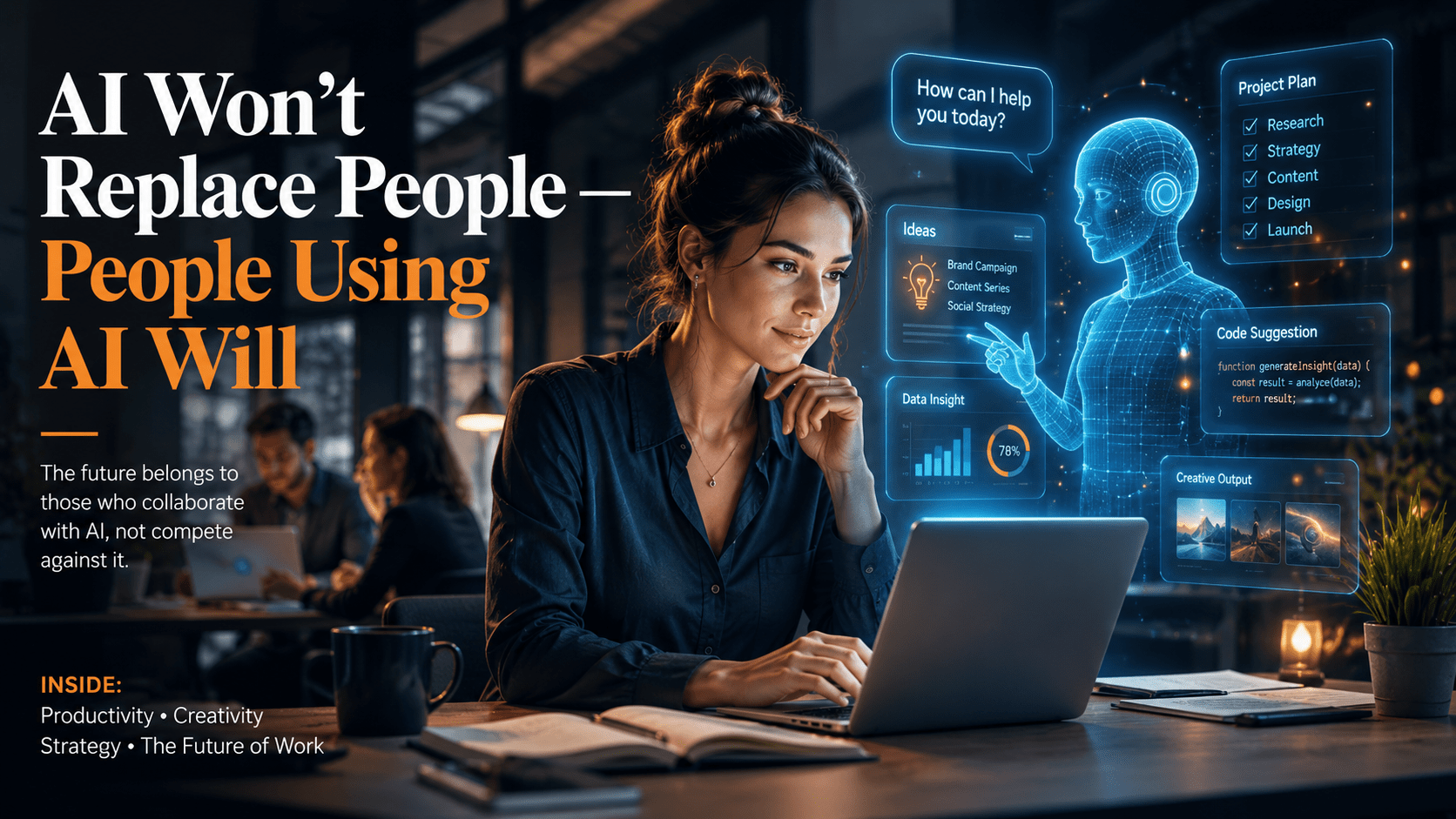
AI Won’t Replace People—
But People Using AI
Will Replace Those Who Don’t
The greatest professional disruption of our era isn’t being caused by machines.
It’s being caused by the humans who’ve learned to wield them.
Every major technological revolution has arrived with the same accompanying dread: that this time, finally, the machines will render human labor obsolete. The printing press would destroy scribes. Factories would end artisans. Spreadsheets would eliminate accountants. And yet, with every wave, something unexpected happened — the nature of work shifted, and those who adapted earliest seized asymmetric advantages over those who waited.
We are living through the same inflection point again. But this time, the stakes feel different — not because AI is more dangerous, but because the speed of adoption is faster and the gap between early movers and late adopters is wider than anything we’ve seen before.
The Augmentation Principle
Let’s be precise about what AI is actually doing in the workplace today. It is not replacing the judgment, creativity, relationships, and contextual wisdom that professionals have spent years accumulating. What it is doing is dramatically compressing the time it takes to do foundational, repetitive, and research-intensive work — the scaffolding that used to consume 60–70% of a knowledge worker’s day.
A lawyer who uses AI to draft contract language, research precedents, and summarize depositions isn’t becoming less of a lawyer. They’re becoming a lawyer who can handle three times the caseload, at higher quality, with more time left for the high-stakes counsel that actually requires a human mind. Now imagine competing against that person while still doing everything manually.
Average productivity gain reported by professionals using AI daily
Of job tasks in most industries are augmentable by current AI tools
Of hiring managers now prefer AI-literate candidates over non-users
The Invisible Divide Widening Every Day
Here is what makes this moment unusual: the competitive gap is not abstract or futuristic. It is happening right now, in performance reviews, client proposals, and job interviews. Two people with identical resumes, identical experience, and identical qualifications enter the same market. One has spent six months incorporating AI into their daily workflow. The other has not.
They are not the same candidate. They are not doing the same quality of work. And the difference is only going to compound — because the person using AI is learning faster, iterating faster, and building skills that the non-user will fall further and further behind on.
The industrial revolution separated the mechanized from the manual. The AI revolution is separating the augmented from the unassisted — and the gap is widening by the month.
What “Using AI” Actually Means
There’s a common misconception that “using AI” means becoming a prompt engineer or building neural networks. It doesn’t. For most professionals, integrating AI into their workflow looks far more mundane — and far more powerful.
- A marketer who uses AI to generate twelve campaign concepts in an afternoon instead of two, then applies their taste and judgment to select and refine the best
- A product manager who uses AI to synthesize 400 user feedback responses into structured themes in twenty minutes instead of two days
- A teacher who uses AI to draft differentiated lesson plans for multiple learning levels simultaneously, preserving their time for actual student interaction
- A developer who uses AI pair-programming tools to write boilerplate, catch bugs, and document code — spending their cognitive energy on architecture and problem-solving instead
- A small business owner who uses AI to handle customer emails, social media, invoicing follow-ups, and market research — competing with companies ten times their size
None of these people have been replaced. All of them have become significantly more competitive than counterparts who haven’t made the same shift.
The Human Irreplaceables
The fear that AI eliminates human value is understandable but misplaced. What AI cannot replicate — and may never replicate — is the distinctly human capacity for earned trust, moral accountability, embodied empathy, and creative leaps made from lived experience. A therapist, a surgeon, an entrepreneur, a teacher: the expertise is not just knowledge — it is judgment under pressure, formed through years of feedback loops that cannot be shortcut.
AI is brilliant at pattern-matching across known territory. Humans are irreplaceable at navigating genuinely novel territory — where precedent fails, where ethics get complicated, where the right answer requires moral courage, not just cognitive power. The professionals who understand this distinction, who let AI handle the former so they can focus entirely on the latter — those are the people who will define the next era of every industry.
The Choice in Front of You Right Now
There is a version of the next three years in which you learn to work with AI as a genuine collaborator — using it to do the same work better, faster, and with greater creative range. There is another version in which you wait, resist, or dismiss it as hype — and watch as colleagues and competitors quietly become two, three, or five times more productive than you.
The good news is that the on-ramp has never been lower. You don’t need to study machine learning. You need to spend two hours exploring how the tools available today can eliminate the parts of your work that feel most like busywork — and do more of the work that only you can do.
The professional world is not dividing into humans and machines. It is dividing into the augmented and the unassisted. Which side of that divide you end up on is, right now, still entirely your choice.
Ready to build an AI-ready workforce?
At Reskill & Rise, we help organizations design and deliver AI reskilling programs that are role-specific, human-centred, and built to last — not one-time events, but lasting capability.