📑 Table of Contents
In a world where roles evolve faster than job descriptions, the organizations that invest in their people don’t just survive disruption — they lead through it.
There’s a quiet assumption baked into most organizational structures: that employees are hired for what they already know. Skills are screened at the door, matched to a role, and expected to stay relevant indefinitely. But in an era defined by automation, AI, and constant market shifts, that assumption is becoming one of the most expensive ones a business can make.
The truth is, the most valuable thing an employee brings to work isn’t their current skillset — it’s their capacity to grow. And the organizations smart enough to cultivate that capacity are building something more durable than any product line or market position: they’re building an adaptable workforce.
The hidden cost of standing still
Most companies talk about talent. Far fewer invest in it systemically. When workforce restructuring looms — whether driven by automation, cost pressure, or strategic pivots — the default move has long been the layoff. Cut headcount, reduce costs, move on. It’s familiar. It feels decisive.
But the math rarely tells the full story.
33% of annual salary to replace a single employee
6–9 months for a new hire to reach full productivity
70% of employees say learning opportunities influence their stay
Beyond the numbers, there’s a subtler cost that never appears on a balance sheet: institutional knowledge. Every departing employee takes with them years of context — how customers think, why decisions were made, where the bodies are buried. That wisdom cannot be rehired. It simply walks out the door.
“Replacing people is expensive. Losing what they know is catastrophic.”
Reskilling as a strategic advantage, not a last resort
The organizations redefining workforce management aren’t waiting for a crisis to invest in learning. They’re treating continuous development as core infrastructure — as essential as their technology stack or their supply chain.
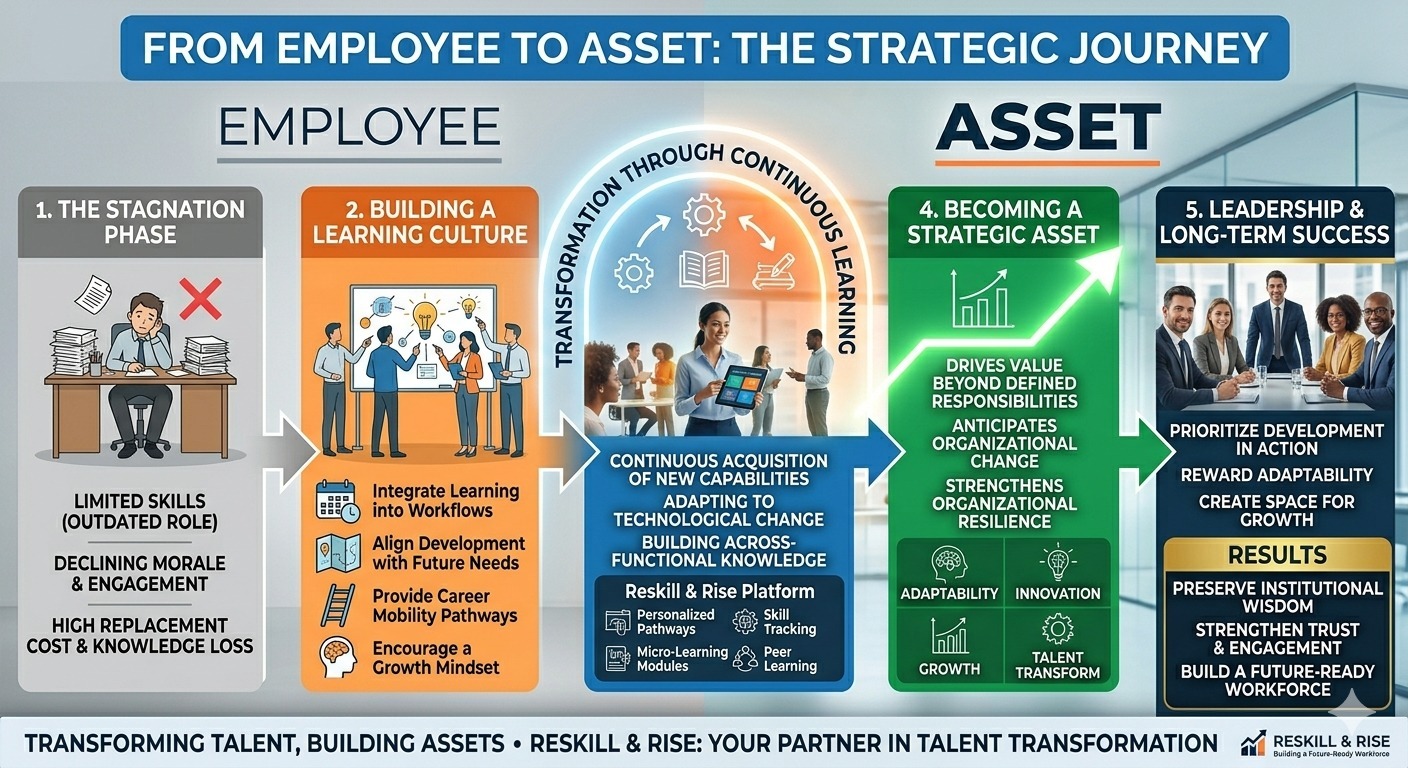
This shift reframes the entire employment relationship. An employee hired for one role but developed across many becomes something different: a resilient, multi-dimensional contributor whose value compounds over time. They understand the company’s culture, history, and systems. They bring trust, context, and loyalty. All they need is the skills to meet the next challenge.
The Reskill & Rise Perspective
Workforce transitions don’t have to be traumatic. When organizations invest in reskilling before restructuring becomes necessary, they transform a moment of risk into an opportunity for renewal — retaining the people who know the business best, while building the capabilities the future demands.
This isn’t idealism. It’s a documented, measurable approach to change management. Companies that prioritize internal mobility and learning programs consistently report higher retention, stronger employer brand, and lower restructuring costs — while emerging from transitions with morale intact rather than shattered.
What continuous learning actually looks like
Effective workforce development isn’t a once-a-year training day or an online course catalog no one opens. It’s a culture — one where learning is embedded in how work gets done, where managers are equipped to coach, and where growth pathways are visible and real.
In practice, that means connecting employees with skills assessments that illuminate their own gaps and strengths. It means pairing them with mentors who have walked adjacent paths. It means creating internal secondments — opportunities to work across functions before a role is even posted externally. And crucially, it means leadership that signals, consistently and credibly, that growth is valued here.
The goal isn’t to turn every employee into a Swiss Army knife. It’s to ensure that when the business pivots — and it will — there are people already inside who can pivot with it.
Protecting people is protecting the business
There’s a false tension embedded in how many organizations approach workforce decisions: the idea that protecting people comes at the expense of protecting the bottom line. Responsible change management challenges that assumption directly.
When employees see that an organization invests in them — genuinely, not performatively — they reciprocate. They stay longer. They recommend the company to peers. They weather difficult moments with resilience rather than resentment. They become advocates, not cautionary tales.
That kind of loyalty is built over time, one learning opportunity at a time. It’s the compounding interest of human-centered leadership. And when disruption arrives — as it always does — it’s the difference between a company that hemorrhages talent and one that retains its best people through the storm.
At Reskill & Rise, we believe that the workforce of the future isn’t built by hiring better — it’s built by developing deeper. The organizations that will lead the next decade aren’t those with the most aggressive restructuring strategies. They’re the ones who figured out, early, that their people aren’t a cost to be managed. They’re an asset to be grown.
The question isn’t whether your workforce needs to evolve. It’s whether you’re going to be the one to lead that evolution — or watch it happen to you.
Ready to transform how your organization approaches workforce transitions?