📑 Table of Contents
Employers say they’re investing more in reskilling than ever. Employees say they’re getting less support than they need. Both are telling the truth. The gap between those two realities is where workforce potential quietly disappears — and where the smartest organizations are starting to pay attention.
There’s a question that sits uncomfortably at the heart of most workforce development conversations: whose job is it, really, to keep employees relevant and growing?
Ask HR leaders and they’ll point to learning budgets, mentorship programs, and L&D initiatives. Ask employees and many will describe feeling left to figure it out on their own. Ask a workforce consultant and they’ll tell you the debate itself is the problem — because growth only happens when both sides show up to the contract.
In 2026, with global employee engagement at a five-year low and automation reshaping roles faster than training programs can keep pace, the old model of top-down development or sink-or-swim self-reliance is failing everyone. A new framework is needed — one built on mutual accountability, not blame.
The silent standoff
Something revealing is happening right now in organizations across every sector. Workers are increasingly reporting that they lack access to meaningful development opportunities. At the same time, employers say they are providing more upskilling and reskilling resources in 2025 than ever before.
Both cannot be fully wrong. Which means the problem isn’t just supply or just demand — it’s a fundamental misalignment between what employers are offering and what employees actually need. Finger-pointing fills the gap where a shared strategy should be.
The consequences aren’t abstract. Gallup found that companies which double the number of employees who feel they have opportunities to learn and grow could see a 14% increase in productivity and an 18% increase in profit. The cost of inaction — on both sides — compounds quietly until it doesn’t.
What employees owe themselves
Let’s be direct about something that often gets lost in the push to hold employers accountable: employees are not passive recipients of development. In an era where half of all job roles are being meaningfully reshaped by technology, waiting for an employer to hand you relevance is a strategy that will consistently fail.
The most forward-looking workforce researchers are clear on this. The WEF’s 2026 future of work outlook names the skills that will define the decade — analytical thinking, resilience, adaptability, curiosity, and lifelong learning. These are not skills that can be installed by an organization. They are cultivated by individuals who take ownership of their own trajectory.
What does employee self-responsibility actually look like in practice?
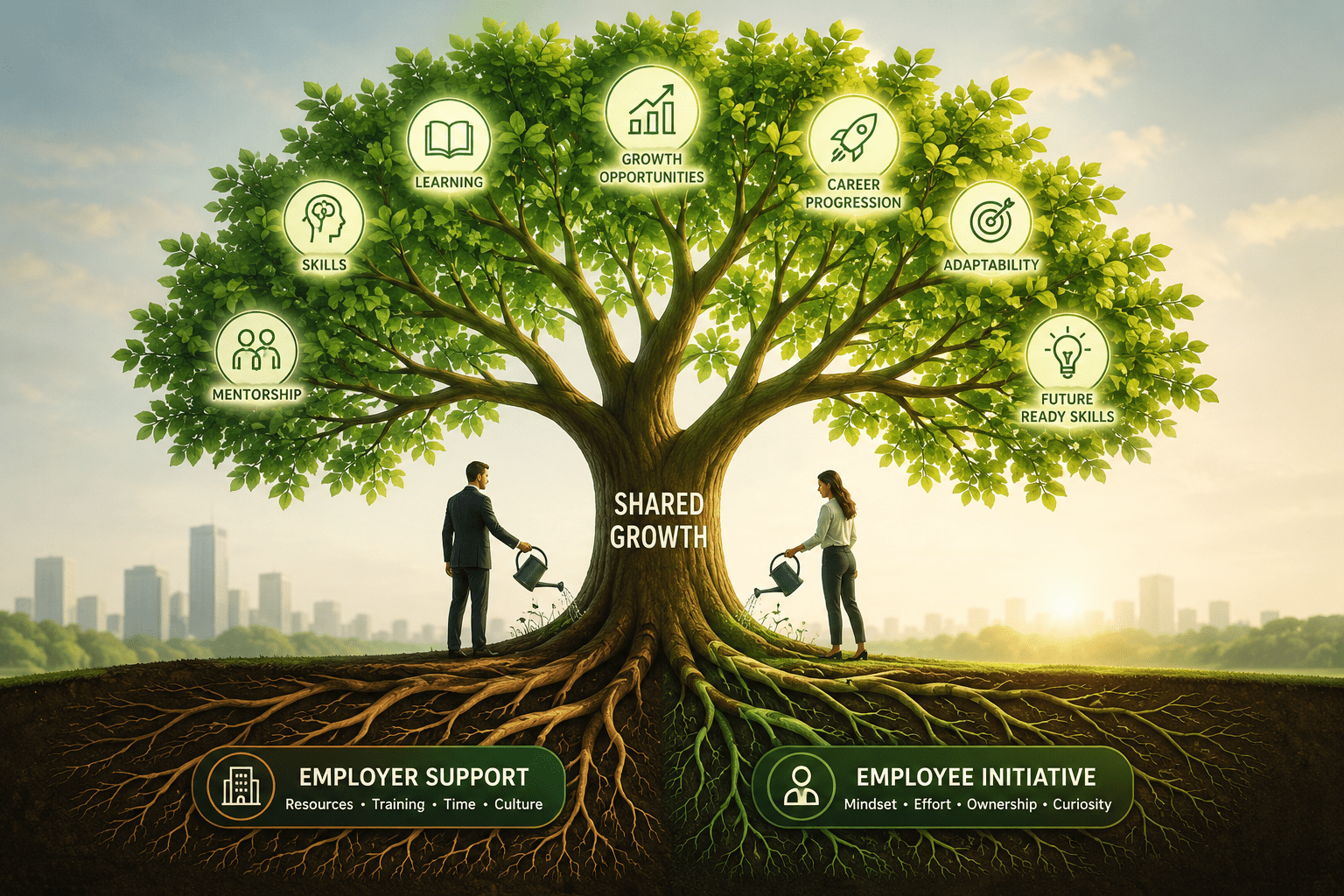
Employee’s side of the contract
- Actively seek learning — don’t wait to be enrolled
- Develop a growth mindset: curiosity over comfort
- Communicate career goals clearly with managers
- Apply new skills on the job, not just in training rooms
- Take initiative on stretch projects and cross-functional work
- Stay informed about industry shifts and emerging skills
- Treat feedback as data, not judgment
Employer’s side of the contract
- Create structured, accessible learning pathways
- Link skills development to real career progression
- Give employees time and permission to learn
- Build managers who coach, not just direct
- Make development visible and recognized
- Align training with actual market needs — not internal comfort
- Protect development investment during cost pressures
“Upskilling is both a professional and personal responsibility — a continuous process of self-renewal that extends beyond what the employer provides.”
— HR leaders consensus, HRKatha Research, 2025
What employers owe their people
Employee self-responsibility cannot be used as cover for organizational neglect. This is the other side of the contract — and it matters just as much.
The data is unambiguous: professional development is the single biggest driver of employee engagement today, ahead of flexible work arrangements and even AI tools. When organizations fail to build genuine development infrastructure — not just a learning platform that no one uses, but real pathways tied to real careers — they are not just missing an opportunity. They are eroding the foundation of their workforce’s motivation to stay and grow.
ADP’s 2025 HR trends study found that nearly all large organizations feel a strong responsibility for employee wellbeing. Yet confidence in their ability to actually deliver on that responsibility was significantly lower — a gap that points not to bad intentions, but to execution failures that need structural fixes, not just good values.
Critically, the most damaging employer failure isn’t refusing to invest in development. It’s investing in the wrong things — generic training disconnected from actual roles, tick-box compliance courses, or one-time programs treated as permanent solutions in an environment that changes constantly.
The real cost of getting it wrong: Organizations with structured, business-aligned development programs are 98% more likely to retain high performers and 57% more prepared to respond to change, according to Quantum Workplace’s 2025 HR trends research. Development isn’t a benefit — it’s a business strategy.
The shared contract: what it looks like when it works
The most effective model isn’t employer-led or employee-led. It’s a genuine partnership — where the organization builds the environment and the individual brings the initiative. When both sides show up, something qualitatively different happens: learning becomes embedded in the culture rather than scheduled into a calendar.
The shared growth contract
Brings curiosity, initiative, and ownership of their own development trajectory
Builds the pathways, time, resources, and recognition that make growth possible
Communicates clearly about career goals, skills gaps, and what they need to grow
Listens, responds, and ties development to real progression — not just training completion
Applies new skills actively, takes on stretch opportunities, and shares what they’ve learned
Protects development investment even under cost pressure — and models a growth culture from the top
Where reskilling fits into all of this
Reskilling is where the shared contract becomes most visible — and most tested. When automation, restructuring, or market shifts force a workforce to change direction, the question of ownership becomes urgent. Who adapts? Who supports the adaptation? Who is accountable when it doesn’t happen fast enough?
At Reskill & Rise, we see this moment as an opportunity rather than a threat — but only when both sides are genuinely engaged. Employees who approach reskilling with ownership and curiosity move faster and further. Employers who invest in structured, human-centered transition support lose less institutional knowledge, maintain stronger morale, and emerge with a workforce that’s genuinely more capable — not just more compliant.
The organizations that navigate workforce transformation best in 2026 are those treating reskilling not as a program to run, but as a cultural commitment to honor. And the employees who thrive are those who understand that their career trajectory is ultimately something they co-author — not something that happens to them.
“When both sides align, upskilling transforms from a strategy into a shared path to progress.”
— HRKatha Research, 2025
Three things to do differently starting now
- For employees: Map the skills your role will need in 24 months — not 24 years. Start building toward one of them this quarter. Don’t wait for a program to be announced.
- For employers: Audit whether your development programs are tied to actual career pathways or just learning completion metrics. If the answer is the latter, you’re investing in the wrong outcomes.
- For both: Have the conversation directly. The gap between what employers think they’re offering and what employees think they’re receiving is rarely intentional — it’s usually a communication failure. A structured career conversation, done honestly, closes more distance than any LMS platform.
The bottom line: Growth is not something organizations do to employees, nor something employees achieve in spite of their organizations. It is a shared act — requiring initiative from individuals and investment from institutions in equal measure. In 2026, the workplaces that understand this aren’t just more engaged. They’re more resilient, more adaptive, and more human.
Building the shared contract in your organization
Reskill & Rise helps organizations create the conditions for genuine workforce development — protecting people, preserving knowledge, and making transitions human-centered from start to finish.