📑 Table of Contents
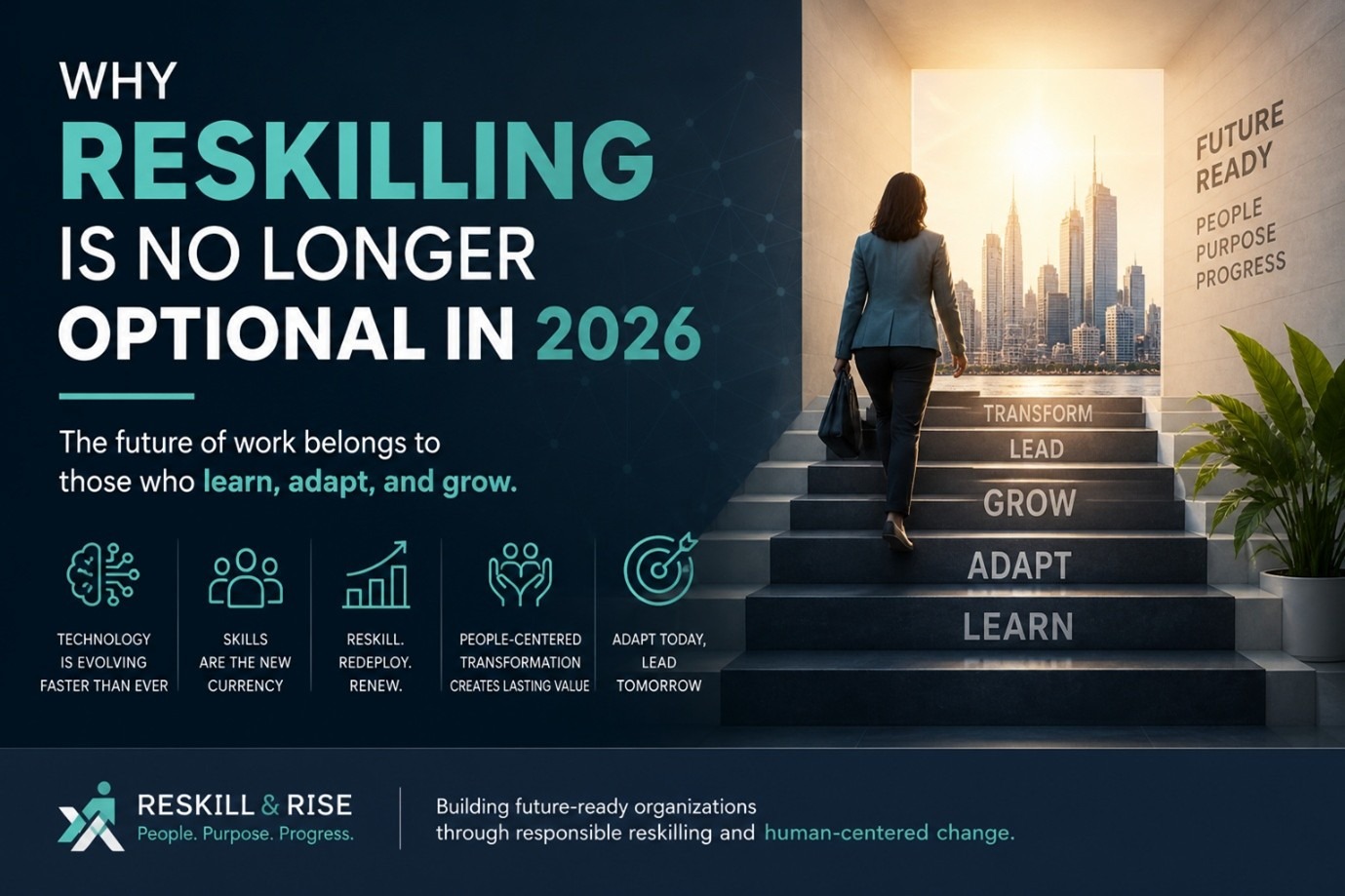
The question is no longer whether your workforce will need to change — it’s whether your organization will lead that change thoughtfully or scramble to catch up. In 2026, reskilling isn’t a nice-to-have benefit; it’s a strategic imperative.
For years, companies treated workforce development as a line item — something to cut when budgets tightened and restore when times were good. That era is over. The convergence of AI-driven automation, shifting global supply chains, and tightening talent markets has collapsed the window between when a skill becomes obsolete and when that obsolescence becomes a crisis.
Organizations that haven’t built reskilling into their operating model aren’t just behind — they’re accumulating risk with every passing quarter.
Key Statistics for 2026
| Metric | Impact |
| 85M | Jobs displaced globally by automation by 2025 (WEF) |
| $8.5T | Projected talent shortage cost by 2030 if skills gaps go unaddressed |
| 54% | Of employees who will need significant reskilling within 3 years |
| 6x | Cost of external hiring vs. reskilling an existing employee |
The old playbook is broken
When cost pressure, automation, or restructuring forced difficult workforce decisions, companies defaulted to the familiar script: announce layoffs, cut headcount, and wait for the stock price bump. It felt decisive and manageable.
But the damage was always there — quietly compounding:
- Institutional knowledge walked out the door.
- Morale among those who stayed collapsed.
- Employer brand suffered, leading to higher hiring costs later.
- Eliminated skills were often the very ones needed eighteen months later, just in a different form.
In 2026, that playbook doesn’t just underperform — it actively destroys value.
What’s different now
Three forces have converged to make reskilling urgency reach a new threshold this year:
- AI adoption has accelerated past the pilot phase: Generative and agentic AI tools are reshaping roles across every function — from finance and legal to operations and customer service.
- Talent markets remain structurally tight: External hiring for technical and adaptive roles remains expensive and slow; the fastest path to capability is the talent you already have.
- Employees expect investment: Development opportunities are a top reason people stay — and their absence is a top reason they leave.
The paradox of the moment: Organizations are simultaneously experiencing workforce surplus in some roles and critical shortage in others — often within the same company. Reskilling bridges that gap, turning a cost center into a strategic asset.
Reskilling as responsible change management
At Reskill & Rise, we believe workforce transitions don’t have to be traumatic. Responsible change management doesn’t just protect people — it creates lasting organizational value.
When companies invest in reskilling as a core strategy, several things happen:
- Institutional wisdom is preserved: Context and relationships that can’t be onboarded in 90 days stay within the company.
- Trust deepens: This directly affects discretionary effort and retention.
- Reduced exposure: Legal and reputational risks from poorly managed transitions are minimized.
- Adaptive capacity: The organization builds the ability to shift continuously as conditions change.
Where to start
Reskilling at scale requires clarity on three specific areas:
- Map your gaps: Identify roles that will change in the next 24 months and map them against your current workforce.
- Human-centered design: Ensure employees understand “what’s in it for them” to make the transition successful.
- Measure and iterate: Treat reskilling like a product — launch, learn, and improve continuously.
The organizations best positioned for 2027 and beyond are building this capacity now.
Ready to turn workforce transition into an opportunity?
Reskill & Rise helps organizations transform restructuring from a source of risk into a path to renewal — protecting people and preserving institutional wisdom along the way.