📑 Table of Contents
Every year, 55,000 young Omanis enter the workforce with degrees in hand and ambitions intact. Too many of them wait months — sometimes years — for a job that matches their expectations. This isn’t a motivation problem. It’s a structural one. And reskilling is the missing piece.
Oman presents a paradox that is quietly becoming a crisis. On paper, the country is in the midst of a bold economic transformation — Vision 2040 promises a knowledge-based economy, diversification away from oil, and a thriving private sector. In practice, Omani graduates are finding themselves caught between a system that prepared them for a world that no longer exists and a labor market that keeps reaching past them for cheaper expatriate alternatives.
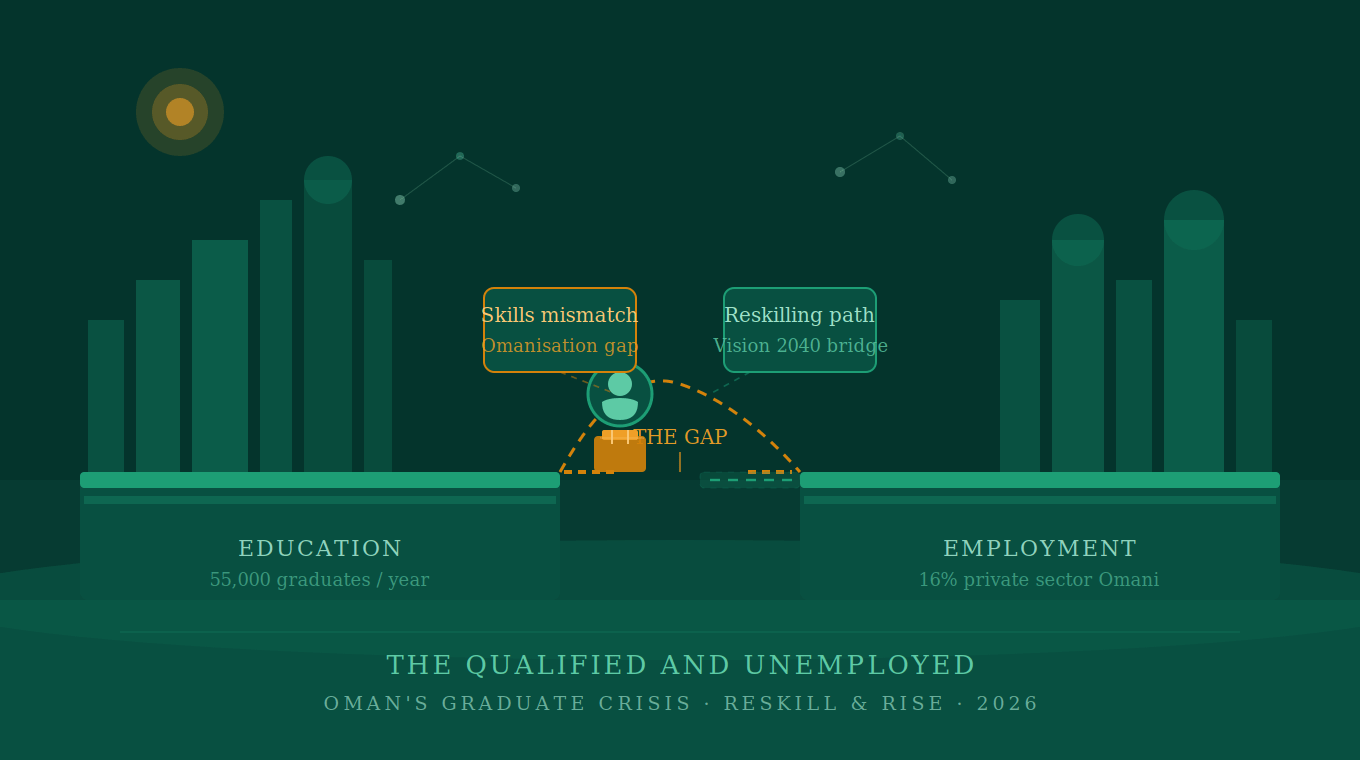
The numbers make this concrete.
Three forces driving the gap
Oman’s graduate unemployment challenge isn’t one problem — it’s the product of three structural forces converging at once.
The skills mismatch
Educational outcomes are misaligned with what the labor market actually needs. Graduates emerge with qualifications that don’t map to the skills private sector employers are hiring for — particularly in technical, digital, and analytical roles.
The expatriate dependency
Oman’s private sector has long relied on lower-cost expatriate labor. With around 55% of the population being Omani nationals, the pressure is growing — but companies face real transition costs when shifting from experienced expatriate workforces to newer Omani graduates.
The public sector preference
Research consistently shows Omani graduates prefer government employment for its stability and salaries. When private sector wages fall short of expectations — graduates often expect at least OR600/month vs. the OR400 minimum — the result is extended unemployment rather than sector switching.
“As graduates, we can accept non-manual jobs such as office jobs but it is now becoming a challenge because employers are making it harder for us to get a job because of the salary scale.”
— Yakeen Al-Shamsi, finance graduate, Muscat (AGBI, 2025)
The Omanisation paradox
The government’s response to this has been Omanisation — quota-based policies requiring private sector companies to employ minimum percentages of Omani nationals. In June 2025, deadlines were tightened further: companies tendering for government contracts faced a May 2026 deadline to comply with Omanisation requirements or risk being barred from public procurement.
This creates a genuine paradox. Quotas without reskilling infrastructure simply shift the problem. Companies feel compelled to hire Omanis to meet compliance targets, but simultaneously report that graduates lack the sector-specific skills they need — particularly for the diversification-linked roles in logistics, technology, tourism, and advanced manufacturing that Vision 2040 prioritizes.
The gap in one sentence: Only around 16% of private sector jobs in Oman were held by Omani nationals even at post-pandemic peak employment — in a country where more than half the population is Omani. Quotas can mandate employment. Only reskilling can make it sustainable.
“Is it wise to remove expatriates in skilled jobs at a time when Oman is spending billions of dollars diversifying its economy? We don’t have enough skills for these diversification programs.”
— Saif Al-Kindi, economist, Oman Business Forum
What Vision 2040 demands — and what’s missing
Oman’s Vision 2040 is an ambitious national blueprint — transitioning from a hydrocarbon-dependent economy to a diversified, knowledge-based one. Its human capital pillar calls for a skilled, productive workforce aligned with a positive private sector work culture. It emphasizes innovation, digital capability, and competitive talent development.
The goals are right. The infrastructure to get there is still catching up.
The IMF’s 2025 analysis of Oman’s labor market dynamics noted that access to low-cost expatriate labor has historically enabled the private sector to expand while technically meeting Omanisation quotas — without genuinely developing Omani talent pipelines. The result is a structural dependency that is difficult to unwind quickly, and painful to unwind badly.
Reskilling is the bridge between where Oman’s graduates are today and where Vision 2040 needs them to be.
What responsible reskilling looks like in this context
Oman’s Ministry of Labour has recognized the urgency. Its 2025 operational plan targeted 45,000 new job opportunities, including 11,000 training and qualification slots for jobseekers, alongside employment-linked training and wage support programs. Compliance with training-linked employment programs stood above 82% — a strong foundation.
But government-led programs alone cannot close a gap of this scale. The private sector — and the organizations that support workforce transitions — must step in with human-centered approaches that go beyond compliance:
- Bridging programs that translate degree-level knowledge into sector-specific applied skills
- Structured onboarding and mentorship that preserves institutional knowledge while building new capability
- Salary pathway frameworks that give graduates a credible roadmap to OR600+ rather than an immediate demand
- Public-private partnerships that align curriculum reform with what employers are actually hiring for
- Transition support for organizations replacing expatriate roles with Omani nationals — managing the knowledge transfer without losing operational continuity
The cost of getting this wrong
The stakes are not abstract. Youth unemployment was a documented contributing factor to the 2011 Arab Spring demonstrations that swept Oman and the wider region. The government responded then with unemployment benefits and governance reforms. A decade and a half later, the structural pressures have grown — more graduates, a larger population, a private sector still more comfortable with the known quantity of expatriate labor, and a national transformation agenda that can only succeed if Omani talent is genuinely ready to lead it.
Organizations that treat Omanisation as a compliance checkbox — hiring to quota without investing in the real development of their Omani workforce — will accumulate risk. High turnover, institutional knowledge gaps, reputational exposure, and ultimately a talent base that isn’t ready when it needs to be.
Those that approach it as Reskill & Rise does — as a human-centered investment, with structured transition management, capability-building, and genuine respect for the people involved — will build something that lasts.
The opportunity: Oman’s graduate cohort is large, growing, and motivated. The country’s Vision 2040 ambitions are real. The gap between the two is a skills gap — and skills gaps are exactly what reskilling is designed to close. Workforce transitions don’t have to be traumatic. Done well, they’re where organizational renewal begins.
Helping organizations bridge the gap in Oman and beyond
At Reskill & Rise, we turn workforce restructuring from a source of risk into an opportunity for renewal — protecting people, preserving institutional wisdom, and building human-centered business practices.