📑 Table of Contents
The Growth Multiplier: Why Coaching and Mentoring Are the Most Underused Tools in Employee Progression
Companies with structured mentoring programs report 2x higher profits and 72% retention among mentees compared to just 49% for those without one. Yet fewer than 26% of employees rate their organization’s mentoring programs as genuinely effective. The data is clear — the gap isn’t intent, it’s execution.
Think about the best professional growth you’ve ever experienced. Was it a training course? A certification exam? An e-learning module? Probably not. For most people, the moments that genuinely accelerated their career came from a person — a manager who believed in them before they believed in themselves, a senior colleague who shared hard-won wisdom, or a peer who held them accountable to do the work they said mattered.
That’s coaching and mentoring. And in 2026, as organizations scramble to close skills gaps, retain talent, and build leadership pipelines in increasingly competitive markets, it remains — remarkably — one of the most underinvested tools available.
This is a mistake that compounds over time. Here’s why, and how to fix it.
Coaching and mentoring are not the same thing — and both matter
One of the most common mistakes organizations make is conflating coaching and mentoring, then underinvesting in both. They are distinct disciplines with different purposes — and a complete employee development strategy needs both.
| Dimension | Coaching | Mentoring |
|---|---|---|
| Focus | Performance improvement & specific skill development | Long-term career guidance & personal growth |
| Timeframe | Short-to-medium term, goal-oriented | Long-term, often ongoing relationship |
| Direction | Coach asks questions to unlock the employee’s own answers | Mentor shares experience, wisdom and networks |
| Who delivers it | Line manager, internal coach, or external professional | Senior colleague, cross-functional leader, or peer |
| Best for | Skill gaps, role transitions, performance plateaus | Career trajectory, leadership readiness, culture navigation |
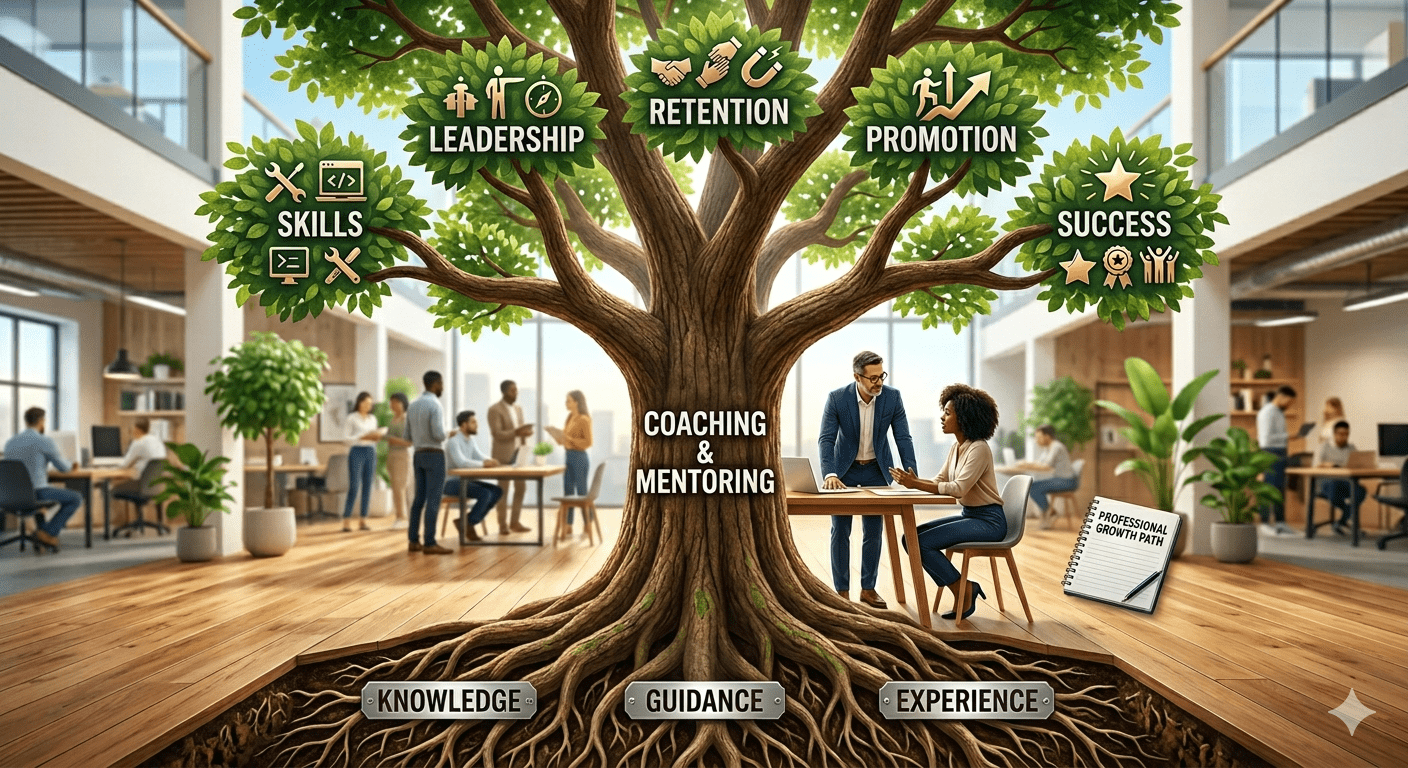
The most powerful employee development environments don’t choose between the two — they build both into the fabric of how people grow inside the organization.
“70% of individuals with a mentor experience improved work performance and leadership development.”
— International Coach Federation
What coaching and mentoring actually do for progression
The evidence across two decades of research is consistent and strong. These are not soft initiatives that feel good but resist measurement. Coaching and mentoring produce concrete, trackable outcomes across every dimension that organizations care about.
Faster competence
84% of employees with mentors said their mentor helped them achieve role competence significantly faster than they would have alone, according to Harvard Business Review research.
Higher earnings
79% of workers with a mentor report being well paid, compared to 69% without — and 89% feel their contributions are valued by colleagues, compared to 75% without.
Equal opportunity
Employees with formal mentors are 58% more likely to strongly agree their workplace provides equal opportunities for advancement, according to Gallup research.
Business performance
Organizations with strong coaching cultures outperform competitors by 61% in employee engagement and achieve 49% higher revenue growth, per the International Coaching Federation.
Leadership pipeline
Mentors themselves are 6x more likely to be promoted. Mentoring isn’t just a gift to mentees — it actively develops the capabilities of those doing the mentoring.
ROI on coaching
An ICF survey of 100 executives found an average ROI of nearly 6x the cost of coaching. Reliable ROI estimates for executive coaching range from 500% to 700%.
The generation gap that mentoring must bridge: Gen Z now makes up 18% of the US workforce, with an average tenure of just 1.1 years. 31% plan to switch jobs within 6 months — up from 25% in 2024. But Millennials with mentors are twice as likely to stay 5 or more years. Mentoring is not a retention tactic — it is the retention strategy for the modern workforce.
Why most mentoring programs fail to deliver
If the evidence is this strong, why do only 26% of employees rate their company’s mentoring programs as genuinely effective? The answer lies in how programs are typically built — and the assumptions organizations bring to them.
- Matching is arbitrary. Pairing people based on seniority or availability rather than genuine developmental alignment produces relationships with nowhere to go. Good matching considers skills gaps, personality, goals, and chemistry.
- There’s no structure. Left entirely informal, mentoring conversations drift into pleasant but unfocused lunches. Without shared goals, milestones, and accountability, the relationship quietly fades.
- Mentors aren’t developed. Organizations ask their best people to mentor without giving them the skills to do it well. Great performers are not automatically great coaches — the capabilities are different and need to be built.
- It’s treated as a one-way relationship. The most durable mentoring relationships are reciprocal. When mentors gain as much as mentees — perspective, digital fluency, a view of the organization from the ground level — programs become self-sustaining.
- Success isn’t measured. What doesn’t get tracked doesn’t get invested in. Organizations that tie mentoring outcomes to retention, promotion rates, and time-to-productivity keep the investment alive. Those that don’t eventually cut it.
“Organizations with mature coaching cultures see 73% higher employee engagement and 56% better talent retention rates.”
— International Coaching Federation / Rework Research, 2025
The new shape of mentoring in 2026
Traditional mentoring — a senior person passing wisdom downward to a junior person — is still valuable. But the organizations getting the most from mentoring in 2026 have expanded the model significantly.
Reverse mentoring
Junior employees mentor senior leaders on technology, generational perspectives, and emerging cultural dynamics. It bridges generational gaps and increases early-career retention by giving junior talent visible access and influence. Deloitte’s 2025 survey found only 6% of Gen Z want traditional leadership positions — they want skills, visibility, and meaningful contribution. Reverse mentoring delivers all three.
Peer mentoring circles
Groups of six to twelve employees at similar career stages meet regularly to support each other’s development, share challenges, and hold each other accountable. Everyone contributes regardless of experience. This model scales well and builds psychological safety across teams.
Skills-based mentoring
Rather than pairing on seniority, organizations match employees with mentors who have specific capabilities the mentee needs — data literacy, commercial acumen, cross-cultural communication. This is especially powerful during workforce transitions and reskilling programs where specific capability gaps need closing quickly.
Cross-functional mentoring
Breaking mentoring out of silos — pairing someone from operations with a mentor in commercial, or finance with product — builds organizational breadth, surfaces institutional knowledge, and creates the cross-functional relationships that drive innovation and agility.
Where reskilling and mentoring intersect
At Reskill & Rise, we see coaching and mentoring not as standalone programs but as the connective tissue of effective workforce transitions. When organizations restructure, automate, or need to rapidly shift their talent mix, the technical reskilling component is the visible part. But the invisible part — helping people navigate the change, build confidence in new roles, and carry forward institutional wisdom — is almost always a mentoring challenge.
The employees who transition successfully during workforce transformations are rarely just those who pick up new skills fastest. They are those who have a mentor helping them interpret what the change means for their career, a coach helping them perform under uncertainty, and a peer group that normalizes the struggle of becoming someone new in the same organization.
The Reskill & Rise approach: We help organizations build mentoring and coaching infrastructure as part of their wider workforce transition strategy — not as an afterthought, but as the human scaffolding that holds everything else together. Structured mentoring during reskilling programs reduces time-to-productivity, preserves institutional knowledge, and delivers the psychological safety that makes people willing to learn in the first place.
Five things to do this quarter
Audit your current state
Do you have formal mentoring? Is it structured or informal? What percentage of employees participate? What’s the retention and promotion rate of participants vs. non-participants? You can’t improve what you haven’t measured.
Train your mentors
Don’t assume your best performers know how to mentor. Run a half-day workshop on active listening, goal-setting in mentoring relationships, and how to give developmental feedback. The quality of the mentor determines the quality of the relationship.
Make matching intentional
Use a structured intake process — a short survey on goals, development areas, working style preferences, and career aspirations — before making any mentoring pair. Thoughtful matching is the single biggest predictor of mentoring relationship quality.
Build in milestones
Give every mentoring pair a shared goal for the first 90 days. Check in at 30 and 60 days. Make the relationship accountable to outcomes, not just good intentions. Structure is what separates programs that deliver from programs that fade.
Tie it to your business metrics
Track retention, promotion rates, time-to-productivity, and engagement scores for mentoring participants vs. the broader workforce. When mentoring data shows up in business reviews, it becomes strategic — and strategic programs get sustained investment.
The bottom line: Coaching and mentoring are not soft initiatives for organizations that can afford them. They are the highest-ROI tools available for developing talent, retaining the people you’ve invested in, and building the leadership pipeline every organization needs. The cost of not investing in them isn’t a line item — it’s the people who quietly decide their growth matters more than their current employer and leave to find it elsewhere.
Ready to build mentoring into your workforce strategy?
At Reskill & Rise, we help organizations create human-centered workforce development programs — from mentoring infrastructure to full transition support — that protect people and preserve institutional wisdom.