📑 Table of Contents
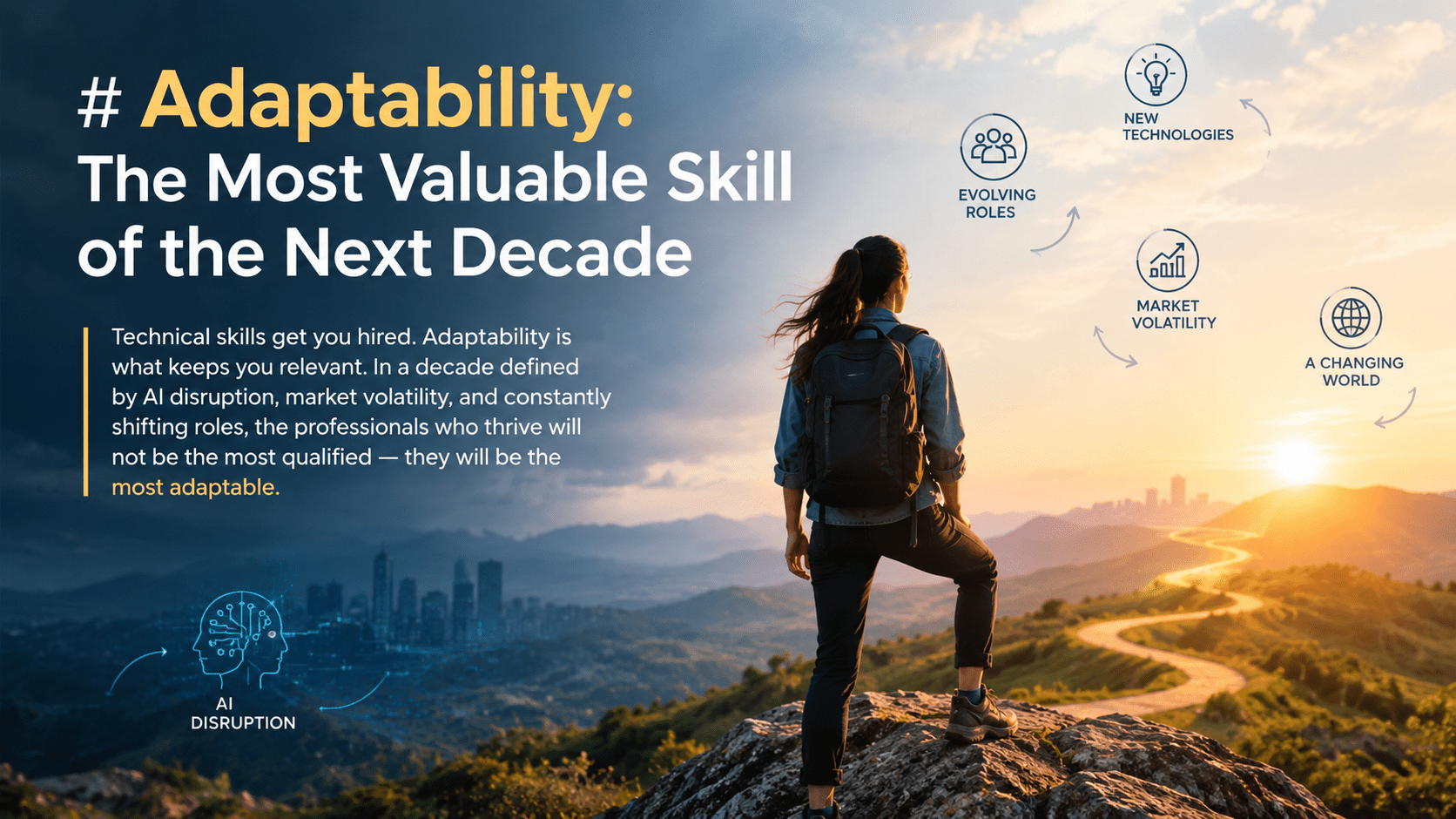
Adaptability:
The Most Valuable Skill
of the Next Decade
Technical skills get you hired. Adaptability is what keeps you relevant.
In a decade defined by AI disruption, market volatility, and constantly
shifting roles, the professionals who thrive will not be the most
qualified — they will be the most adaptable.
Adaptability was the fastest-growing skill on LinkedIn in 2024 — with seven of the platform’s top ten most in-demand skills for 2026 being human skills that AI cannot replicate.
Source: LinkedIn Skills on the Rise Report 2024 · The Interview Guys — 125 Soft Skills for 2026
Ask any hiring manager in 2026 what separates candidates who merely qualify for a role from those who genuinely stand out, and the answer is rarely a specific technical credential. It is the evidence that someone has navigated change, entered unfamiliar territory, and come out more capable on the other side. Adaptability has always mattered. What has changed is how fast the environment is shifting — and how quickly a professional’s failure to adapt becomes visible.
Of core job skills will be disrupted by 2030 — WEF Future of Jobs 2025
Higher earnings for professionals who combine soft skills with technical expertise — Forbes 2026
Of organisations now consider adaptability critical when evaluating candidates — Projective Staffing 2026
Why Adaptability Now — Two Real Examples
These two examples sit at opposite ends of the career spectrum. Together they make the same point: the advantage belongs to the person who moves first.
When generative AI began reshaping the design industry in 2023, Canva faced a fork in the road. Rather than defending its existing product, the design team pivoted — integrating AI into its creative tools, retraining product managers and designers on AI-assisted workflows, and shipping an entirely new enterprise suite in under six months. By mid-2025, Canva’s enterprise user base had grown by over 200%, and its AI-native features were cited by customers as the primary reason for switching from legacy design platforms.
The speed of that pivot was not a product of better technology. It was a product of a team that had built the organisational habit of entering unfamiliar territory without waiting for certainty first.
Source: Canva Enterprise Growth Report (2025) · The Motley Fool — Canva AI Strategy (Feb 2025)
In 2024, a ward nurse at an NHS Trust in the UK watched as AI diagnostic tools were deployed across her department. Rather than viewing the technology as a threat, she enrolled in a six-month clinical informatics programme in her own time, learned how to audit AI-generated diagnostic outputs, and identified a systematic error in a radiology AI model that was producing false-negative rates 12% above acceptable clinical thresholds.
She was appointed Clinical AI Audit Lead within eighteen months — a role that did not exist when she began her training. Her salary increased by 34%. The technology did not replace her. Her willingness to adapt made her the person the technology needed.
Source: NHS Digital Workforce Programme Report (2025) · NHSX Clinical AI Governance Review (2025)
What Adaptability Actually Means
Adaptability is not the absence of expertise. It is the refusal to let expertise become a ceiling — the willingness to be a beginner again when the situation demands it.
Adaptability is not a personality trait you either have or don’t. It is a set of practised behaviours that anyone can build deliberately:
- Learning agility — picking up new domains quickly and applying them to real work, not just completing a course
- Assumption testing — regularly questioning whether what worked last year still works now, before the market forces the question
- Comfort with being a beginner — entering unfamiliar territory without waiting for complete confidence first
- Visible evidence of adaptation — documenting pivots, new skills, and transitions so employers can see the pattern, not just the credential
How to Build It — Four Actionable Steps
-
Run a quarterly skills audit.
List the three skills your current role depends on most. For each, ask: is this growing or declining in relevance? What would I need if this were automated or made redundant in the next two years? The audit takes thirty minutes. The awareness it creates changes your development choices for the next quarter. -
Enter one new domain every quarter.
Not a full certification — four to six hours of deliberate exposure to an adjacent field. The NHS nurse didn’t wait for her employer to enrol her. She started learning before it was urgent. That window — when adaptation is a choice rather than a crisis response — is the most valuable one available to any professional right now. -
Make your adaptations visible.
A skill you’ve built but not documented doesn’t exist in the hiring market. Write about a transition you made, add a project to your portfolio, mention a pivot in your LinkedIn summary. Employers are not looking for perfect career lines — they are looking for evidence that you have navigated change and grown through it. -
Practise being wrong faster.
The professionals who adapt most quickly are not those who make fewer mistakes — they are those who identify and correct errors faster. Build in regular reflection: what assumption did I make this week that turned out to be wrong? What did I learn from it? Speed of update, not absence of error, is the measure of adaptability.
The Canva team didn’t know exactly what AI would do to their market in 2024. The NHS nurse didn’t know her new role would exist when she started learning. Both moved before they had certainty — and that early movement is precisely what created the advantage. The next decade will continue to reward the same disposition: not the deepest expertise in a fixed domain, but the fastest and most honest relationship with change.