📑 Table of Contents
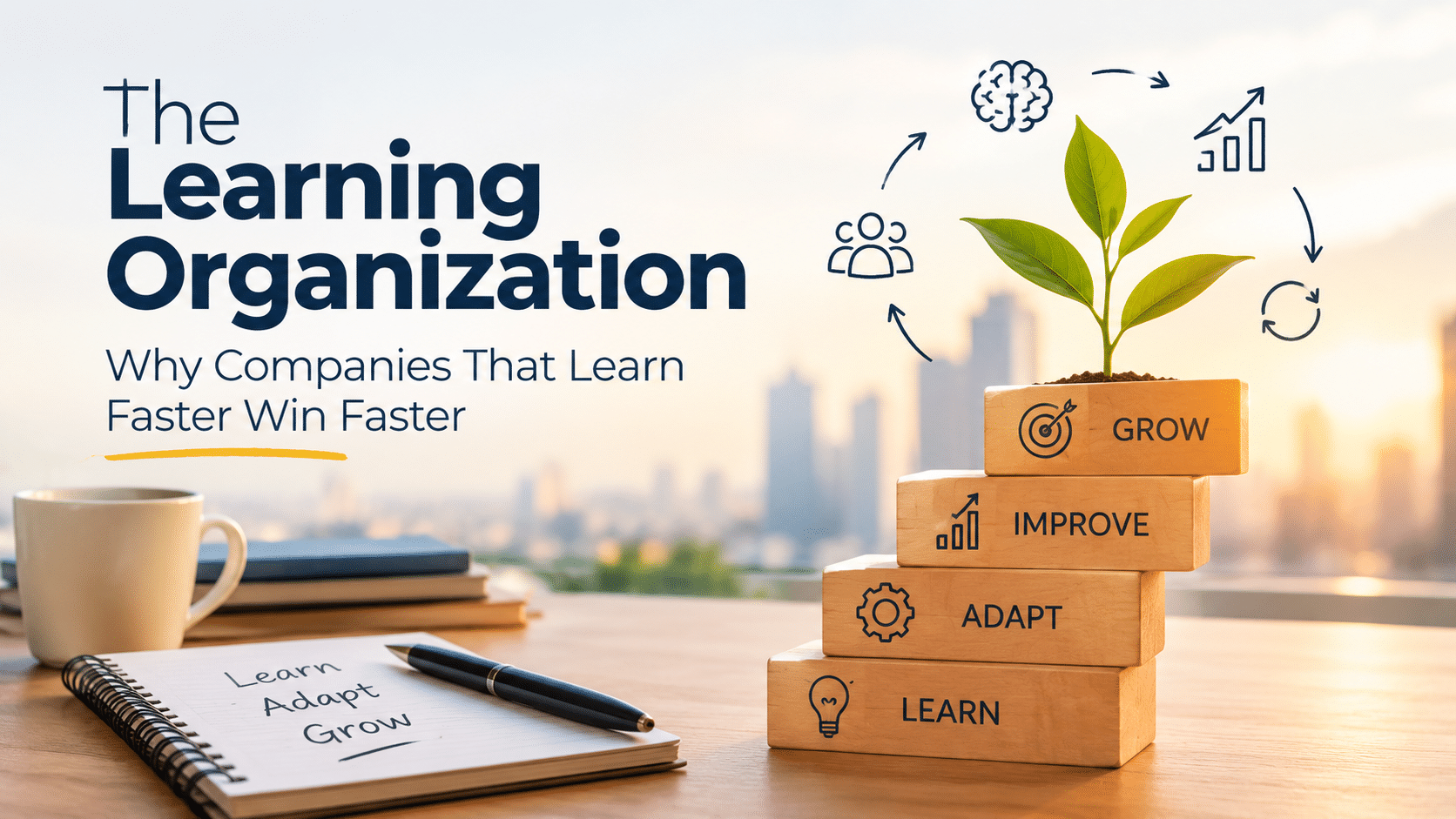
The Learning Organisation:
Why Companies That
Learn Faster Win Faster
Strategy, technology, and capital are all replicable. The one sustainable
competitive advantage that cannot be copied is how quickly your
organisation learns from what it does — and acts on what it learns.
Organisations with strong learning cultures are 92% more likely to innovate, 37% more productive, and 17% more profitable than their peers — yet only 28% of companies have built environments where continuous learning genuinely drives competitive advantage.
Source: Ignite HCM — Becoming a Learning Organization (June 2025) · Forrester — Future Fit Organizations Learn to Win (2025)
In a market where products are copied within months, technologies are commoditised within years, and strategies are reverse-engineered overnight, the question every leadership team should be asking is not “what do we know?” but “how fast do we learn?” The learning organisation — a concept Peter Senge introduced in 1990 and that has only grown more urgent since — is not a culture initiative or an L&D programme. It is a structural capability: the ability to continuously generate, share, and apply knowledge faster than competitors can react. And the organisations that have built it are outperforming those that haven’t by every measurable margin.
More likely to innovate — organisations with strong learning cultures vs. peers · Ignite HCM 2025
Higher productivity in learning organisations — and 17% more profitable on average
Of companies have successfully created environments where learning drives competitive advantage
Two Organisations That Made Learning the Strategy
These two examples sit at opposite ends of the industry spectrum. Together they show that the learning organisation is not a philosophy reserved for tech companies or large enterprises — it is a structural choice available to any organisation willing to make it.
Toyota’s production system is the most studied manufacturing operation in the world — not because of its technology but because of its learning architecture. At its core is kaizen: the principle that every employee, at every level, is responsible for identifying and communicating process improvements. In 2025 alone, Toyota’s global workforce submitted over 700,000 improvement suggestions, of which approximately 95% were implemented. The average Toyota production line worker submits more improvement ideas per year than most organisations collect in a decade.
The competitive result is documented across seven decades of operations. Toyota’s defect rate, production efficiency, and supply chain resilience consistently outperform Western automotive peers who have more capital, more technology, and comparable engineering talent. The difference is structural: Toyota has built the infrastructure for learning into the daily operation of work itself. The knowledge doesn’t live in a training programme. It lives in every shift, every line, every supervisor conversation.
Source: Toyota Global Sustainability Report 2025 · Learning Organizations in the Age of AI — Nebrija University Research (2025)
Supercell, the Finnish mobile gaming company behind Clash of Clans and Brawl Stars, has killed more games than most studios have ever shipped. That is not a failure statistic. It is a learning strategy. Supercell operates in autonomous teams called “cells” — small, self-directed groups of typically five to seven people who have full authority to build, test, and kill their own products. When a cell decides a game isn’t working, they celebrate the shutdown with champagne. The ritual is deliberate: it removes the organisational fear of failure that prevents most companies from killing under-performing projects quickly.
In 2025, Supercell generated over $2.3 billion in revenue with fewer than 400 employees — one of the highest revenue-per-employee ratios of any games company globally. The organisation learns through failure faster than competitors can learn through success. Each killed project produces a documented retrospective that feeds directly into the next cell’s work. The knowledge compounds. The speed of learning is the product.
Source: Learning Organizations in the Age of AI — Nebrija University Research (2025) · Supercell Annual Report 2025 · Wired — How Supercell Builds Its Games (2025)
What a Learning Organisation Actually Requires
A learning organisation is not a company that runs more training programmes. It is a company that has made learning inseparable from how work actually happens — so that every project, every failure, and every customer interaction produces knowledge that improves the next one.
The gap between a company that talks about learning and one that actually learns faster is structural, not motivational. Toyota doesn’t have more curious employees than its competitors. Supercell doesn’t hire unusually reflective game designers. What both companies have built are systems — rituals, incentives, roles, and processes — that extract learning from daily work and distribute it where it can be used.
Four structural conditions separate genuine learning organisations from those that perform learning culture without building it:
- Psychological safety to surface failure. Supercell’s champagne ritual is not whimsy. It is the structural removal of the stigma that causes most organisations to hide failures rather than learn from them. Toyota’s suggestion system works because floor workers know their input will be taken seriously. Without safety, the knowledge that matters most stays invisible.
- Knowledge flows across silos. Most organisations have pockets of learning — teams that develop strong practices in isolation. A learning organisation has built the mechanisms (retrospectives, cross-functional reviews, internal case studies, communities of practice) that move that knowledge across the organisation before it becomes irrelevant.
- Leaders who model inquiry over answers. In a learning organisation, the leader’s job is not to have the best answer — it is to ask the best questions. The shift from “here is what we are doing” to “what did we learn from that, and what does it change?” is the behavioural signal that a learning culture is either present or absent.
- Learning measured as a business output. What gets measured gets managed. Organisations that track only delivery metrics (output, revenue, deadlines) will always prioritise delivery over learning when the two compete — and they always compete. Learning organisations track learning indicators: improvement suggestions implemented, retrospectives completed, knowledge articles created, skills gaps closed.
How to Build It — Four Practical Steps
-
Install a retrospective cadence — not just for projects.
Toyota’s kaizen works because it is daily, not annual. Build a lightweight retrospective practice into every significant piece of work: what did we learn, what would we do differently, what should the next team know before they start? The format matters less than the frequency. Quarterly learning reviews produce quarterly learning. Weekly ones compound continuously. -
Make failure reporting safe — and structured.
Supercell’s champagne ritual works because it sends a signal, not just a message. Find the equivalent for your organisation: a visible, consistent act that demonstrates leadership’s genuine response to a well-executed project that didn’t work is respect, not punishment. Then build the structured debrief that turns the failure into a transferable insight. The insight is the asset — the discomfort is just the cost of producing it. -
Create one knowledge-sharing mechanism that outlives the project.
Most organisations lose their learning when the project team disbands. Build one lightweight, consistent mechanism — a shared internal case study format, a brief post-project wiki page, a ten-minute all-hands segment called “what we learned” — that captures the insight and makes it searchable by the next team that faces the same problem. The investment is small. The compounding value over time is significant. -
Measure one learning metric alongside your delivery metrics.
Identify a single learning indicator you will track at leadership level alongside your standard business metrics. Improvement suggestions submitted and implemented. Retrospectives completed per quarter. Internal knowledge articles created. The specific metric matters less than the act of measuring — because what leadership measures is what the organisation takes seriously. One learning metric at the leadership level changes the cultural signal about what the organisation values.
Toyota built a 70-year competitive advantage not from patents or capital but from institutionalising what its workers already knew and creating the conditions for that knowledge to improve every day. Supercell turned failure into the fastest feedback loop in gaming by making failure safe, structured, and transferable. Neither required a transformation programme or a new technology platform. Both required a leadership decision about what the organisation would measure, reward, and take seriously. That decision is available to any organisation willing to make it — including yours.