📑 Table of Contents
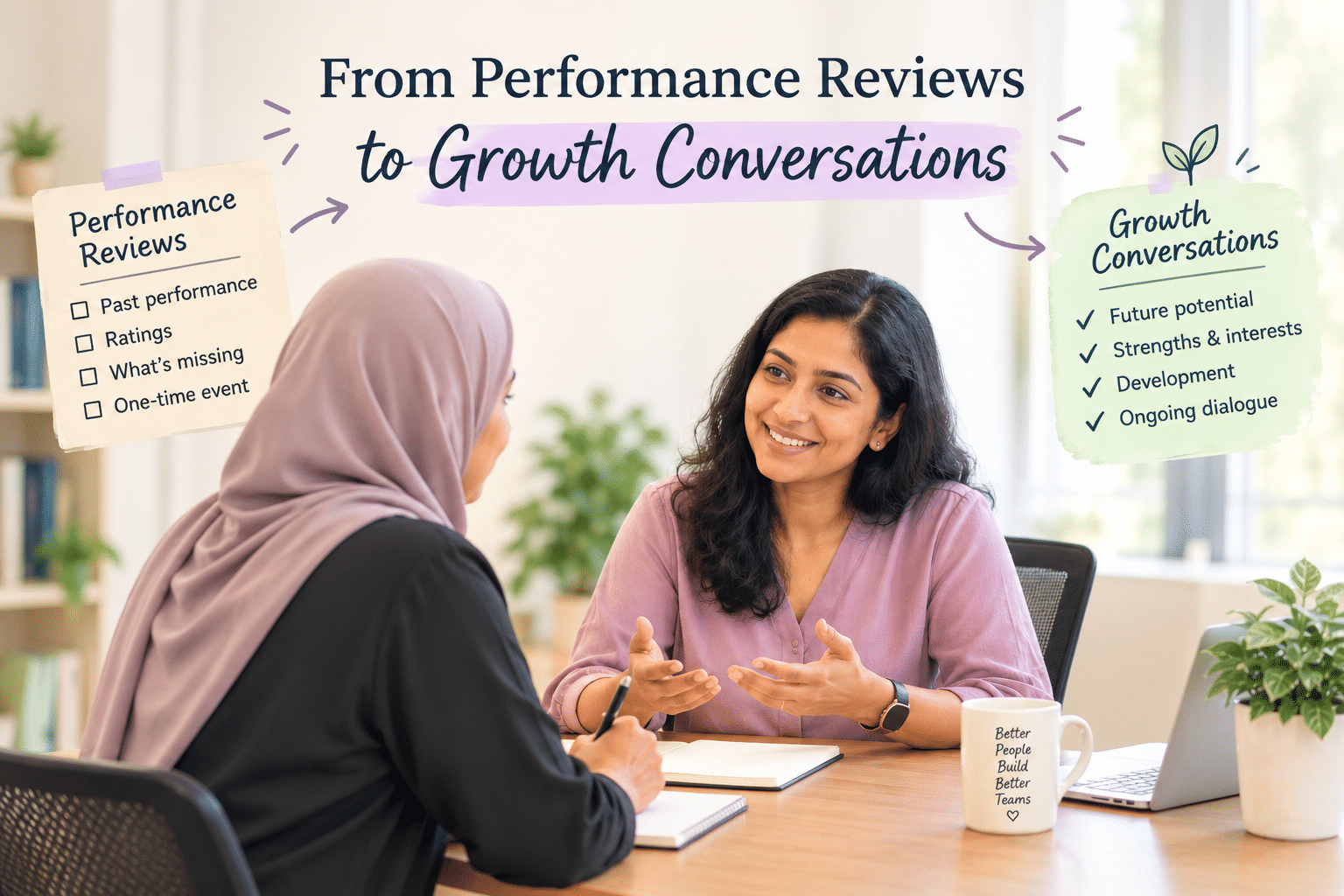
From Performance Reviews
to Growth Conversations
The annual performance review is one of the most universally dreaded
rituals in organisational life — and one of the least effective.
The companies winning the talent war have already replaced it with
something better.
72% of workers do not trust their organisation’s performance management process. And 59% say traditional annual reviews have zero impact on how they actually do their jobs.
Source: Deloitte Global Human Capital Trends 2025 · Gartner Performance Management Survey 2019 (still the most-cited figure in the field)
Most organisations know their performance review process is broken. The evidence has been clear for years: reviews are backward-looking by design, conducted too infrequently to be useful, evaluated by managers who rarely have full visibility of the work, and experienced by employees as an exercise in anxiety rather than a source of genuine development. Yet the ritual persists — dressed up with new software, new rating scales, or new language, but structurally unchanged. The problem is not that organisations lack better options. It is that the shift from evaluation to growth requires a different kind of management capability than most organisations have built — and that gap is harder to close than switching platforms.
Of workers don’t trust their organisation’s performance management process — Deloitte 2025
More likely to outperform peers — companies focused on people’s performance · McKinsey 2025
Of organisations rate their managers as very effective at enabling team performance — Deloitte 2025
Review vs. Conversation — The Structural Difference
The shift from performance review to growth conversation is not cosmetic. It is a change in the fundamental purpose of the interaction — and that change has measurable consequences for engagement, retention, and performance outcomes.
| Dimension | Performance Review | Growth Conversation |
|---|---|---|
| Time orientation | Backward — what you did last year | Forward — where you are going next |
| Frequency | Annual or semi-annual | Monthly or quarterly — close to the work |
| Primary output | A rating or score | A development commitment and next step |
| Manager’s role | Evaluator and judge | Coach and thought partner |
| Employee’s posture | Defensive — protecting their rating | Open — exploring their growth |
| Tied to pay | Usually — creates inherent conflict | Separated — allows honest conversation |
Two Companies That Already Made the Shift
In 2012, Adobe eliminated its annual performance review cycle entirely and replaced it with a system called “Check-Ins” — ongoing, undocumented conversations between managers and employees about expectations, feedback, and career development. There was no mandatory form, no forced ranking, no single annual moment of judgment. Managers were expected to have regular, substantive conversations. Employees were expected to drive their own development goals.
The results, tracked over more than a decade, have been cited across the industry as the template for what the shift looks like in practice. Voluntary attrition fell significantly in the years following implementation. Managers reported spending less time on administrative review preparation and more time on actual development work. By 2025, Adobe’s Check-In model had been studied, adapted, and replicated by organisations across sectors — and Adobe had continued iterating on it rather than treating it as a fixed destination.
Source: Engagedly — Performance Management System Examples 2026 · KnowledgeCity — HR Leaders Replacing Annual Reviews (2025) · Adobe Corporate Blog
Accenture’s shift is notable for its scale — over 500,000 employees globally — and for its explicit philosophy. The company replaced its annual review and performance ratings with a system called “Performance Achievement”, built around real-time, one-on-one coaching conversations. The key design decision: ratings were abolished. Instead of receiving a number, employees receive ongoing, specific, contextual feedback close to the work that generated it.
The forward-looking orientation is explicit in the system’s name: Performance Achievement — focused on where employees are going, not where they have been. By 2026, Accenture reports that the shift has produced higher engagement scores, stronger internal mobility, and a management culture where development conversations are normalised rather than reserved for annual moments. Critically, the model required substantial investment in training managers as coaches — a step that most organisations skip and then wonder why their new system produces the same outcomes as the old one.
Source: Engagedly — 8 Top Companies That Redefined Performance Management (2026) · Conversational Leadership — Performance Conversations (2026)
Neither Adobe nor Accenture eliminated performance management. They changed what it was for — from judging the past to shaping the future. That is the only change that matters.
What the Shift Actually Requires
The companies that attempt this transition and fail almost always make the same mistake: they change the process without changing the capability. They eliminate the annual review form and replace it with a new platform for quarterly check-ins — and then discover that their managers have no more idea how to have a genuine development conversation than they did under the old system. The form was never the problem. The conversation was.
- Managers trained as coaches, not evaluators. The growth conversation requires a fundamentally different skill set from the annual review. Asking “where do you want to go, and how can I help you get there?” is not harder than filling out a competency grid — but it requires practice, psychological safety, and a relationship that most annual-review cultures have never built.
- Frequency over formality. A monthly fifteen-minute conversation that is honest and specific produces more development than an annual two-hour review that is careful and diplomatic. Feedback close to the work is more accurate, more actionable, and less threatening than feedback delivered twelve months after the fact from reconstructed memory.
- Separation of development from pay decisions. When the growth conversation is tied to a salary outcome, it stops being a growth conversation. Both Adobe and Accenture made this separation explicit. The development conversation cannot be honest when the employee is simultaneously defending their compensation.
- Employee ownership of the agenda. In a growth conversation, the employee brings the questions: what am I working on, where am I stuck, where do I want to go next, what does the organisation need that I could provide? The manager’s job is to respond, challenge, and resource — not to deliver a pre-prepared verdict.
How to Make the Shift — Starting Now
-
Start with one honest conversation before redesigning the system.
Ask one direct report: “If we could change one thing about how we discuss your development, what would it be?” The answer will tell you more than any framework. Most organisations build elaborate new processes before understanding why the current one fails. Start with the problem, not the solution. -
Separate development from compensation in timing and structure.
If you cannot immediately decouple pay from development conversations, at minimum create a separate cadence: a quarterly growth conversation that explicitly does not feed into compensation decisions. The psychological shift this creates — for both manager and employee — is immediate and significant. -
Train managers in the four growth conversation questions.
What are you most proud of since we last spoke? Where are you finding the work most difficult? What do you want to develop in the next quarter? What can I do to make that more possible? These four questions are not a script — they are a structure that replaces the evaluator’s grid with the coach’s curiosity. Practise them. They feel uncomfortable before they feel natural. -
Measure conversation quality, not just completion.
Most organisations track whether check-ins happened. Fewer track whether they were useful. Add one question to your quarterly pulse survey: “In my recent development conversation, I left with a clear next step.” The percentage who agree tells you whether the process is working — not whether the calendar slot was filled.
Adobe’s Check-In model is now over a decade old. Accenture’s Performance Achievement system serves more than half a million people. Neither company is still debating whether to make the shift. The organisations still running the annual review cycle in 2026 are not behind because they lack access to better models — they are behind because the shift requires developing managers as coaches, and that is slower and harder than switching software. It is also, by every available measure, worth it.