📑 Table of Contents
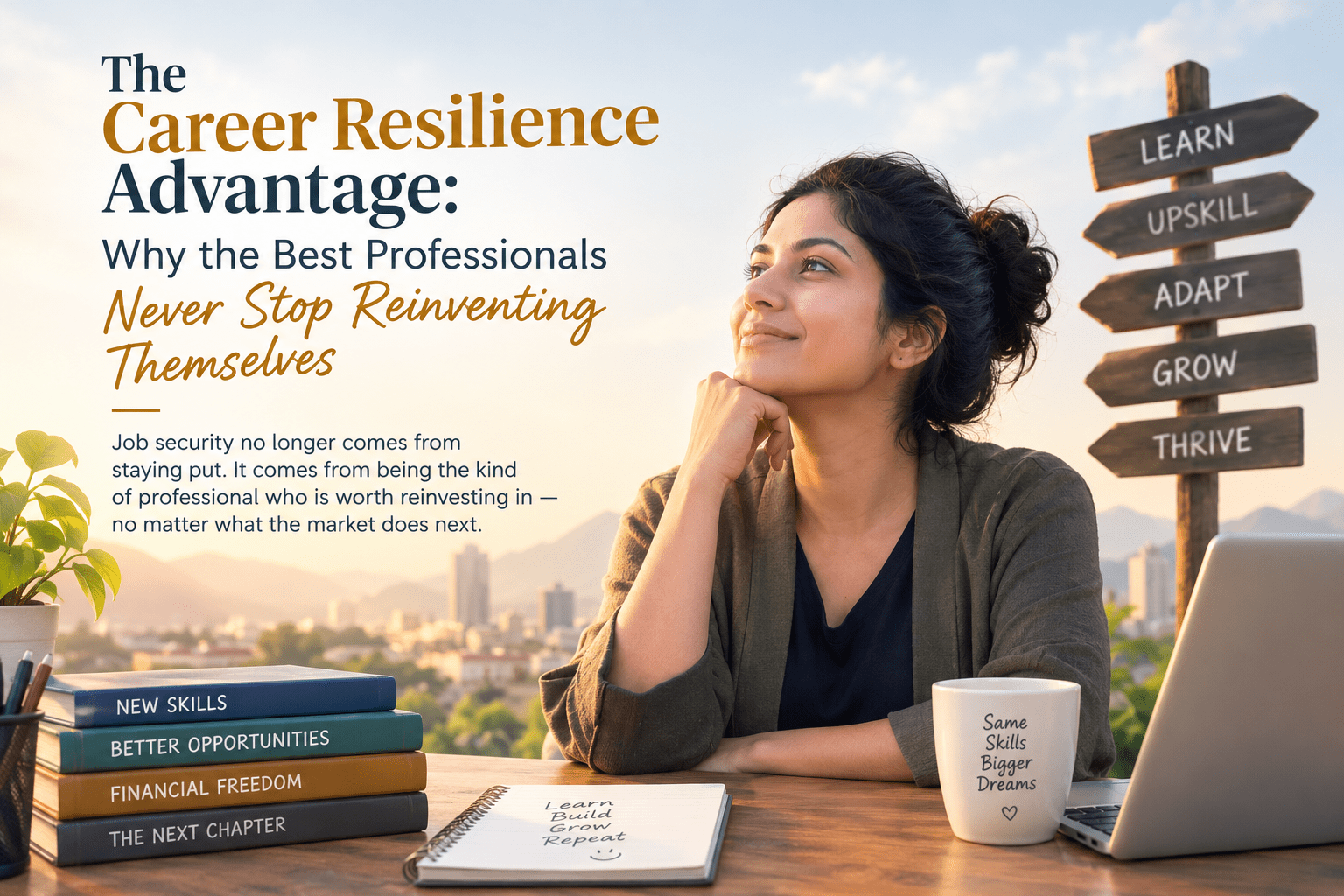
The Career Resilience
Advantage: Why the Best
Professionals Never Stop
Reinventing Themselves
Job security no longer comes from staying put. It comes from being
the kind of professional who is worth reinvesting in — no matter
what the market does next.
Over 1.17 million workers were laid off in 2025 — many with no warning, including top performers. Companies cited AI-driven efficiencies and automation as the justification for approximately 50,000 of those cuts alone.
Source: Forbes — In 2026, Reinvention Is the New Resolution (Jan 2026) · Challenger, Gray & Christmas Job Cut Report 2025
In 2025, the assumption that strong performance guarantees job security was tested — and broken — at scale. Layoffs hit high performers and recent promotions alike. Projects that had defined careers were cancelled overnight. Five-year plans became irrelevant within months. The professionals who navigated that disruption best were not those who had the deepest expertise in a single domain. They were those who had been quietly reinventing themselves all along — building new skills before they needed them, expanding their professional identity before the market forced the question.
Workers laid off in 2025 — many top performers, many citing AI as the cause
Of professionals who navigated major career transitions in 2024 had been building secondary skills beforehand — LinkedIn
Of all US college students are now over 25 — mid-career reinvention is becoming the norm — NCES 2026
What Career Resilience Actually Looks Like — Two Real Examples
Dr. Gloria Wu was an established physician and surgeon. When the pandemic disrupted healthcare systems globally, she didn’t wait to see what would happen to her role. She enrolled in an MBA programme at Los Angeles Pacific University mid-career — alongside her clinical practice — to build the leadership and business capability she saw becoming essential in the next phase of healthcare. “If I was going to reinvent myself for the next decade,” she said, “I needed to embrace change.”
While completing the degree, she stepped into leadership roles within emerging healthcare ventures — positions that did not exist when she started. Her reinvention was not reactive. It was deliberate, made before the pressure arrived.
Source: Los Angeles Pacific University / PRNewswire — Career Reinvention on the Rise (March 2026)
Of the 210,000 US tech workers who lost their jobs in 2025, a measurable subset did something that separated their outcomes from the majority: they moved laterally rather than waiting for a direct replacement role. Former software engineers pivoted to AI prompt architecture, AI compliance auditing, and human-AI workflow design — roles that barely existed in 2023 and were acutely understaffed in 2025.
The professionals who made those transitions fastest had one thing in common: they had already been building adjacent skills on their own time, treating their career not as a fixed track but as a portfolio to actively manage. Their resilience was not a response to the layoff. It was the reason the layoff did not define them.
Source: Forbes — Reinvention Is the New Resolution (Jan 2026) · LinkedIn Workforce Insights Q1 2026
Why Resilience Is Not Toughness
Career resilience in 2026 is not about enduring more pressure. It is about maintaining the capacity to see clearly, adapt intelligently, and move before the market forces your hand.
The old definition of resilience — push harder, stay longer, power through — has worn out its welcome. Scientists are now redefining resilience not as endurance at any price but as intelligent energy management — the capacity to recover, redirect, and reinvest rather than simply absorb.
For professionals, that means four things:
- Proactive portfolio management — treating your career like an investment portfolio: diversifying skills, not concentrating everything in one role or technology
- Recovery speed over invulnerability — the most resilient professionals are not those who never get hit; they are those who process setbacks fastest and redirect soonest
- Identity flexibility — decoupling professional identity from a specific title or domain so that reinvention feels like growth, not loss
- Visible reinvention — documenting career pivots, lateral moves, and new capabilities so employers can see the pattern of adaptability, not just the credentials
How to Build Career Resilience — Practically
-
Audit your career portfolio quarterly.
Identify which of your skills are appreciating, which are stable, and which are beginning to depreciate. The tech workers who pivoted fastest in 2025 had already noticed their core stack was becoming commoditised — and had started building adjacent capability before the layoff arrived. -
Build before you need to.
Dr. Wu enrolled in her MBA when her surgical career was thriving, not when it was threatened. The window for reinvention is widest when current performance is strong. Use that runway. Every quarter you wait makes the pivot harder and the options narrower. -
Expand your professional identity deliberately.
Describe yourself not only by your current role but by what you are capable of across contexts. A surgeon who also understands healthcare business models. A software engineer who understands AI governance. Identity breadth is what makes career transitions feel like natural next chapters rather than desperate pivots. -
Make your reinvention visible.
Add transitions to your LinkedIn. Write about what you learned from a lateral move. Document a skill you built outside your core role. 76% of professionals who successfully navigated major career transitions in 2024 had been actively developing secondary skill sets before they needed them. The evidence of that development is what makes the transition credible to employers and recruiters.
The best professionals of the next decade will not be defined by how long they stayed in one lane. They will be defined by how many times they had the clarity to see a shift coming and the courage to move before it arrived. Career resilience is not a response to disruption. It is the practice that makes disruption navigable — and eventually, an advantage.