📑 Table of Contents
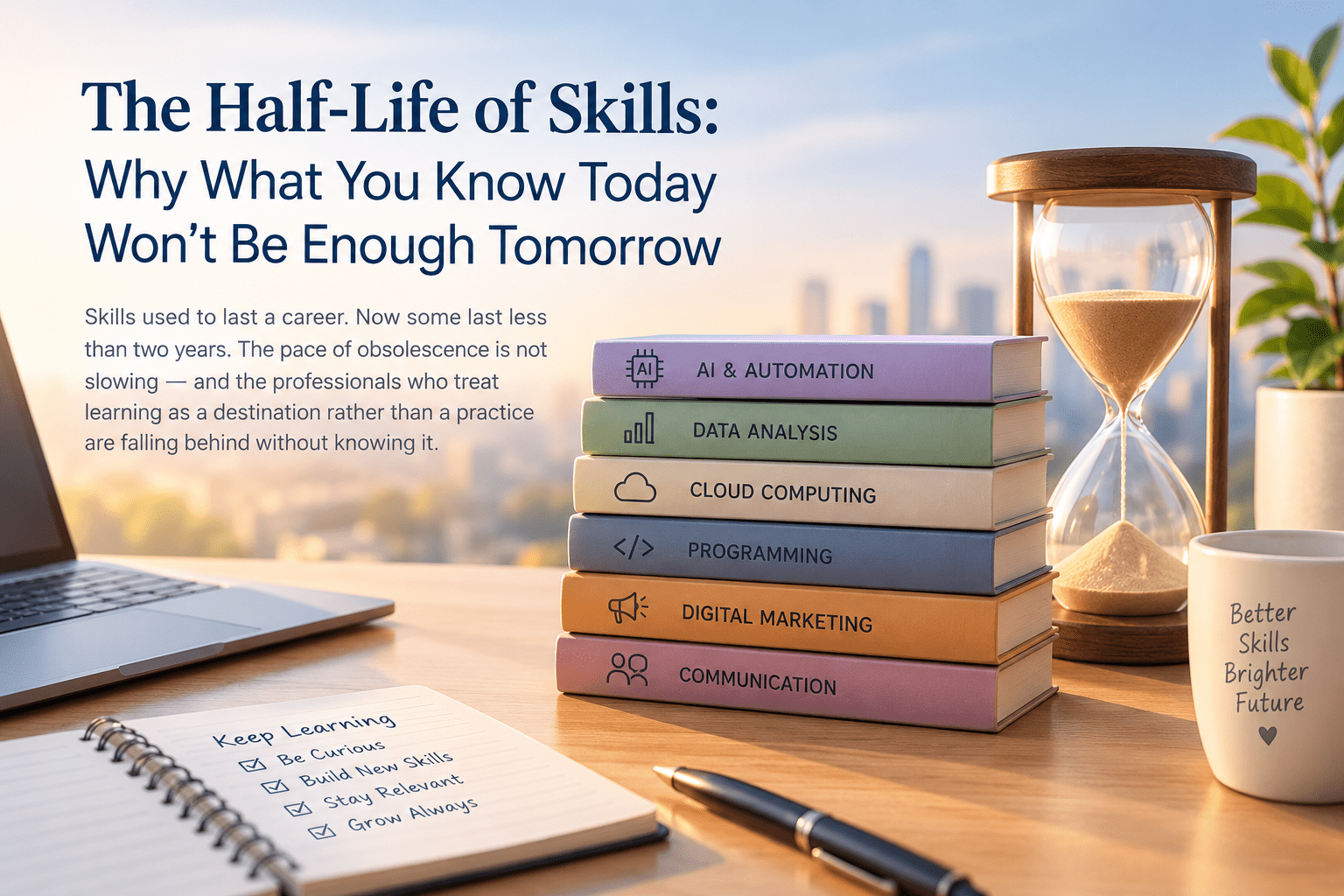
The Half-Life of Skills:
Why What You Know Today
Won’t Be Enough Tomorrow
Skills used to last a career. Now some last less than two years.
The pace of obsolescence is not slowing — and the professionals
who treat learning as a destination rather than a practice are
falling behind without knowing it.
Professional skills now expire twice as fast as a decade ago. What once took 15 years to become outdated now takes around five — and in AI and data science, some skills lose half their relevance in under two years.
Source: Fuel50 — Hidden Talent, Broken Systems (2025) · Gartner, Predicts 2026: AI’s Impact on the Future of Workforce (Nov 2025)
The half-life of a skill is the time it takes for that skill to lose half its professional value. For most of the twentieth century, that window was ten to fifteen years for technical roles — long enough that a qualification earned at twenty-five could sustain a career well into the forties. That window has collapsed. Gartner now projects the half-life of technical skills will reach two to five years by 2030. In the fastest-moving domains — generative AI, data engineering, digital marketing — it is already there. The skill that made you hireable in 2022 may be table stakes in 2024 and obsolete by 2026.
Average half-life of a technical skill today — down from 10–15 years a generation ago
Of the skills used in most jobs will change by 2030 — LinkedIn Work Change Report 2025
Of organisations say critical skills become obsolete within 3 years or less — Fuel50 2026
What This Looks Like in Practice — Two Real Events
By the mid-2010s, AT&T’s leadership had identified a crisis hiding in plain sight: nearly half of their 250,000-strong workforce held skills built for a hardware-and-cable world that was rapidly becoming a software-and-cloud world. The half-life of those skills was expiring in real time. Rather than wait for the obsolescence to become a staffing crisis, AT&T launched its Future Ready programme — a multi-year, billion-dollar commitment to retrain 140,000 employees in software engineering, data science, cybersecurity, and network virtualisation.
By 2025, roles filled internally from the programme outnumbered external hires in critical technical functions. The cost per retrained employee was a fraction of the cost of replacement hiring. AT&T didn’t wait for the skill gap to become a talent gap. They intervened while the window was still open — and the returns compounded over seven years.
Source: Harvard Business Review — AT&T’s Talent Overhaul (2018) · Training Industry — AT&T Future Ready Update (2025)
In early 2025, a senior content marketing manager at a mid-size UK agency was made redundant. The reason was direct: the agency had adopted AI content generation tools that could produce first-draft copy at a volume her team of six could not match on cost. Her specific skill — writing and managing content production at scale — had its half-life cut short not by any failure of hers, but by a technology shift that happened faster than her employer had anticipated or prepared for.
Rather than looking for the same role elsewhere, she spent three months completing a course in AI content strategy and prompt engineering — skills that turned her existing domain expertise into an asset for directing AI tools rather than competing with them. Within six months she had been hired as an AI Content Strategist at a FTSE 250 company at a 28% higher salary than the role she had left. Her domain knowledge didn’t become worthless. It became the context that made her AI skills valuable.
Source: LinkedIn Workforce Insights Q2 2025 · The Guardian — AI and the Marketing Workforce (March 2025)
What Stays Relevant — and What Doesn’t
The skills with the longest half-life are not the most technical — they are the most human. Critical thinking, communication, judgment, and adaptability decay in decades, not years. They are also the hardest to automate.
Not all skills are decaying at the same rate. The decay curve visual above tells the story clearly: tool-specific and platform-specific skills go stale fastest. Foundational human capabilities — the ability to reason under ambiguity, communicate with clarity, lead through uncertainty, build trust — hold their value across market shifts, technology generations, and industry disruptions.
The implication is not that technical skills are worthless — they are the currency of the current moment. It is that technical skills need to be paired with the durables. The marketing manager’s AI Content Strategist role was only achievable because she combined a new technical capability with ten years of domain expertise and professional judgment that no course could replace. The AT&T engineers who thrived in the Future Ready programme were those who brought existing analytical rigour into the new technical domains. The new skill gave them the door. The durable skills got them promoted.
What to Do About It — Four Practical Steps
-
Know your personal decay curve.
Map the skills your current role depends on against the decay categories above. Which sit in the fast-decay zone — tool-specific, platform-specific, process-specific? Which are durable? The honest answer tells you exactly where to invest development time this quarter. Most professionals are overinvested in their decaying skills and underinvested in their durables. -
Layer new skills onto existing expertise — don’t replace.
The marketing manager’s pivot worked because she added AI literacy to domain expertise, not instead of it. AT&T’s fastest-improving employees were those who brought existing analytical capability into new technical domains. New skills compound when they sit on top of genuine experience. They often fail when they try to stand alone. -
Build in twelve-month refresh cycles.
Set a recurring calendar block — annually, minimum — to assess which technical skills in your stack have meaningfully moved. Not every skill needs annual attention, but the fast-decay domains do. Twelve months is about the cadence at which generative AI tools, data platforms, and digital marketing channels are shifting materially. Treat it like a software update, not a career crisis. -
Invest in the undecayables.
Communication, analytical thinking, leadership, and the ability to work effectively through ambiguity are the skills that employers in 2026 are struggling hardest to find — and that AI is least able to replicate. They require no refresh cycle. Every investment in them compounds across every role you will ever hold. If your development plan does not include at least one of these, it is incomplete regardless of how technically current the rest of it is.
AT&T’s half-trillion-dollar insight was simple: the skills that built the company would not sustain it. They acted on that insight seven years before the obsolescence became a crisis. The marketing manager’s insight was the same, applied personally. Neither waited for external pressure to make the choice obvious. In a world where the half-life of skills is measured in years rather than careers, that early decision — to update before you have to — is the difference between leading the transition and being managed by it.