📑 Table of Contents
The AI Dispatch
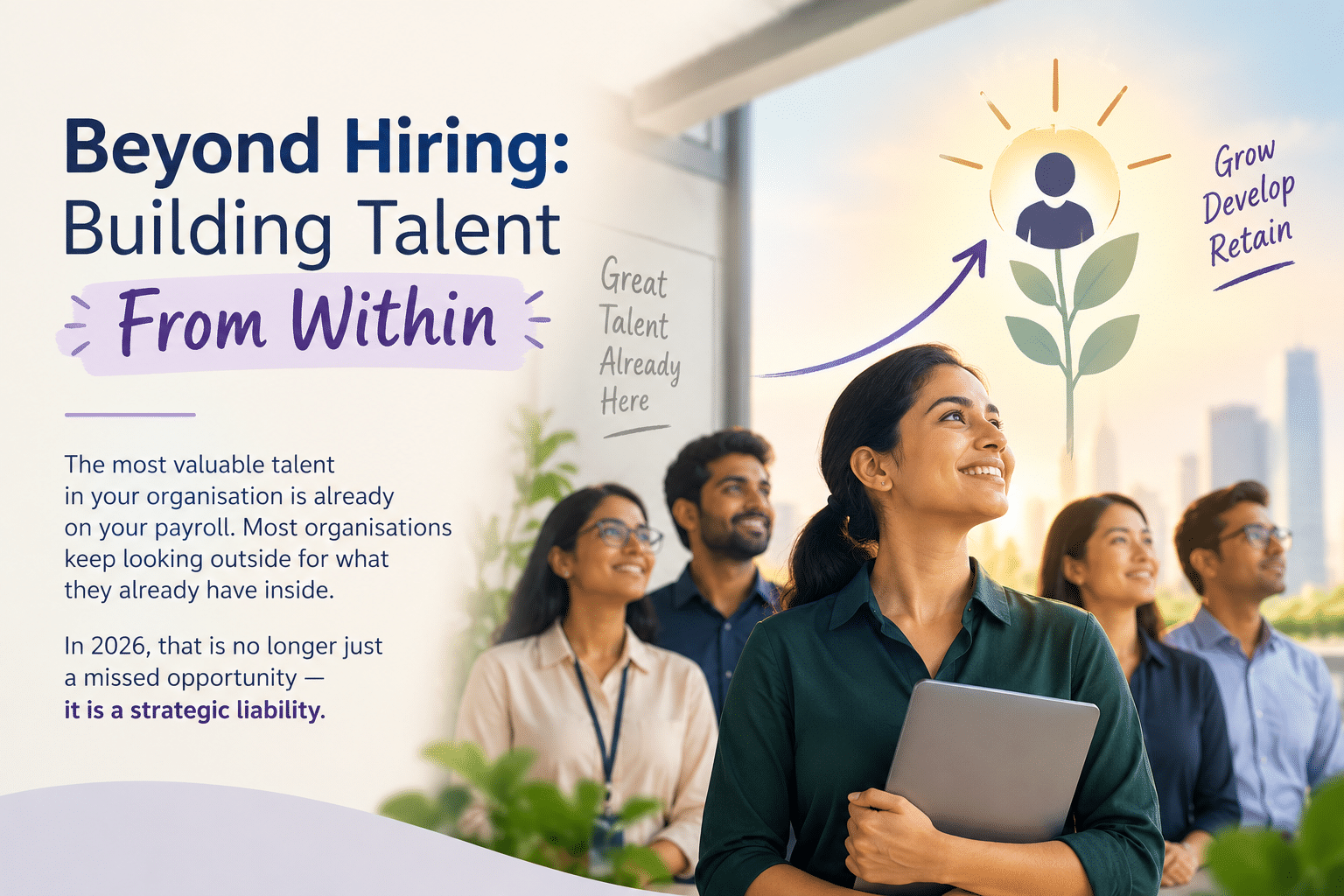
Beyond Hiring:
Building Talent
From Within
The most valuable talent in your organisation is already on your
payroll. Most organisations keep looking outside for what they
already have inside. In 2026, that is no longer just a missed
opportunity — it is a strategic liability.
Internal hires reach full productivity 50% faster than external recruits — and they stay 41% longer. Yet most organisations still fill more than 70% of open roles from outside, overlooking the people who already understand the culture, the systems, and the work.
Source: LinkedIn Workplace Learning Report 2025 · Phenom Talent Agility Guide 2026
Organisations spend enormous energy searching for talent — posting roles, engaging recruiters, running interview loops, negotiating offers — while the people best positioned to fill those roles are sitting in adjacent teams, waiting for a path that nobody has thought to build. The case for internal talent development is not sentimental. It is economic. And in 2026, with Gartner projecting that one-third of all recruiting capacity will shift to internal hiring this year, organisations that have not built the infrastructure to move talent internally are about to feel the gap acutely.
Higher retention in companies with strong internal mobility cultures — LinkedIn 2025
Of recruiting capacity projected to shift to internal hiring in 2026 — Gartner
Of TA leaders say internal mobility is receiving greater investment in 2025 — Veris Insights
Two Organisations That Built the Infrastructure
These two examples sit at very different scales. Both made the same core decision: stop treating internal talent movement as an exception to manage, and start building it as a system to run.
Unilever operates across 190 countries with 170,000 employees — a scale at which internal talent movement, without deliberate infrastructure, simply does not happen. In 2023, Unilever launched an AI-powered internal talent marketplace designed to match employees to internal gigs, projects, and roles based on their skills, not their job titles. The platform made internal opportunities visible to employees who would otherwise never have encountered them, and surfaced capabilities across the organisation that had been invisible to hiring managers.
By 2025, the programme had significantly reduced external hiring costs in functions where internal candidates were identified and developed. Employees who completed internal gigs reported higher engagement and stronger retention intent. Crucially, the platform surfaced people whose potential had been invisible through their static job descriptions — workers in operations, logistics, and finance who had built transferable capabilities that roles had been searching for externally.
Source: Josh Bersin Company · Joveo Internal Mobility Guide 2026 · Unilever People Report 2025
NBCUniversal restructured its internal mobility approach in 2024, focusing not just on filling open roles but on actively sharing talent across its business units — news, entertainment, theme parks, and streaming — that had historically operated as separate talent pools. The shift required dismantling the informal organisational barriers that prevented managers from releasing high performers to other teams: the most common and most intractable obstacle to internal mobility in large organisations.
By 2025, NBCUniversal had achieved a 15% increase in talent sharing across its business units. Employees who moved internally developed cross-functional capabilities that made them more effective in subsequent roles than peers who had stayed in a single function. Internal movers also became informal bridges between business units, accelerating collaboration in ways that external hires almost never produce.
Source: PowerToFly · Joveo Internal Mobility Ultimate Guide 2026
Why Most Organisations Still Look Outside First
The bias toward external hiring is not rational — it is structural. Managers are rewarded for filling roles quickly, not for developing the people already on their team. Until that incentive changes, internal mobility will remain the exception rather than the default.
The economic case for internal development is clear. The practice remains rare. Three structural barriers account for most of the gap:
-
Manager hoarding.
High performers are the employees managers are least willing to release to another team. When manager accountability is measured only on team output — not on talent developed and shared — the incentive to hoard wins every time. This is the single most consistent pattern across organisations that struggle with internal mobility. -
Skills invisibility.
Most organisations have no systematic view of what their people can do beyond the capabilities described in their current job title. Only 9% of companies have a skills-based internal talent marketplace, according to Josh Bersin. Without that visibility, internal matching is guesswork — and external candidates with visible credentials win by default. -
No internal career infrastructure.
External candidates benefit from a clear process: job posts, applications, interviews, offers. Internal candidates often face an informal, ambiguous, relationship-dependent process that disadvantages anyone without direct access to decision-makers. The playing field is systematically tilted toward outsiders in organisations that have not built internal career pathways deliberately.
Where to Start — Four Practical Steps
-
Audit skills before opening your next external role.
Before posting any vacancy externally, run a structured internal search based on transferable skills — not job titles. Unilever’s lesson applies at any scale: the people you are hiring for externally often already exist inside the organisation, invisible because their capability has not been mapped. A simple skills audit of your current workforce will surface matches that no recruitment process will find. -
Make internal opportunities as visible as external ones.
Most organisations have a public-facing careers page and a hidden, informal process for internal roles. Reverse that priority. Internal roles should be visible to all employees, with clear application processes and response timelines. NBCUniversal’s 15% talent-sharing increase was not achieved by changing culture first — it was achieved by making movement structurally accessible to people who had never known it was possible. -
Change what you measure for managers.
If managers are measured only on team performance and not on talent developed and placed elsewhere, they will always prioritise retention over growth. Add one metric to your management performance framework: talent developed and successfully moved to other parts of the organisation. The organisations that have cracked internal mobility at scale all made manager accountability for talent development explicit and visible. -
Start with cross-functional gigs, not full role changes.
The most effective internal mobility programmes do not begin with permanent lateral or upward moves — they begin with short-term project assignments that allow employees to demonstrate capability in a new context before a full transition. These gigs are lower-risk for managers, higher-value for employees, and more revealing of genuine capability than any interview process.
Unilever found people in operations and logistics with capabilities they had been paying recruiters to source externally. NBCUniversal discovered its most effective cross-functional collaborators were the people who had already moved between its business units. Neither breakthrough required a transformation programme. Both required a decision to look at the talent already there — and to build the infrastructure that made it visible, moveable, and rewarded for developing. That decision is available to any organisation, at any size, starting this quarter.
Ready to build the talent you already have?
At Reskill & Rise, we help organisations design internal development pathways, skills visibility systems, and management practices that turn existing talent into lasting competitive advantage.