📑 Table of Contents
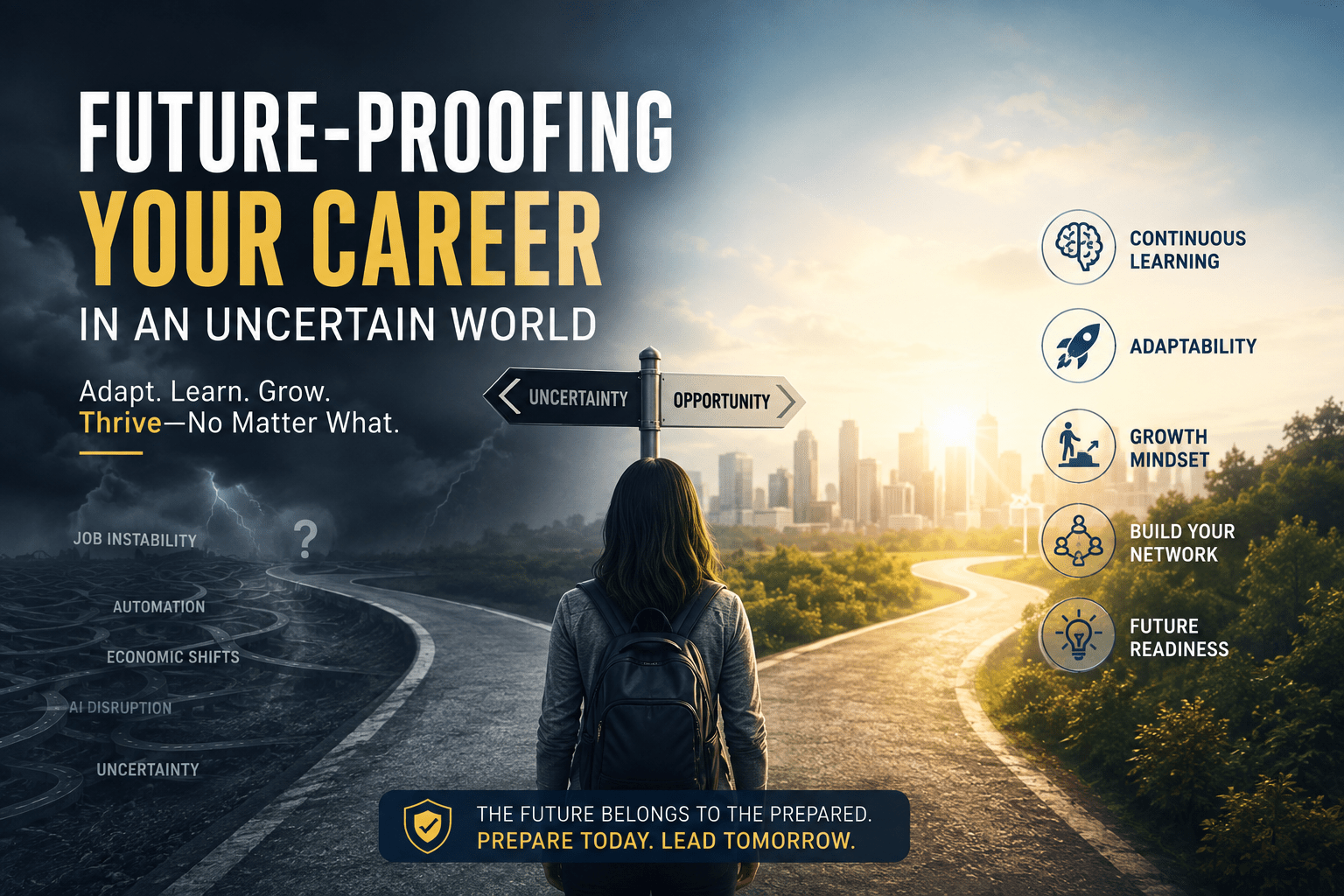
Future-Proofing
Your Career in an
Uncertain World
The half-life of a professional skill has never been shorter.
The question is no longer whether your career will be disrupted —
it is whether you will be ready when it is.
By 2030, 39% of the core skills required in today’s jobs will change or become outdated. Six in ten workers globally will require significant retraining to keep pace — yet only 7% of companies currently have active reskilling strategies for AI-impacted roles.
Source: World Economic Forum — Future of Jobs Report 2025 · Brookings Institution 2025
There is a version of career advice that has circulated, largely unchanged, for two decades: find your passion, develop expertise, build a network, deliver results. That advice is not wrong. But it is increasingly incomplete. The conditions it was written for — a world where skills stayed relevant for a career’s length, where industries evolved slowly enough for professionals to adapt gradually, where a single area of expertise could sustain a working life — those conditions are gone. The professional landscape of 2026 rewards a different kind of readiness. Not the readiness of the person who has learned the most, but the readiness of the person who has learned how to keep learning.
Future-proofing a career is not about predicting which specific roles will survive automation or which technologies will dominate the next decade. It is about building the dispositions, skills, and habits that allow you to navigate any disruption — to see change coming early enough, adapt fast enough, and remain genuinely useful regardless of which tools, platforms, or industries shift beneath your feet.
Of core job skills will change by 2030 — WEF Future of Jobs Report 2025
New roles projected to emerge globally by 2030, while 92M existing positions are displaced
Wage premium earned by AI-skilled workers over peers — up from 25% in 2023 · LinkedIn 2025
The Real Example: Amazon’s $1.2 Billion Bet on Its Own People
In 2019, Amazon made a commitment that looked ambitious at the time and has since proved prescient: a $1.2 billion investment to upskill 300,000 of its employees by 2025. The programme — called Upskilling 2025 — was not designed around generic training content. It was built around specific role transitions that Amazon could see coming in its own operations: the shift from manual warehouse work to robotics coordination, from customer service to AI-assisted case management, from data entry to machine learning operations.
By 2025, Amazon reported that over 300,000 employees had participated in the programme. Of those who completed technical upskilling tracks, a significant proportion moved into higher-wage roles within the company — in areas including cloud operations, data analytics, and AI systems management — without leaving Amazon to do so. The programme produced measurable business outcomes: lower attrition in upskilled cohorts, faster role-to-productivity timelines for internal movers, and a workforce that was meaningfully more capable of operating alongside the automation tools the company was simultaneously deploying.
The Amazon case demonstrates something that individuals can apply at the personal level: the organisations and people who will navigate disruption most successfully are those who invest in adaptation before the disruption arrives. Amazon did not wait until automation had eliminated roles to begin reskilling. It began reskilling when the trajectory was visible — not yet inevitable. That early investment window is available to every professional. The question is whether they use it.
Sources: Amazon Upskilling 2025 Programme Report (2025) · CNBC — Amazon’s $1.2 billion workforce training commitment (2025) · WEF Future of Jobs Report 2025
The Six Skills That Actually Future-Proof a Career
Not all skills age at the same rate. Technical skills in specific tools and platforms have a half-life measured in years — sometimes months. Human skills — the capacities that are most difficult to automate and most transferable across roles and industries — have a half-life measured in decades. The most durable career investment is not learning the next tool. It is building the foundational capacities that allow you to learn and apply any tool effectively.
Adaptive Learning Velocity
The demonstrated ability to pick up new domains quickly — evidenced by what you have already taught yourself, not claimed. The most valuable signal to a future employer.
AI Fluency
Not engineering — applied literacy. Knowing how to direct, prompt, validate, and integrate AI tools into professional workflows. Now a baseline expectation in most knowledge roles.
Analytical Thinking
The WEF ranks this as the top core skill for 2025–2030. The ability to structure ambiguous problems, reason from evidence, and make defensible decisions in conditions of incomplete information.
Cross-Domain Communication
The ability to translate between technical and non-technical stakeholders — to make complex ideas legible, build consensus across disciplines, and write with precision and clarity.
Emotional Intelligence
As AI handles more of the analytical work, the distinctly human capacities — empathy, interpersonal judgment, conflict resolution, trust-building — become more valuable, not less.
Visible Portfolio of Work
Not a credential — a body of demonstrated output. Projects, analyses, writing, tools built. The shift from degree-first to evidence-first hiring makes this more valuable every year.
What Future-Proofing Is Not
The term attracts a great deal of advice that sounds useful but functions primarily as anxiety management. Worth naming what it is not, so the genuine article is easier to recognise.
Future-proofing is not collecting certifications. It is not following every technology trend. It is not optimising your LinkedIn headline. It is building the internal capacity to navigate whatever comes — including what nobody has yet predicted.
- It is not about predicting the future. The professionals who try to identify the single skill or role that will be most valued in ten years are playing a game the evidence doesn’t support. The pace of change makes specific predictions unreliable beyond three to five years. Build adaptability, not prophecy.
- It is not a one-time investment. The Ebbinghaus Forgetting Curve applies to professional relevance too — not because skills are forgotten, but because the context in which they are applied keeps changing. Continuous learning is not a virtue. It is the structural requirement of working in the current era.
- It is not about doing more. The most common mistake is adding learning to an already full schedule without removing anything. Sustainable professional development requires deliberate choices about what to stop doing — not an additional layer of activity on top of existing commitments.
- It is not only the individual’s responsibility. The Amazon case illustrates this clearly: the organisations that navigate disruption best are those that invest in their people’s adaptability before the disruption hits — not those that outsource the responsibility for reskilling to employees operating on their own time and budget.
A Practical Framework: The Three Horizons of Career Investment
The most useful frame for thinking about career future-proofing is not a single list of skills to acquire. It is a portfolio across three time horizons — each requiring different kinds of investment and returning different kinds of value.
-
Horizon 1: Defend your current position (0–18 months).
Identify the two or three skills most likely to be automated or deprioritised in your current role within the next two years. Invest specifically in the AI and digital fluency that would allow you to work alongside those tools rather than be replaced by them. This is not about learning everything — it is about closing the specific gaps most likely to matter first. -
Horizon 2: Build your adjacency (18 months–3 years).
Map the roles one step away from your current function that are growing in demand. Identify what capabilities they require that you don’t yet have — and begin building them now, while you have the runway. The Amazon employees who moved into cloud operations and data analytics roles did not pivot overnight. They built adjacent capability over eighteen to twenty-four months before the transition. -
Horizon 3: Invest in permanent advantage (3+ years).
The skills with the longest durability are not technical. They are the meta-skills — the ability to learn quickly, think analytically, communicate with precision, and build trust in complex environments. These do not become obsolete. Invest in them not because they will be needed next year, but because they will be the differentiating factor in every role you hold for the rest of your career. -
Make your learning visible.
A skill that cannot be demonstrated is a skill that does not exist in the hiring market. Whatever you are learning, build evidence of it — a project, a published analysis, a tool, a case study, a presentation. The shift from credential-based to evidence-based hiring is already underway. Position yourself ahead of it. -
Start before it is urgent.
This is the single most important lesson from the Amazon case. The organisation that began reskilling in 2019 — before automation had arrived in force — had a fundamentally different outcome than those that began in 2023 when the urgency was obvious and the runway was short. The professional who begins investing in adaptability now, before their current role is under pressure, will be in a structurally different position to the one who begins when the pressure arrives.
The Career That Builds Itself Forward
The professionals who will look back on the 2020s as a period of extraordinary opportunity are not those who correctly predicted every technology shift. They are those who built — deliberately, continuously, and early — the capacity to adapt to whatever the shift turned out to be. They invested in learning before the urgency was obvious. They made their skills visible before the credential was sufficient. They built portfolios while their peers were still collecting titles.
The uncertain world is not a reason to wait. It is the reason not to. The runway is longest right now. The skills that will matter most — analytical thinking, AI fluency, adaptive learning, clear communication — are available to anyone willing to begin. The question is not whether the disruption is coming. It demonstrably is. The question is whether, when it arrives, you will be someone it lifts or someone it leaves behind.
Ready to future-proof your workforce — before the urgency arrives?
At Reskill & Rise, we help organisations and individuals build the skills, habits, and development frameworks that compound over time — so disruption becomes an advantage, not a crisis.