📑 Table of Contents
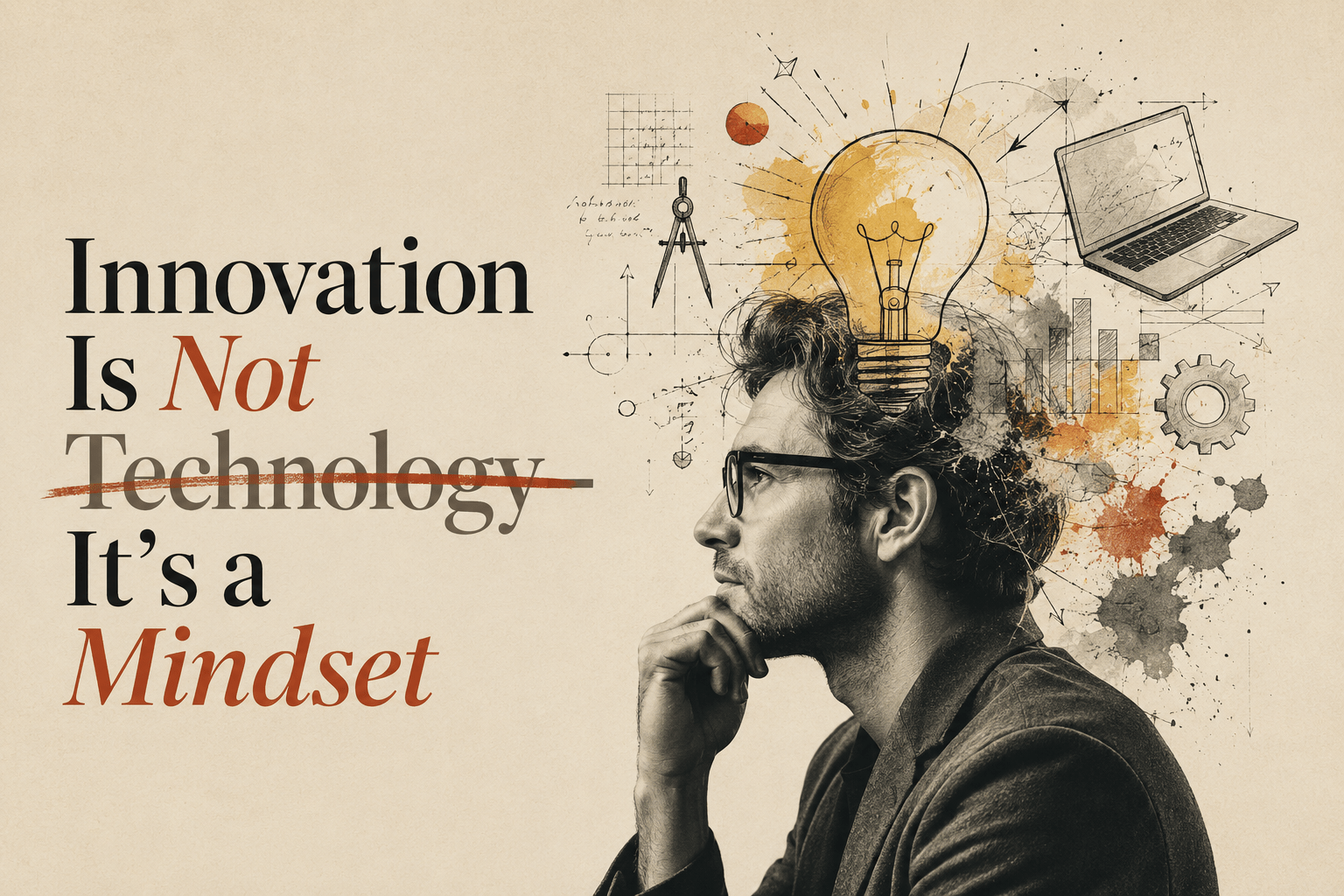
Innovation Is Not
Technology —
It’s a Mindset
Organisations keep buying innovation. They budget for it, brand it, and
announce it. What they rarely do is build the internal conditions that
make it possible — and that gap is costing them billions.
There is a seductive idea that has guided corporate strategy for the better part of two decades: that innovation is primarily a technology problem. That if you invest enough in the right platforms, hire enough engineers, and stand up the right unit with the right mandate, transformation will follow. It is a comforting belief because it is tractable. Technology can be procured. Headcount can be approved. A roadmap can be built, presented to the board, and declared a strategy. What cannot be so easily procured — and what most organisations discover, expensively and late, that they have neglected — is the human and cultural substrate that determines whether any of it actually works.
Innovation is not an output of technology. It is an output of minds working in environments that reward curiosity, tolerate intelligent failure, distribute decision-making authority, and treat questioning the status quo as a contribution rather than a threat. Technology is an accelerant. Applied to an organisation with the right mindset, it is extraordinarily powerful. Applied to one without, it simply makes the existing dysfunction faster, more expensive, and harder to unwind.
In 2020, Volkswagen Group announced one of the most ambitious technology initiatives in automotive history. Cariad — its newly formed software unit — was tasked with building a unified operating system across all twelve VW group brands, including Audi, Porsche, Lamborghini, and Volkswagen itself. The vision was to become, in the words of then-CEO Herbert Diess, “the second SAP” — a global software powerhouse born from German industrial heritage. Over €14 billion was committed. Thousands of engineers were hired or transferred from across the group.
By 2025, the distance between that vision and the outcome was extraordinary. Flagship model launches — the Audi Q6 e-tron, the Porsche Macan Electric — were delayed by years due to software failures. Over 100,000 ID.4 vehicles were recalled. Cariad underwent three major strategic resets. Roughly a third of its workforce was cut. And in 2024, Volkswagen bypassed Cariad entirely for its future software architecture, striking a $5 billion partnership with US electric vehicle maker Rivian instead.
What went wrong? The technology ambition was sound. The investment was genuine. But Cariad inherited something far more consequential than a software brief: it inherited the governance logic, approval hierarchies, and cultural assumptions of the automotive organisations it was drawn from. Every decision required committee approval. Procurement controlled vendor selection. Developers spent their time in status meetings rather than building. As one insider put it: “We were supposed to build the future. Instead, we were constantly putting out fires.” A system that preached innovation had been structurally designed for compliance. The mindset required to do one is incompatible with the systems designed to enforce the other.
Cariad is not a story about software. It is a story about what happens when an organisation attempts to buy an innovative outcome without building an innovative culture to produce it.
Sources: German Auto Preneur Insider Report (Apr 2026) · DigitalDefynd Case Analysis (2025) · Adolfo Carreno — Architecture of Impossible Transformation (Mar 2026)
The Innovation Theatre Problem
Cariad is an extreme case, but the pattern it illustrates is not unusual. Across industries, organisations have learned to perform innovation without producing it. They launch innovation labs that operate at arm’s length from core business decisions. They run hackathons that generate ideas that are never resourced. They appoint Chief Innovation Officers whose mandates are broad and whose authority is narrow. They invest in AI platforms, design thinking workshops, and agile transformations — and then wonder why the culture feels exactly the same six months later.
This is what researchers call innovation theatre: the visible, auditable performance of innovative activity, without the structural conditions that would allow it to compound into genuine competitive advantage. It satisfies the board. It appears in the annual report. And it changes almost nothing about how decisions are actually made, how failure is actually processed, or how deeply the people doing the work are actually trusted to question what they’re being asked to do.
Innovation theatre is what organisations do when they want the reputation of being innovative without accepting the discomfort of becoming it.
Of digital transformation initiatives still fail — consistent across three decades of research
Invested in Cariad before VW pivoted to Rivian — with minimal innovation to show for it
More likely to succeed — projects with strong cultural change management vs. poor (Prosci, 2025)
What an Innovation Mindset Actually Looks Like
The word “mindset” risks sounding abstract — the kind of thing that belongs in a keynote rather than an operational strategy. But an innovation mindset has concrete, observable characteristics. It is not a personality trait that some people have and others lack. It is a set of practised dispositions that are cultivated or suppressed by the environment in which people work. Organisations that produce sustained innovation have, in most cases, deliberately engineered that environment.
The clearest contrast is between what Microsoft looked like under Steve Ballmer and what it became under Satya Nadella. Ballmer’s Microsoft was organised around knowing: being the expert, defending the position, treating internal competition as a proxy for ambition. Nadella’s Microsoft was reorganised around learning: being curious, acknowledging uncertainty, rewarding those who grew others as much as those who outperformed individually. The technology available to both versions of the company was largely the same. The market was largely the same. The difference was the mindset the leadership chose to model — and then systematically install into the organisation’s structures, incentives, and rituals.
| Dimension | Technology-First Thinking | Innovation Mindset |
|---|---|---|
| What is innovation? | A platform, tool, or product to deploy | A practised capacity to create new value |
| Where it lives | A dedicated unit or lab | Distributed across every team and level |
| Response to failure | Avoided, hidden, or attributed to blame | Processed openly as useful data |
| Decision authority | Centralised through committees and approvals | Pushed close to the work and the customer |
| Measure of success | Budget spent, outputs delivered | New value created, assumptions tested |
| Questioning the plan | Seen as resistance or disloyalty | Seen as intellectual contribution |
| Leadership role | Vision-setter and approver | Curiosity-modeller and uncertainty-tolerator |
The Four Mindset Conditions That Drive Real Innovation
Just as learning culture rests on specific structural conditions, so does innovation capacity. These are not soft aspirations. They are hard requirements — each of which can be engineered deliberately, and each of which, when absent, predictably produces the kind of outcome Volkswagen experienced with Cariad.
- Psychological safety for intelligent risk: People do not attempt genuinely new things in environments where failure is penalised. Harvard Business School’s Amy Edmondson has spent decades establishing this relationship empirically. The most innovative teams are not the ones with the most talented individuals — they are the ones where individuals feel safe enough to surface what they don’t know, try what hasn’t been tried, and report problems before they become disasters.
- Distributed decision authority: The Cariad failure was, at its structural core, a decision-rights failure. When the people closest to the problem — the developers, the engineers, the product owners — have no real authority to act on what they know, the organisation loses the fastest feedback loops it has. Innovation requires the authority to experiment to live near the experiment itself, not several committee approvals away.
- Failure as data, not verdict: Organisations that treat every failed initiative as evidence of someone’s inadequacy train their people to avoid initiative. The mindset shift required is precise: a failed experiment is not a failure of judgement. It is a reduction in uncertainty. It tells you something the market, the customer, or the technology couldn’t tell you in advance. That information is valuable — if the organisation is structured to capture and act on it rather than bury it.
- Curiosity as a leadership practice: Innovation culture is not installed by memo. It is modelled by leaders who visibly ask questions they don’t have answers to, who openly change their minds when evidence warrants it, and who reward the people who surface uncomfortable truths rather than those who confirm comfortable ones. The question “what do we not know about this?” asked consistently at the top of an organisation becomes, over time, the question asked habitually at every level below it.
Technology as Amplifier, Not Author
None of this means technology is unimportant. The organisations that will lead their industries over the next decade will be those that combine genuine innovation mindset with sophisticated technological capability. The point is sequence and causality, not a false choice between culture and tools.
Technology amplifies whatever mindset already exists. In an organisation with strong psychological safety, distributed authority, and tolerance for intelligent failure, AI tools accelerate ideation, compress prototyping cycles, and make experimentation faster and cheaper than at any point in history. In an organisation without those conditions, the same tools accelerate the production of polished PowerPoints about initiatives that will never be resourced, and automate the reporting of metrics that no one is genuinely accountable for.
This is why digital transformation fails at the same rate it did thirty years ago, despite technology becoming orders of magnitude more capable. The technology was never the constraint. The people adopting new ways of working — their trust in leadership, their psychological safety to try and fail, their genuine authority to act on what they learn — that is where transformation succeeds or stalls.
What Leaders Can Change This Month
Building an innovation mindset across an organisation is a multi-year endeavour. But the conditions that make it possible are not. There are concrete, low-cost interventions available to leaders at every level — not as substitutes for structural change, but as the beginning of it.
- Name a failure publicly and process it openly. The most powerful signal a senior leader can send about psychological safety is not a policy — it is a personal act. Sharing what didn’t work, what you learned, and what you’d do differently is the fastest way to give others permission to do the same.
- Run a “kill the plan” review. Before your next major initiative launches, assign someone the explicit role of finding the strongest case against it. Pre-mortems — imagining the initiative has failed and asking why — surface blind spots that no amount of positive planning will reveal.
- Map your decision bottlenecks. Identify the three decisions your team most frequently escalates that they could, with clearer guardrails, make themselves. Then write those guardrails and hand the authority over. Measure what happens to speed and quality of outcomes.
- Separate exploration from exploitation. Innovation and operations require different management logics. Teams that are being measured on quarterly delivery targets cannot simultaneously be expected to experiment freely. Create explicit, protected space — in time, in budget, and in performance evaluation — where exploration is the mandate rather than an afterthought.
- Ask “what do we not know?” in every strategic conversation. The discipline of surfacing uncertainty before acting on assumption is the single habit most strongly associated with sustained innovative output. It takes ten seconds to ask. The effect, practised consistently, compounds over months into a fundamentally different kind of conversation.
The Organisation That Actually Innovates
Volkswagen had the capital, the talent, the technology ambition, and the market urgency. What Cariad ultimately lacked was a system designed to support the mindset innovation requires. Its developers were told to think like a startup while operating inside a governance architecture built for a century-old manufacturing conglomerate. The contradiction was not survivable.
The organisations that will genuinely innovate over the next decade will not necessarily be the ones with the largest R&D budgets or the most sophisticated AI stacks. They will be the ones that have done the harder, slower, less visible work of building environments where curious people feel safe to try things, are trusted to make decisions, and are rewarded for learning rather than just for being right.
That work cannot be outsourced to a software unit. It cannot be announced in a strategy document. It is built, incrementally and deliberately, in the daily choices leaders make about what they reward, what they tolerate, what they model, and what they ask. Innovation is not a technology problem. It never was. It is a leadership problem — and that is both the most challenging and the most hopeful thing about it.
Ready to build a culture where innovation actually happens?
At Reskill & Rise, we help organisations develop the leadership mindsets, team conditions, and structural habits that turn innovation from a programme into a practice.