📑 Table of Contents
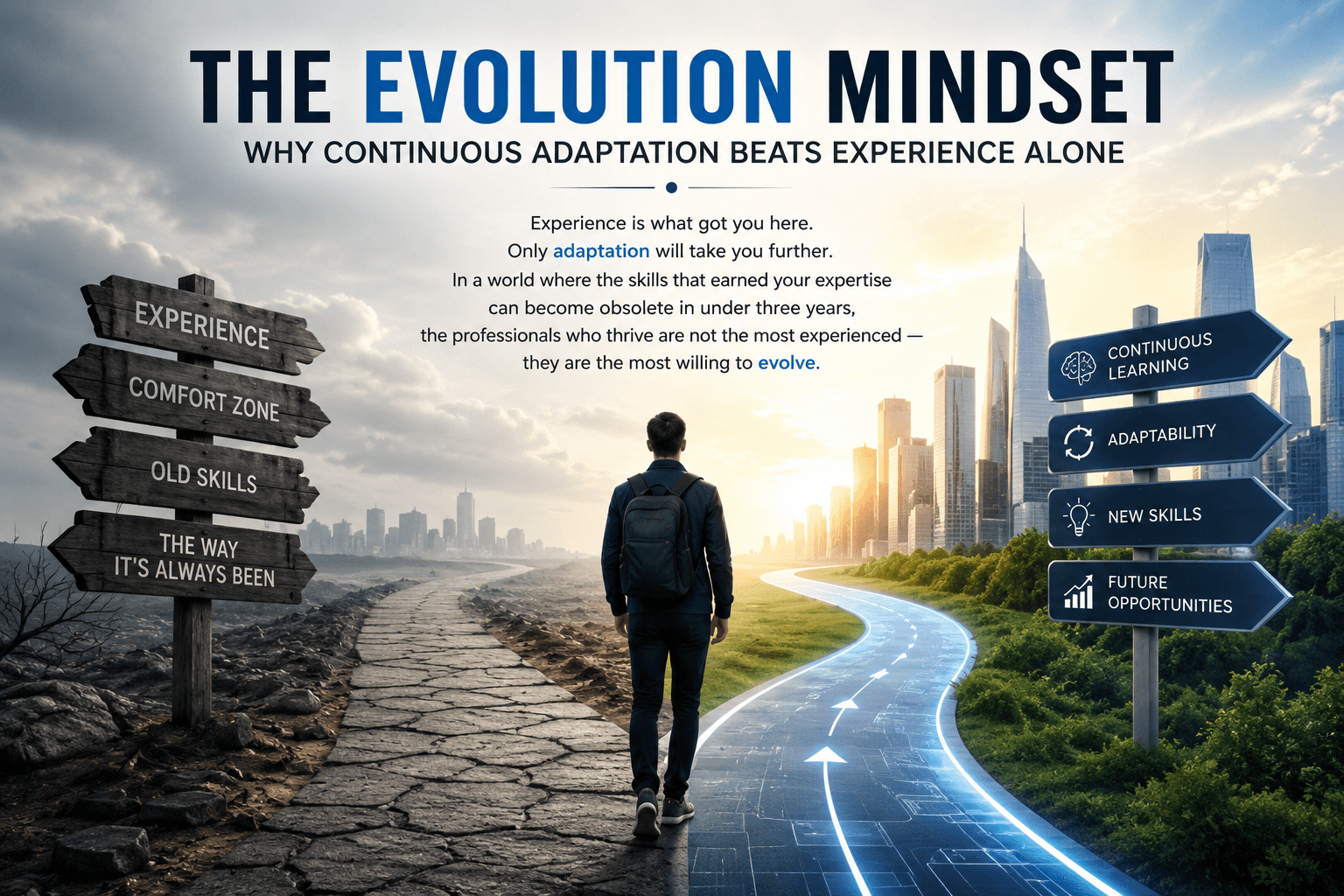
The Evolution Mindset:
Why Continuous Adaptation
Beats Experience Alone
Experience is what got you here. Only adaptation will take you further.
In a world where the skills that earned your expertise can become
obsolete in under three years, the professionals who thrive are not
the most experienced — they are the most willing to evolve.
Adaptability topped LinkedIn’s Most In-Demand Skills list for 2024 with the largest year-over-year growth of any skill — and hiring managers now rate learning agility as a stronger predictor of future success than years of experience alone.
Source: LinkedIn Most In-Demand Skills Report 2024 · Robert Walters Group 2026
For most of the last century, expertise compounded reliably — each year of experience made the next more valuable. That model has not disappeared. But its half-life has shortened dramatically. The WEF’s 2025 Future of Jobs report found that 39% of current job skills will be disrupted by 2030. In fast-moving sectors, the shelf life of a specific technical skill is now measured in years, not decades. Experience without adaptation is no longer a compounding asset — increasingly, it is a depreciating one.
Adaptability — LinkedIn’s most in-demand skill 2024, largest YoY growth of any skill
Of current job skills will be disrupted or obsolete by 2030 — WEF Future of Jobs 2025
Average half-life of a technical skill before meaningful updating is required — WEF 2025
The Live Example: Nokia and the Cost of Expertise Without Evolution
In 2007, Nokia was the world’s largest mobile phone manufacturer, commanding over 40% of the global handset market. It had spent decades building unparalleled expertise in hardware engineering, distribution logistics, and manufacturing efficiency. Its engineers were among the best in the world at building phones. Its executives had more combined experience in the mobile industry than any team at any competitor. On every conventional measure, Nokia was the dominant force in its sector — not just successful, but definitionally expert.
That same year, Apple launched the iPhone. Nokia’s leadership evaluated it internally and concluded that its battery life was inadequate, its lack of a physical keyboard was a user experience flaw, and its price point was too high for mass-market adoption. They were right about all three observations. What they were wrong about was everything that mattered: that software would become the primary competitive battleground for mobile devices, that the App Store model would redefine what a phone was for, and that consumers would pay premium prices for a device that was genuinely useful rather than merely functional.
By 2013, Nokia’s market share had collapsed from 40% to under 4%. The company sold its handset business to Microsoft for $7.2 billion — a fraction of what it had been worth at its peak. Nokia’s failure was not a failure of expertise. Its engineers and executives were genuinely exceptional at what they knew. It was a failure of the Evolution Mindset: the unwillingness to question the relevance of existing expertise when the competitive landscape shifts beneath it. They applied deep experience to a set of assumptions that were no longer valid — and paid the price that such rigidity always extracts.
Sources: Harvard Business Review — The Real Lessons From Nokia’s Decline (2016) · CFR Group — The Adaptability Premium (June 2026) · WEF Future of Jobs Report 2025
What the Evolution Mindset Actually Is
In practice, the Evolution Mindset is a precise and observable set of dispositions — ways of orienting toward new information and unfamiliar challenges — that consistently predict professional resilience in rapidly changing environments.
The Evolution Mindset is not the rejection of expertise. It is the refusal to allow expertise to become a ceiling — to let what you know today limit what you are willing to learn tomorrow.
The professionals who demonstrate it are not generalists — many are deep experts. What distinguishes them is that they treat their knowledge as a foundation to build from rather than a position to defend. When evidence suggests their approach is no longer optimal, they update. The environment matters too: a culture that rewards expertise but penalises questioning assumptions will suppress the Evolution Mindset regardless of individual intent.
The Four Dimensions of the Evolution Mindset
- Learning agility — above domain expertise. The demonstrated capacity to enter unfamiliar domains quickly, extract what is relevant, and apply it to current challenges. Hiring managers now view learning agility as a stronger predictor of future success than experience alone — because the pace of change means that what a candidate will need to know in three years is often unknowable at the point of hire. The person who learns fast is more valuable than the person who already knows.
- Assumption audit as a regular practice. The Evolution Mindset treats the assumptions underlying current strategy — about customers, competitors, technology, and industry structure — as hypotheses to be tested rather than truths to be defended. Nokia’s executives did not lack intelligence. They lacked the habit of regularly asking: what would have to be true about the world for our current approach to be wrong?
- Identity separation from expertise. When professional identity is built entirely on a specific body of knowledge, the obsolescence of that knowledge feels like a personal threat. The Evolution Mindset decouples professional identity from specific expertise — placing it instead in the capacity to develop expertise, in judgment, in curiosity, and in the process of learning itself. This separation is what makes updating possible without crisis.
- Deliberate exposure to the unfamiliar. The Evolution Mindset does not emerge from comfort zones. It is built through repeated, intentional exposure to unfamiliar problems, domains, and perspectives — through cross-functional work, adjacent reading, diverse professional relationships, and the willingness to be a beginner again in a domain that matters. Particularly valuable are examples that demonstrate successful adaptation across industries, functions, cultures, or business models — these provide stronger evidence of adaptability than any linear career path.
Nokia vs. Nadella: The Same Era, Two Outcomes
The more instructive contrast to Nokia is Microsoft under Satya Nadella — both operating from established expertise, both facing the same disruption. Nadella’s first act was not a product launch but a cultural intervention: replacing the “know-it-all” identity with “learn-it-all,” shifting rewards from individual expertise performance to cross-functional learning. The Evolution Mindset was not announced — it was structurally installed.
By 2026, Microsoft had grown from $300 billion to nearly $3 trillion. Nokia spent a decade rebuilding from scratch. The lesson is identical: the Evolution Mindset applied early produces compounding advantage. Applied under duress, it produces survival — at enormous cost.
Building the Evolution Mindset — Practical Steps
-
Schedule a quarterly assumption audit.
Identify the three most important assumptions your current role or strategy depends on. For each one, ask: what would have to be true for this to be wrong? What evidence would I expect to see if it were already becoming wrong? This is the habit that Nokia’s leadership did not have — and the one that most reliably protects against the gap between expertise and reality. -
Set a deliberate beginner target each quarter.
Choose one domain adjacent to your current work that is growing in relevance and spend four to six hours per month entering it — reading, taking a course, speaking to someone who works in it. The discomfort of being a beginner is the signal that you are building the adaptation muscle. Professionals who only operate in domains they already understand are not building adaptability — they are rehearsing expertise. -
Separate your identity from your current knowledge.
The practical version of this is straightforward: when you encounter a challenge to your current approach — a new technology, a contradictory data point, a perspective that undermines a working assumption — practise the response of curiosity before the response of defence. “That’s interesting — what would it mean if that were true?” is the Evolution Mindset in action. -
Make adaptation visible — build evidence of it.
Adaptability is not measured by a certification or job title. Employers look for evidence through a candidate’s experiences — times they had to learn something quickly, major workplace changes and how they responded. Document your adaptations: the domains you entered, the tools you adopted, the approaches you updated. A portfolio of demonstrated learning is more valuable in the current market than a resume of accumulated titles.
The Professional Who Compounds
The professional who compounds over a long career is not the deepest expert in a stable domain — it is the one who builds expertise, then adapts it, then builds again. Experience is the raw material. The Evolution Mindset is what determines whether that material keeps compounding or slowly stops working. Nokia had the experience. What it lacked cost everything.