📑 Table of Contents
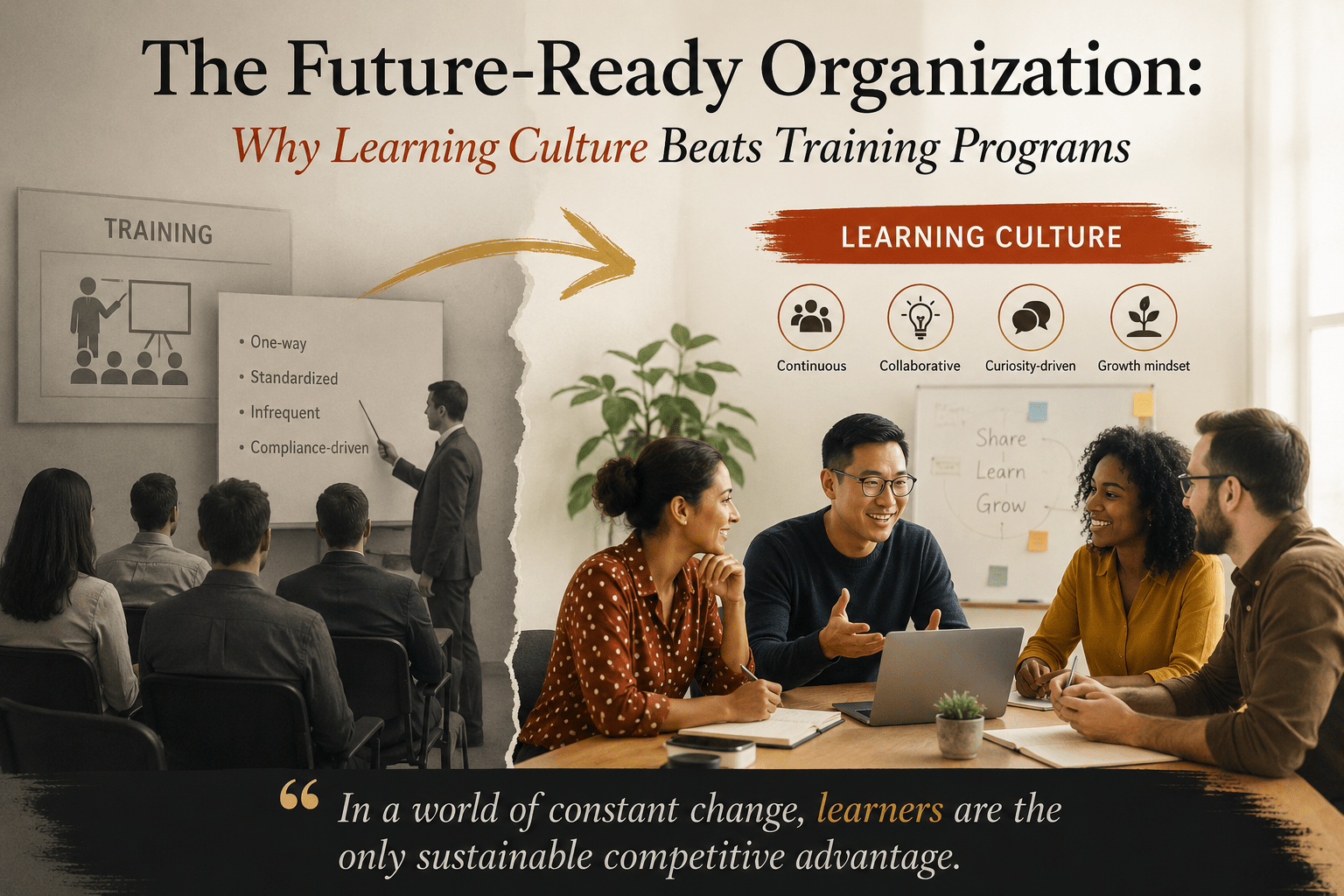
The Future-Ready Organisation:
Why Learning Culture
Beats Training Programs
Most companies have training programs. Very few have a learning culture.
The gap between those two things is where competitive advantage is quietly won and lost.
Every organisation that has ever faced a skills crisis has done the same thing: launched a training program. They’ve commissioned e-learning modules, booked external facilitators, built out an LMS, and announced to the workforce that upskilling is now a priority. The activity looks good in board reports. It satisfies the HR audit. And in the vast majority of cases, it changes almost nothing about how the organisation actually learns, adapts, or performs six months later.
The reason is not that training is useless. It’s that training is an event, and events don’t build capability. Culture does. The organisations that are genuinely future-ready in 2026 — the ones navigating AI disruption, skills obsolescence, and market volatility without lurching from crisis to crisis — share a common trait that has very little to do with their L&D budget. They have built environments where learning is not something that happens to employees. It’s something employees do, continuously, as an intrinsic part of how work itself gets done.
In January 2026, Salesforce CEO Marc Benioff told investors the company would hire no new software engineers for the foreseeable future. The reason: Agentforce, Salesforce’s AI agent platform, had rendered the headcount unnecessary. Employees whose roles were affected were directed to Trailhead — Salesforce’s own free online learning platform, which has existed since 2014 — and encouraged to reskill for AI-adjacent roles.
The offer looked generous on paper. In practice, Salesforce’s own internal data, presented at Dreamforce 2025, told a different story: fewer than 12% of employees who began a Trailhead learning path completed it. Of those who did finish, fewer than half reported using their new skill in their current role. The platform had been available for over a decade. The content was free and well-produced. What was missing was never the training. It was a culture in which learning was a normal, supported, ongoing behaviour — not a crisis response that employees were suddenly expected to perform on their own.
The Salesforce case is not a failure of a training program. It is a failure to build a learning culture before the training program was ever needed.
Source: Live in the Future / Dreamforce 2025 internal data, March 2026
What a Learning Culture Actually Is
The term gets used loosely enough that it has nearly lost meaning. In practice, a learning culture is not a benefit offering, a budget line, or a platform subscription. It is a set of observable, repeatable behaviours — reinforced by leadership, incentivised by systems, and normalised by everyday practice — that make continuous adaptation the default mode of the organisation rather than an exceptional effort.
It shows up in small ways that compound into large competitive advantages. Teams that conduct brief after-action reviews after projects, not because HR mandated it but because they’ve found it genuinely useful. Managers who openly discuss what they got wrong in a decision, modelling the psychological safety that makes their reports willing to do the same. Individuals who block time in their week for learning as routinely as they block time for meetings. Organisations where a junior analyst can question a senior director’s assumption without career risk — and where that kind of intellectual friction is understood to produce better outcomes.
In a learning culture, failure is not the opposite of success. It is data. The organisation that processes that data fastest has the structural advantage.
Of employees say their company views training as time away from “real” work — TalentLMS 2026
Of layoff survivors felt unprepared or made costly errors due to lack of structured learning — Kahoot! 2025
Of companies with deployed AI tools were working on reskilling strategies for AI-impacted roles — Brookings 2025
Why Training Programs Fail on Their Own
The structural problem with standalone training programs is that they treat learning as a transfer of content rather than a change in behaviour. Content can be transferred in an afternoon. Behaviour change requires sustained environmental conditions — repeated practice, meaningful feedback, social reinforcement, and enough psychological safety to try something new and fail at it without consequence.
Most corporate training programs are designed around delivery, not adoption. The LMS gets launched. Completion rates are tracked. Certificates are issued. Then the programme is considered done. But the question that determines whether learning actually occurred — “Is this person doing anything differently in their work?” — is rarely asked, rarely measured, and rarely structurally supported. The content was never the bottleneck.
| Dimension | Training Program | Learning Culture |
|---|---|---|
| Trigger | Skills gap identified, crisis response | Continuous, embedded in daily work |
| Ownership | HR and L&D team | Every leader and individual |
| Measure of success | Completion rates, certificates issued | Behaviour change, applied performance |
| Failure response | Avoided, penalised, or ignored | Processed, shared, learned from |
| Knowledge flow | Top-down, expert to learner | Multi-directional, peer-to-peer |
| Time horizon | Event-based, episodic | Ongoing, compounding over time |
| Leadership role | Sponsor and mandate | Model and participate visibly |
The Four Conditions That Make Learning Culture Real
Building a learning culture is not a single initiative. It is a set of conditions that must coexist for the culture to take hold and sustain. Organisations that attempt to install one condition without the others consistently find that their efforts produce short-term activity without long-term shift. The four conditions are interdependent. Weaken any one and the system degrades.
- Psychological safety: People will not share what they’ve learned from their failures if failure is a career-limiting event. Amy Edmondson’s research at Harvard has established this link conclusively — psychological safety is not a soft cultural nicety, it is a structural prerequisite for learning to occur at an organisational level.
- Leader modelling: When executives skip retrospectives, delegate learning to HR, and never publicly discuss their own development goals, the signal to the workforce is clear: learning is for other people. The most powerful learning intervention a senior leader can make is visible, honest participation in their own growth.
- Time as a structural resource: Organisations that load every sprint, quarter, and workday entirely with delivery commitments leave no structural space for reflection, experimentation, or skill-building. Learning that is permanently squeezed out by urgency never happens. Time for learning must be protected explicitly, not hoped for in the gaps.
- Systems that reward curiosity: If performance reviews measure only delivery, and promotions go only to those who stayed in their lane and hit their numbers, the organisation has structurally incentivised against learning. Curiosity, knowledge-sharing, mentorship, and adaptive skill-building must be visible in how people are evaluated and recognised.
The Compounding Return on Learning Culture
The most compelling case for building learning culture over training programs is not ideological — it is economic. Learning culture compounds. A training program produces a one-time return that decays as the content ages and the behaviour reverts. A learning culture produces an accelerating return because each cycle of learning improves the organisation’s capacity to learn in the next cycle.
Consider what happens when two organisations face the same disruptive technology. The first organisation — one with strong training infrastructure but weak learning culture — launches a mandatory upskilling programme six months after the technology has already changed market conditions. Completion rates are high. Behaviour change is low. The organisation is behind, and the gap is real. The second organisation — one where learning is embedded in daily operations — has already been experimenting with the technology informally, sharing observations across teams, and surfacing emerging best practices through its existing social learning mechanisms. By the time a formal programme is designed, the organisation is already six months ahead.
What Leaders Can Do This Quarter
Building a learning culture is a multi-year endeavour, but it is not one that requires waiting for the next strategic planning cycle to begin. There are actions available to leaders at every level, right now, that begin to shift the conditions in meaningful ways.
- Run a retrospective on your last three major projects and share the findings publicly — not just with your team, but with adjacent ones. Model the behaviour you want normalised.
- Audit your team’s calendar: what percentage of time is currently protected for reflection, experimentation, or skill-building? If the answer is zero, that is a structural decision to reverse.
- Ask your people directly: “What have you learned this month that changed how you work?” The question itself signals that learning is expected, valued, and visible.
- Review how your performance system rewards (or ignores) knowledge-sharing, mentorship, and adaptive upskilling. If the incentives don’t support learning, the culture won’t either.
- Identify three people in your organisation who are already functioning as informal learning catalysts — connecting people, sharing insights, experimenting openly. Recognise them, resource them, and make their behaviour more visible.
- Stop launching learning programmes in response to crises. Start asking what learning infrastructure, installed now, would prevent the next crisis from requiring a programme at all.
The Organisation That Will Win the Next Decade
The future-ready organisation is not the one with the most sophisticated LMS, the largest L&D budget, or the most impressive portfolio of external certifications. It is the organisation that has built the internal conditions for learning to happen continuously, at every level, without waiting for a crisis to make it urgent.
That organisation asks better questions faster than its competitors. It surfaces and processes failure before it becomes systemic. It distributes knowledge horizontally rather than hoarding it vertically. It attracts and retains people who are intrinsically motivated to grow — because it has built an environment where growth is the norm, not the exception.
The Salesforce story is not a cautionary tale about AI. It is a cautionary tale about what happens when an organisation mistakes the availability of training for the presence of learning. The technology was not the problem. The platform was not the problem. The culture — or rather, the absence of one — was the problem. And that is a problem that no training program can solve, because it is the exact problem that only a culture can prevent.
Ready to build a culture of learning — not just a library of training?
At Reskill & Rise, we help organisations move beyond episodic training programs to build the structural conditions for continuous, embedded learning that compounds over time.