📑 Table of Contents
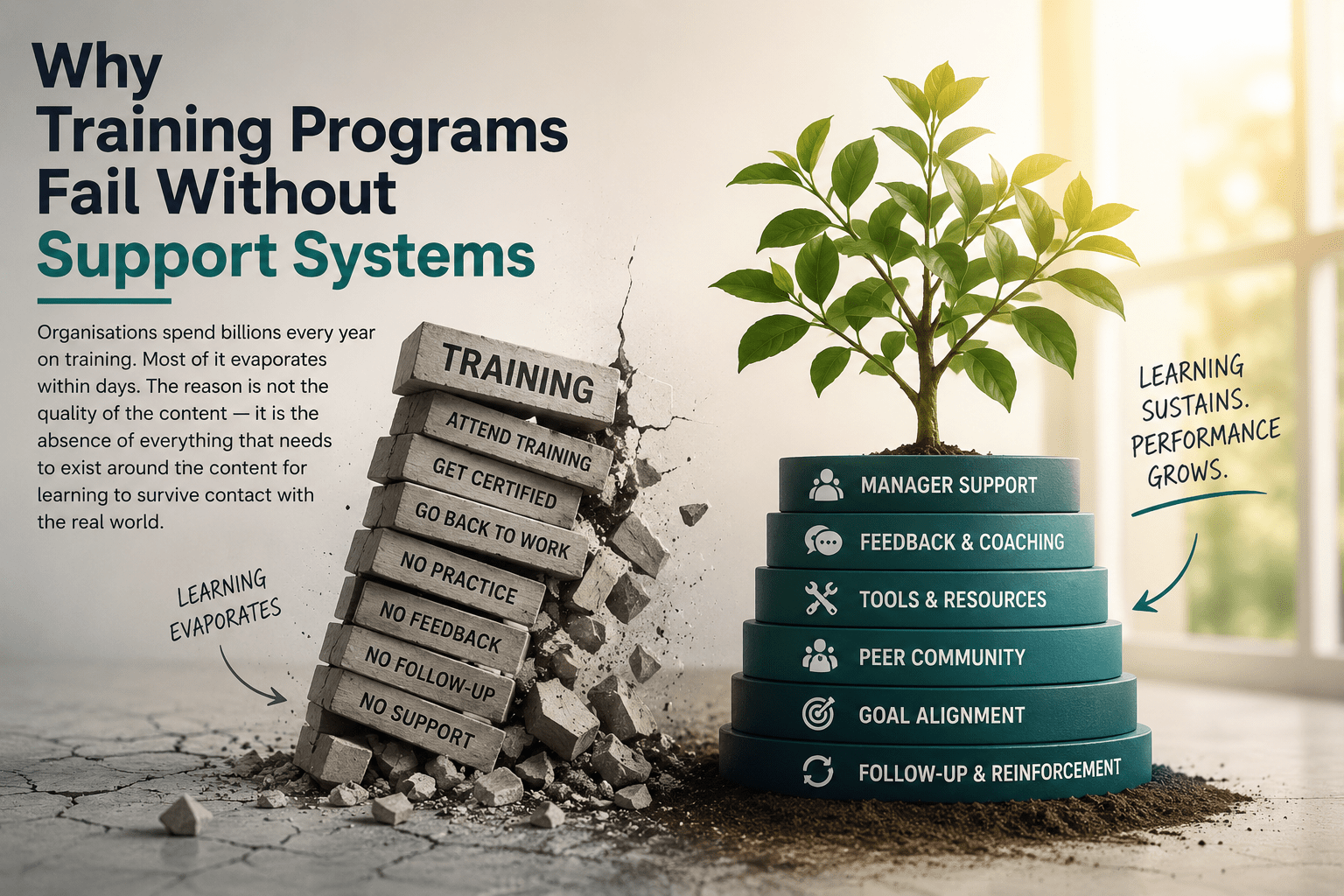
Why Training Programs
Fail Without
Support Systems
Organisations spend billions every year on training. Most of it evaporates
within days. The reason is not the quality of the content — it is the
absence of everything that needs to exist around the content for learning
to survive contact with the real world.
People forget up to 70% of new information within 24 hours if it is not reinforced — and up to 90% within a week. Yet most corporate training programs provide no structured reinforcement whatsoever after the session ends.
Source: Ebbinghaus Forgetting Curve · ATD State of the Industry Report 2024
Every year, organisations around the world invest in training programs with genuine intention. Leadership workshops are booked. E-learning modules are built. Facilitators are hired, rooms are reserved, and certificates are issued. Employees attend, take notes, nod in the right places, and return to their desks. And within a week — sometimes within a day — the vast majority of what was taught has vanished, along with any hope that the training will change how they work. This is not an edge case. It is the norm. A 2024 McKinsey report found that only 25% of employees believe their company’s training significantly improves their performance. The other 75% are sitting through programs that are, by their own assessment, not working.
The instinctive response is to improve the training itself — make it more engaging, more interactive, more relevant. These are reasonable interventions and they help at the margins. But they address the wrong problem. The content is rarely the constraint. What kills most training programs is not what happens in the room. It is what does not happen after it. The absence of a support system — the structural conditions that allow new knowledge to be practised, reinforced, applied, corrected, and embedded — is the reason that most L&D investment disappears without a trace.
Of employees say their company’s training does not significantly improve their performance — McKinsey 2024
Spent annually on corporate training in the US — with the majority producing no lasting behaviour change
Of new information is forgotten within a week without structured post-training reinforcement
The Live Example: TD Bank and the $3 Billion Training Failure
In October 2024, TD Bank was hit with a $3 billion fine — one of the largest anti-money laundering penalties in US banking history. The US Department of Justice found that for nearly a decade, TD Bank had failed to maintain an adequate anti-money laundering compliance programme, allowing illicit funds to flow through the institution with insufficient scrutiny. The case involved over $670 million in transactions connected to drug trafficking networks.
What made the case particularly instructive was this: the employees had completed their compliance training. The certificates were filed. The boxes were checked. By every standard L&D metric — completion rate, assessment score, training hours logged — the programme had succeeded. And yet the behaviour the training was meant to produce — genuine vigilance, active reporting of suspicious transactions, meaningful application of anti-money laundering knowledge — was largely absent in practice. The Department of Justice noted explicitly that employees had acknowledged the failures in internal communications, suggesting awareness of the problem without the systems in place to act on it.
TD Bank’s compliance failure was not a training content problem. The content covered the regulations, the red flags, the reporting obligations. What was missing was everything around the training: manager reinforcement of the behaviours on the floor, psychological safety to raise concerns without career risk, escalation pathways that were genuinely accessible, and a culture that treated compliance as a real professional responsibility rather than an annual checkbox. The training existed in a vacuum. The support system did not exist at all.
Sources: US Department of Justice Press Release (Oct 2024) · Institute for Financial Integrity — Why Compliance Training Still Fails (2025) · Fast Company — Why Workplace Training Programs Fail (Sep 2025)
TD Bank is an extreme case in scale, but the structural failure it represents is not extreme at all. It is the same failure playing out in organisations of every size, in every industry, every time a training programme is launched without the surrounding infrastructure needed to make it real. The fine was $3 billion. The more common cost is quieter — missed performance, persistent skills gaps, disengaged employees, and an L&D budget that produces completion certificates and nothing else.
What a Support System Actually Is
The phrase “support system” is broad enough to be meaningless without specificity. In the context of training, a support system is the set of structural conditions — human, cultural, and process-based — that determine whether a new skill or behaviour survives the transition from the training environment to the work environment. It has nothing to do with follow-up emails or reminder notifications. It is about whether the world the learner returns to is designed to reinforce, enable, and reward the behaviour the training intended.
Training changes what people know. Support systems change what people do. The gap between those two outcomes is where most L&D investment is lost.
| Element | Training Program (alone) | Training + Support System |
|---|---|---|
| Knowledge retention | 70% lost within 24 hours without reinforcement | Structured repetition and spaced practice significantly reduce decay |
| Behaviour change | Minimal — reverts to pre-training habits within weeks | Sustained when managers reinforce and environment rewards new behaviours |
| Manager role | None — training is seen as an HR function | Active — managers coach, model, and create opportunities to practise |
| Failure response | Errors are corrected or penalised without learning | Errors are processed as feedback and used to refine the new behaviour |
| Psychological safety | Absent — new behaviours risk exposure and vulnerability | Present — people feel safe to try, fail, and ask for help |
| Measure of success | Completion rate and assessment score | Behaviour change observed on the job, tracked over time |
| Time horizon | Episodic — ends when the session ends | Continuous — embeds learning into how work is done daily |
The Five Support Conditions That Training Requires to Work
These are not optional enhancements to a training programme. They are the structural prerequisites for training to produce the outcome it was designed for. Without all five, the programme will produce knowledge that decays, certificates that are filed, and behaviour that reverts. With them, training compounds — each application of new skill creates the conditions for deeper skill, which enables the next level of capability.
- Manager reinforcement. The single most important determinant of whether training transfers to behaviour is whether the learner’s direct manager actively reinforces it. Not through emails, but through questions in one-to-ones (“how are you applying what you learned?”), through creating visible opportunities to practise the new skill, and through modelling the behaviour themselves. When managers treat training as something that happens to their team and then ends, behaviour reverts within weeks regardless of how good the content was.
- Psychological safety to practise imperfectly. New behaviours are, by definition, not yet mastered. The learner who tries to apply a new skill and fails — publicly, in front of colleagues or a customer — needs an environment where that failure is treated as a normal part of the learning process, not as evidence of incompetence. TD Bank’s employees were aware of compliance failures in internal communications. That awareness existed. The psychological safety to escalate it did not.
- Spaced repetition and deliberate practice. The Ebbinghaus Forgetting Curve is not a hypothesis. It is a well-replicated finding about how human memory works. Information delivered once in a concentrated session decays rapidly and predictably. The antidote is not a longer session — it is spaced repetition: brief, regular re-exposure to the material over weeks and months, combined with opportunities to practise the skill in varied contexts. This is the mechanism that moves knowledge from short-term acquisition to long-term capability.
- Structured application with feedback loops. Learning that cannot be practised on real work does not become skill. The support system must create structured opportunities for learners to apply new capabilities in their actual role — with access to feedback that is specific, timely, and focused on improvement rather than evaluation. Role plays, real project assignments, peer observation — any mechanism that creates the cycle of attempt, feedback, and refinement is building the muscle that the training only named.
- Cultural and incentive alignment. If the organisation’s performance management system, promotion criteria, and daily social norms reward behaviours that contradict the training, the training will lose. Always. Employees are rational — they apply the skills that their environment rewards. When compliance training exists in an organisation where speed and volume are rewarded and vigilance is treated as obstruction, the vigilance will not survive. When leadership development training exists in a culture where command-and-control management is implicitly valued, the collaborative behaviours taught in the workshop will not be used on Monday morning.
Why Organisations Keep Skipping the Support System
If the evidence that training without support systems fails is so consistent and well-documented, why do organisations keep launching programs without building those systems first? The answer is structural, not ignorant.
Training programs are visible, time-bounded, and easy to report on. A facilitator is booked, a date is set, a completion rate is tracked, a report goes to the board. The activity is legible. Support systems, by contrast, are diffuse, ongoing, and culturally dependent. They require manager behaviour change — which requires manager development — which requires sustained leadership commitment over months rather than a budget approval for a two-day workshop. They require changes to how performance is measured and recognised. They require psychological safety, which cannot be mandated. None of these can be captured in a training completion dashboard.
The result is a systematic institutional bias toward the measurable over the effective. Organisations repeatedly invest in the part of the learning equation that produces data, and underinvest in the part that produces capability. The TD Bank fine is, in part, a $3 billion illustration of where that bias leads when the stakes are high enough to make the gap visible.
What Leaders Can Build — Starting Now
-
Brief managers before the training, not after.
Before any programme launches, the line manager must know what is being taught, why it matters, and what to ask about in the weeks following. Manager briefing is not an HR task — it is the first and most critical step in the support system. -
Design four weeks of structured post-training application.
For every programme, build a four-week schedule of brief, specific real-work tasks that activate the new skill. One per week. Real work, not homework. This is the mechanism that converts knowledge into habit. -
Replace completion rate with behaviour observation.
Build a simple 30-day and 90-day checklist of observable on-the-job behaviours. Give it to managers. Score it. Report it. When you start measuring what people do differently — not just whether they attended — investment decisions about training change. -
Align one performance criterion with the target behaviour.
If the training teaches a behaviour that has no reflection in how people are evaluated, it will not be sustained. Identify one existing performance criterion and update it to include the behaviour the training targets. One structural change does more for transfer than any amount of follow-up content.
The Organisation That Gets It Right
The organisation that consistently gets training right does not have better content than its peers — it has built the conditions that allow any content to translate into genuine capability. Its managers ask the right questions the week after a programme ends. Its performance systems reward the behaviours the training was designed to produce. Its culture makes it safe to try and fail. TD Bank spent years checking every training box the industry recognises as success — and it cost them $3 billion. Not because the training was bad, but because the organisation around it was not designed to make it real. The support system is not a supplement to a training programme. It is the programme.
What is the biggest barrier to effective training in your organisation?
Ready to build learning that actually sticks?
At Reskill & Rise, we design training ecosystems — not just programmes. From manager enablement to structured application pathways, we build the support conditions that turn L&D investment into lasting capability.