📑 Table of Contents
- The Real Innovation: A Procurement Team That Redesigned Its Work
- What Makes an AI-Augmented Team Different
- Where AI Is Reshaping Team Structures Right Now
- The Collaboration Spectrum: From Tool Use to True Partnership
- The Human Skills That Make It Work
- How to Move Your Team Up the Spectrum
- The Team the Next Decade Belongs To
The Rise of
AI-Augmented Teams:
How Humans and AI
Will Work Together
Most organisations have deployed AI. Almost none have redesigned how
their teams work around it. The gap between those two statements is
where billions in expected productivity gains are quietly disappearing.
Experienced developers using AI coding tools took 19% longer to complete complex tasks than those working without AI — yet believed they were 20% faster. A near 40% gap between perception and reality.
Source: METR Randomised Controlled Trial, 2025
That finding should give every leader pause. Not because AI tools are ineffective — they demonstrably are not — but because it reveals something precise and important: adding AI to a workflow that hasn’t been redesigned around AI doesn’t produce the gains the tool is theoretically capable of. It produces the illusion of them. Developers in the METR study felt faster. They were not. The tool was deployed. The working model wasn’t changed. And the result was a productivity deficit dressed as a productivity win.
This is the dominant pattern in AI adoption in 2026. According to Atlassian’s State of Teams report published this year, 88% of organisations are now using AI in at least one business function. Yet only 14% of teams have meaningfully cracked AI ROI — building new ways of working grounded in context, workflows, and culture. The remaining 86% have a subscription. They do not yet have an AI-augmented team. The difference between those two things is not a question of technology. It is a question of design — and behind design, of mindset.
The Real Innovation: A Procurement Team That Redesigned Its Work
In late 2024, a procurement team at a mid-sized European renewable energy company faced a familiar problem. Their weekly supplier review meetings were consuming two full days of preparation and producing decisions that were frequently reversed within the fortnight as new data emerged. The team leader had experimented briefly with AI tools for summarising supplier reports but hadn’t found a consistent method that the whole team could use.
Rather than simply introducing a new tool, the team spent two weeks mapping their actual workflow at task level — identifying where AI could absorb the analytical work and where human judgment remained indispensable. They agreed on four structural changes. One team member became the designated “prompt architect,” building and sharing reusable prompt templates for contract analysis and supplier risk scoring. Another took on a formal validation role — reviewing AI-generated outputs against market knowledge before they entered the meeting. All outputs were opened with the phrase “here’s how we built this,” making the AI’s role transparent rather than hidden.
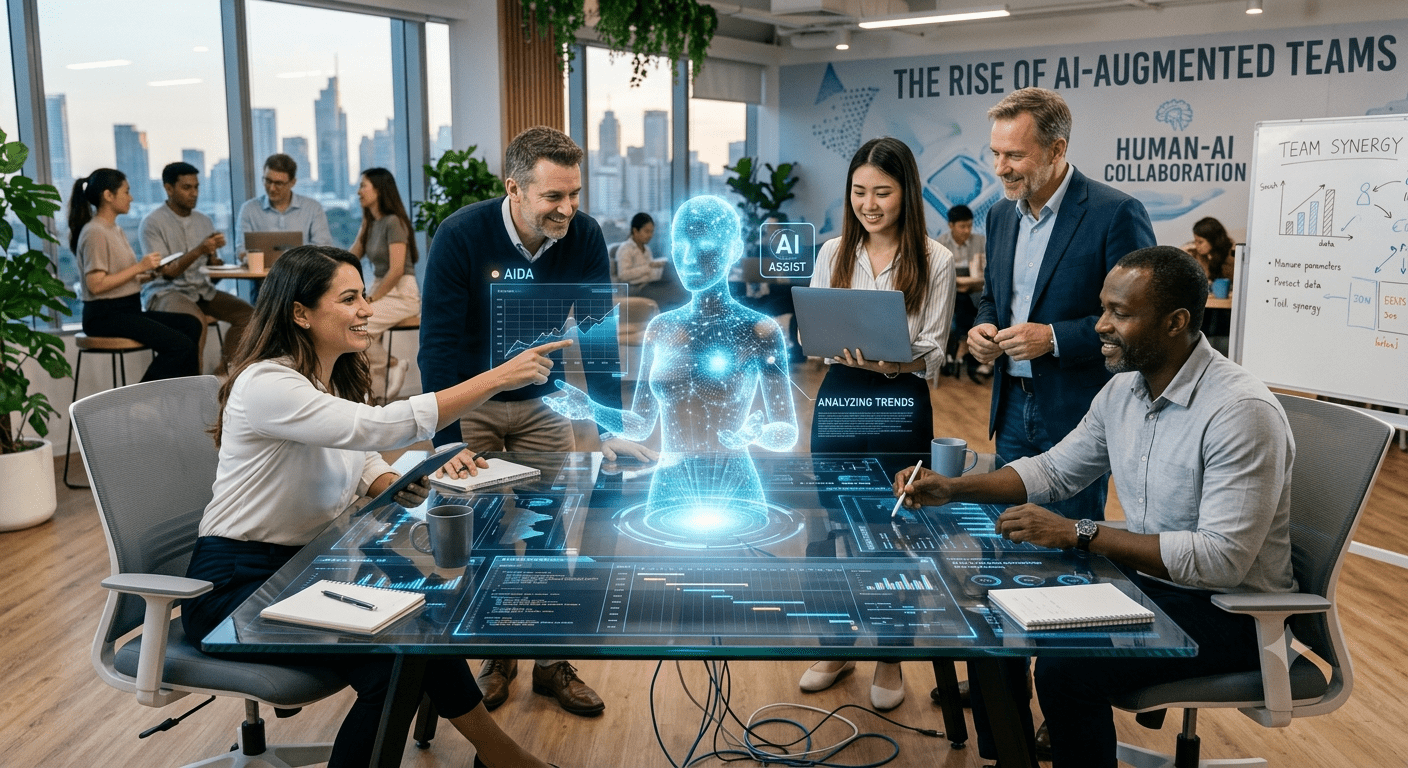
By early 2025, their weekly supplier review meetings had been transformed. When evaluating a complex wind farm equipment tender — a process that previously required days of individual preparation — the team used AI to synthesise technical specifications, market pricing, and supplier performance data in real time during the meeting itself. The work that had taken days was completed in the room. But the critical output — the decision about which supplier to recommend, the assessment of which risks were acceptable, the judgment call about a supplier relationship that numbers alone couldn’t capture — remained entirely the team’s.
Source: Implement Consulting Group — The Next Productivity Revolution Is Deeply Human (Dec 2025)
What made this team different from the 86% who deploy AI without redesigning their work is not that they had better tools or more budget. It is that they invested two weeks in understanding what the AI should own and what they should own — and then built the roles, the transparency norms, and the validation habits that made the collaboration genuinely productive. That is not a technology decision. It is a design decision. And it is available to any team willing to make it.
What Makes an AI-Augmented Team Different
The distinction between a team that uses AI and a team that is genuinely augmented by it comes down to one question: has the work been redesigned around the collaboration, or has the AI simply been added to an existing workflow? The first produces the multiplier effect. The second produces the METR paradox — more tool, same or worse output, and the dangerous illusion of improvement.
An AI-augmented team has not just added a tool. It has redistributed its work — giving machine intelligence what machine intelligence is built for, and freeing human intelligence for what only humans can do.
Where AI Is Reshaping Team Structures Right Now
The shift from individual AI tool use to genuinely redesigned team structures is already underway — and the data on where it is and isn’t happening is instructive. By the end of 2026, 40% of roles in the world’s largest 2,000 companies will involve direct engagement with AI agents, according to IDC. By 2028, Capgemini Research projects that 38% of companies will formally treat AI agents as members of human teams — with defined roles, accountabilities, and performance expectations.
This is not speculation about a distant future. It is a description of the leading edge of what is already happening in the organisations that have moved past the subscription phase and into the redesign phase. In those organisations, new functional distinctions are emerging — not as formal job titles necessarily, but as deliberate allocations of responsibility that make the human-AI collaboration legible, auditable, and improvable.
Of companies will treat AI agents as formal team members by 2028 — Capgemini Research Institute
Wage premium earned by AI-skilled workers over non-AI-skilled peers in 2024 — up from 25% the prior year
Of IT work expected to be done by humans without any AI involvement by 2030 — Gartner survey of 700+ CIOs
The Collaboration Spectrum: From Tool Use to True Partnership
Not all human-AI collaboration is equal. Understanding where a team sits on the collaboration spectrum — and what it would take to move up it — is the most practical diagnostic available to leaders trying to close the gap between AI deployment and AI value.
The Human Skills That Make It Work
Here is the counterintuitive lesson the METR study and the procurement team both teach: the most important skills in an AI-augmented team are not AI skills. They are human skills that have become more valuable because AI now handles what they were previously spent on.
- Question formation. Knowing what to ask — with the precision and domain depth that makes the AI’s answer useful rather than generic — is the highest-leverage skill in human-AI collaboration. The procurement team’s ability to structure the wind farm tender analysis was the reason the AI’s synthesis was actionable. Without that framing, the output would have been a data dump.
- Critical evaluation. The capacity to read AI output with genuine scepticism — to ask what assumptions it made, what it might have missed, where its training data might be producing systematic bias — is what separates teams that improve with AI from teams that are confidently wrong with it. The METR developers were not sceptical enough about their own perceived speed. That cost them.
- Transparent collaboration. The procurement team’s practice of opening every analysis with “here’s how we built this” is not a formality. It is the mechanism by which individual AI capability becomes collective team intelligence. When people share their prompts, their failures, and their validation methods, the team gets better at AI collaboration together — not just in parallel.
- Knowing when to override. AI systems are confident even when wrong. The human with enough domain expertise to know when the confident output is incorrect — and the professional standing to act on that knowledge — is the most important person in the loop. This role cannot be distributed to AI itself.
- Preserving human judgment in high-stakes decisions. As AI absorbs more of the routine work, the decisions that reach human teams will increasingly be the genuinely hard ones — the ambiguous, the ethically complex, the ones where data alone is insufficient. The capacity to exercise judgment in those moments is not something that can be delegated. It must be protected, practised, and valued explicitly.
How to Move Your Team Up the Spectrum
-
Map one workflow before you deploy any tool.
Choose the highest-friction workflow your team runs — the one that consumes the most preparation time and produces the most revisited decisions. Map every task within it. Mark which tasks are high-volume, repeatable, and information-dense (AI territory) and which require judgment, relationship, or contextual nuance (human territory). This map is the design brief for your AI integration. Without it, you are guessing. -
Make AI use visible, not hidden.
The procurement team’s rule — “here’s how we built this” — is the single practice most likely to shift your team from Stage 2 to Stage 3 on the collaboration spectrum. When AI use is hidden, errors propagate silently and learning doesn’t spread. When it’s transparent, the team builds collective intelligence around what works. Normalise showing your prompts and your reasoning alongside your outputs. -
Assign a validator before you assign a generator.
Before any team member uses AI to produce output that will inform a decision, identify who will validate it — and what validation looks like for that type of content. Not a vague “someone should check it.” A named person, a defined standard, and a documented process. This is how the 14% avoid confident errors. It is also how they build organisational trust in AI-generated work. -
Test your perception against your reality.
Run your own version of the METR experiment. Before and after introducing AI into a workflow, measure actual time-to-completion on representative tasks — not perceived time, not estimated time. The gap between what teams believe they are gaining and what they are actually gaining is where course-corrections live. You cannot improve what you haven’t measured honestly. -
Protect the human work that AI cannot do.
As AI absorbs analytical and drafting work, the freed time is the asset. Use it deliberately: for the relationship conversations that don’t happen in data, for the strategic questions that require sitting with uncertainty, for the judgments that require someone to be accountable. If the freed time immediately fills with more analysis, the team has gained efficiency without gaining capability. -
Build psychological safety for AI failure.
Teams that share their AI failures — the prompts that produced nonsense, the outputs that missed the point, the moments they overrode the tool and were right — learn faster than teams that only share successes. Create a standing practice: a brief, regular moment in team meetings where someone shares what didn’t work with AI that week. What went wrong is where the operational intelligence lives.
The Team the Next Decade Belongs To
The developers in the METR study were not bad at their jobs. They were skilled professionals using a genuinely powerful tool in a workflow that hadn’t been designed around it — and the result was a loss dressed as a gain. That pattern is not unique to software development. It is the dominant pattern of AI adoption in 2026, across almost every industry and function.
The 14% of teams who have cracked AI ROI didn’t crack it because they had better technology. They cracked it because they made a different kind of decision — to redesign how work moves, to make AI use transparent and shared, to protect human judgment where it is genuinely irreplaceable, and to measure what actually happens rather than what they hoped would. That decision is available to any team. It doesn’t require a new budget line or a new hire or a different AI subscription. It requires a two-week mapping exercise, a set of team agreements about how AI output is built and verified, and a leader willing to say: we are not just deploying a tool. We are building a new way of working together.
That is what an AI-augmented team actually is. And the window to build one — before competitors do — is still open, but it won’t stay open indefinitely.
Ready to move your team from AI subscriber to AI-augmented?
At Reskill & Rise, we help organisations redesign how work moves — building the human skills, team structures, and collaboration habits that turn AI deployment into genuine competitive advantage.