📑 Table of Contents
- Why training programs, alone, don't build capability
- Training program vs. learning culture: what actually differs
- The five pillars of a genuine learning culture
- The learning culture maturity model
- What a strong learning culture does to business performance
- The role of L&D in building — not just delivering — a learning culture
- Practical steps to start building a learning culture this quarter
- What learning culture means for workforce transformation
- The honest barriers — and how to address them
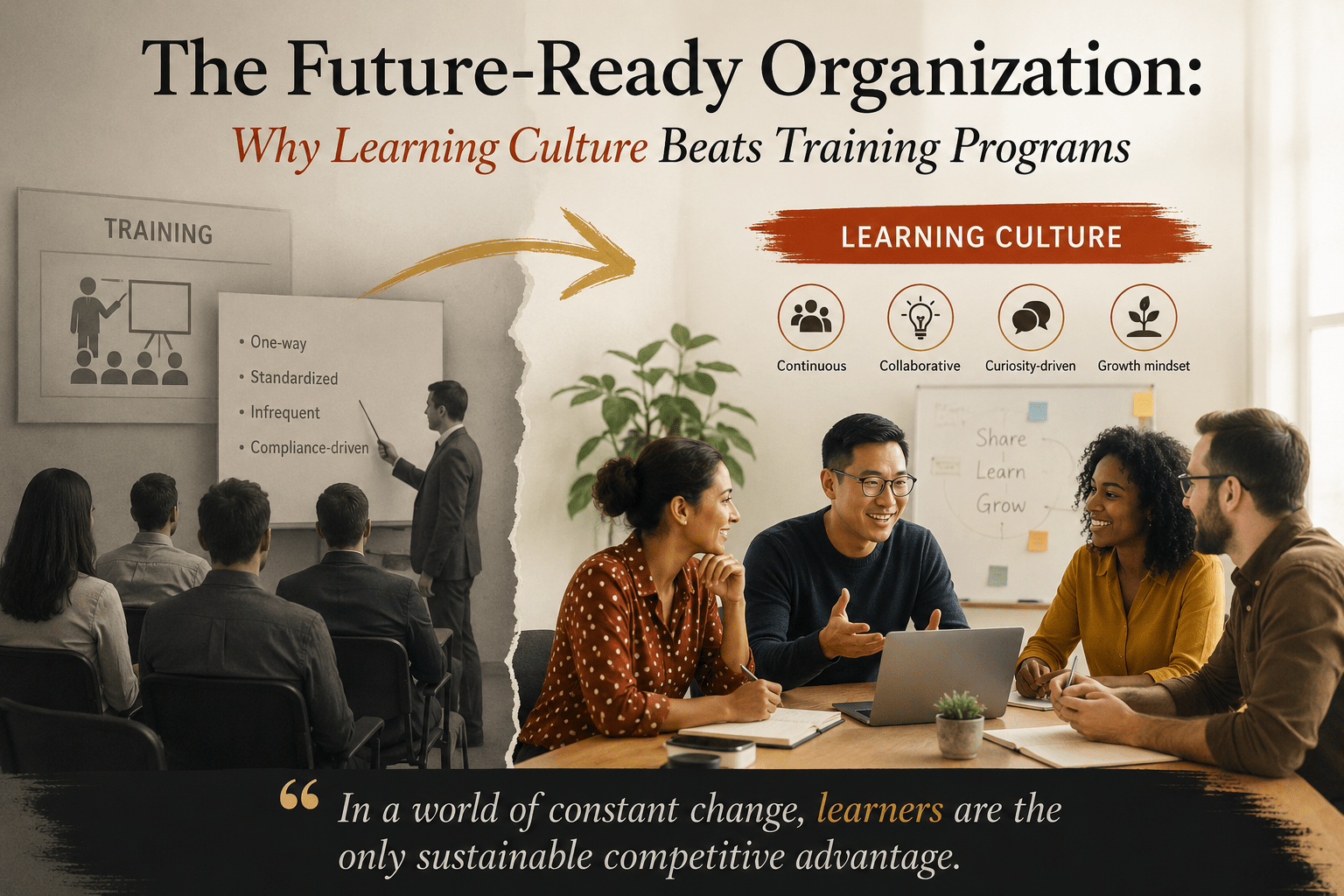
The Future-Ready Organization: Why Learning Culture Beats Training Programs
Organizations that outlast disruption don’t run better training events. They build environments where learning is continuous, social, and inseparable from the work itself.
Organizations with strong learning cultures are 92% more likely to innovate, 52% more productive, and retain employees at rates 30 to 50% higher than their peers. Yet the majority of corporate L&D spending still flows into one-off training events — workshops, e-learning modules, annual compliance courses — that research consistently shows produce minimal long-term behaviour change. The gap between what organizations invest in and what actually builds capability is one of the most costly and least discussed inefficiencies in modern workforce management.
Training programs are not worthless. But they are regularly mistaken for a learning strategy, when they are, at best, one tool within one. The organizations that navigate technological change, talent scarcity, and competitive pressure most effectively are not those that run the most training. They are those that have built environments where learning is continuous, embedded in the flow of work, and culturally expected at every level — from the newest hire to the most senior leader.
That distinction — between a training program and a learning culture — is not semantic. It is structural. It affects how people develop, how knowledge moves through the organization, how quickly capability keeps pace with change, and ultimately, whether the organization can adapt fast enough to survive the pace of disruption it faces.
Here is what separates organizations that have built genuine learning cultures from those running expensive training schedules with limited return.
Why training programs, alone, don’t build capability
The science of learning is unambiguous on this point: knowledge acquired in a single session, without reinforcement, application, or social embedding, decays rapidly. Hermann Ebbinghaus mapped the forgetting curve in the 1880s — it remains one of the most robustly replicated findings in cognitive psychology. Without deliberate reinforcement, people forget approximately 70% of new information within 24 hours and up to 90% within a week.
Yet the dominant model of corporate learning remains the training event: a half-day workshop, a two-hour e-learning module, a conference attendance — each treated as a self-contained development intervention. The problem is not the format. It is the assumption that the event is sufficient.
Effective capability development requires spaced repetition — returning to material across multiple sessions over time. It requires application — using new knowledge in a real context where the stakes are genuine. It requires reflection — processing experience with the support of a coach, mentor, or peer. And it requires social reinforcement — a culture that values and rewards the behaviours the training was designed to build. A one-off training event provides almost none of these conditions.
“The half-life of a learned skill is now estimated at less than five years in most technical disciplines — and as little as 18 months in rapidly evolving fields. Training once is not a strategy. Continuous learning is the only strategy.”
— World Economic Forum Future of Jobs Report, 2025
Training program vs. learning culture: what actually differs
The difference between an organization running training programs and one that has built a genuine learning culture shows up across every dimension of how development is treated — from leadership behaviour to budget allocation to how failure is managed.
Training program mindset
- Learning happens in designated sessions, away from work
- L&D is a support function that delivers courses on request
- Success is measured by completion rates and satisfaction scores
- Leadership attends training but doesn’t visibly model learning
- Mistakes are managed and minimised as performance failures
- Knowledge lives in individuals, not shared systems
- Development is an annual event tied to appraisal cycles
- Budget flows to external courses and off-site programmes
Learning culture mindset
- Learning is embedded in the daily flow of work
- L&D is a strategic partner in business transformation
- Success is measured by capability change and business impact
- Leaders openly share what they are learning and where they struggle
- Mistakes are treated as data — examined, shared, and learned from
- Knowledge is captured, curated, and made accessible across the org
- Development is continuous, self-directed, and peer-supported
- Budget flows to infrastructure, coaching, and internal capability
The organisations that sit in the right column did not get there by replacing their training calendar with a different training calendar. They got there by changing what leadership models, what the system rewards, and what happens to knowledge after it is created.
The leadership paradox: In a 2025 McKinsey survey, 84% of leaders said building a learning culture was important or very important to their organization’s future. But only 26% said their leaders actively modelled learning behaviours — sharing what they were studying, admitting knowledge gaps, or publicly crediting others for teaching them something. The intention is there. The behaviour — which is the only thing that actually shapes culture — is not.
The five pillars of a genuine learning culture
Learning culture is not a single initiative. It is a system of interconnected conditions that, taken together, make continuous development the path of least resistance for every person in the organization. Organisations that get it right have built — deliberately or organically — most of the following five pillars.
Psychological safety
People only learn in environments where it is safe to not know, to ask questions, to try things that might not work, and to share failures without career penalty. Amy Edmondson’s research across healthcare, financial services, and technology consistently shows that psychological safety is the single strongest predictor of team learning behaviour — stronger than talent, resources, or leadership intent.
Learning in the flow of work
The most effective learning happens in context — while doing the real work, not before or after it. This means embedding learning moments into projects: structured reflection after a client pitch, peer feedback after a presentation, a 15-minute debrief after a difficult conversation. The work itself becomes the curriculum.
Social and peer learning
Research consistently shows that 70% of workplace learning comes from experience, 20% from others, and only 10% from formal instruction. Yet most L&D investment flows into that 10%. Learning cultures invest in the 90% — through mentoring, peer coaching, communities of practice, internal knowledge sharing, and deliberate cross-functional collaboration.
Leadership as learning model
Culture is what leaders do, not what they say. When senior leaders visibly invest in their own development — share what they are reading, bring in coaches, admit uncertainty, and credit others for teaching them — they give permission for the entire organization to do the same. This single behaviour is the highest-leverage change available to any organization trying to build learning culture.
Systems that capture and share knowledge
Learning cultures treat organizational knowledge as an asset to be maintained, not a byproduct of individual tenure. This means intentional knowledge management: documenting decisions and the reasoning behind them, capturing lessons from projects, building internal wikis and playbooks, and designing offboarding processes that preserve institutional wisdom before it walks out the door.
Measurement tied to capability, not activity
Training program cultures measure learning inputs — hours completed, courses attended, completion rates. Learning cultures measure outputs — what can people do now that they couldn’t before, and what business problems does that solve? This shift in measurement is what makes the L&D function strategically credible rather than operationally administrative.
The learning culture maturity model
Organizations don’t build learning cultures overnight. They move through recognizable stages — and most are stuck earlier than they realize. Here is a practical maturity model for assessing where your organization currently sits, and what the path forward looks like.
Reactive
Learning is driven by regulatory requirements and risk mitigation. Mandatory courses on health & safety, data protection, and HR policy. No strategic connection between L&D and business priorities. Completion is the metric. Nobody celebrates it.
Transactional
Training programs exist and are delivered. An LMS is in place. Budget is allocated. But programs are episodic, not continuous. Content is largely generic. Impact on business performance is rarely measured. L&D is a support function, not a strategic one.
Intentional
Learning pathways exist for key roles. Development is linked to performance conversations. Managers receive training on how to support their teams’ growth. Some measurement of capability change exists. The L&D team is consulted on business decisions that affect skills needs.
Strategic
Skills development is explicitly part of the organization’s strategic planning. L&D has a seat in business transformation discussions. Coaching and mentoring infrastructure exists and is actively used. Knowledge management is intentional. Learning outcomes are tracked against business metrics.
Adaptive
The organization adapts faster than its competitors because learning is continuous, distributed, and culturally expected. Leaders model vulnerability and curiosity. Mistakes generate organizational knowledge. Skills visibility drives internal mobility. The learning system is self-reinforcing — people choose to develop because the culture rewards it and makes it possible.
Where most organizations actually are: In a 2025 Deloitte Human Capital survey, 71% of organizations rated themselves at L2 or L3 on a similar maturity scale. Only 11% described their learning culture as genuinely embedded in business strategy. The aspiration is almost universal. The execution is rare — and that gap is precisely where competitive advantage lives for those who close it.
What a strong learning culture does to business performance
The case for learning culture is not philosophical. It is financial and operational. The data across multiple large-scale studies is consistent: organizations that invest in building genuine learning cultures outperform those that don’t, on every dimension that matters to business outcomes.
Faster adaptation to change
When learning is embedded in how the organization operates, it can absorb and respond to external disruption faster. New tools, new markets, new competitive threats — a learning organization has the internal mechanisms to reskill and pivot rather than waiting for the next training calendar cycle.
Higher talent retention
LinkedIn’s 2025 Workforce Learning Report found that 94% of employees would stay at a company longer if it invested in their learning and development. In a market where the cost of replacing an employee averages 50–200% of their annual salary, learning culture is one of the highest-ROI retention investments available.
Stronger internal mobility
Organizations with learning cultures fill a significantly higher proportion of senior and specialist roles internally. Internal mobility reduces recruitment costs, accelerates time-to-productivity, and retains institutional knowledge. It also signals to employees that growth is possible without leaving — one of the most powerful retention levers available.
Better innovation outcomes
Innovation requires curiosity, psychological safety, and the willingness to try things that might not work. These are all features of learning cultures — and they are conspicuously absent from cultures driven primarily by performance compliance. Companies that score highest on learning culture measures are consistently over-represented in innovation benchmarks.
Greater resilience in disruption
The organizations that navigated the COVID-19 disruption, the AI adoption wave, and the broader workforce transformation most effectively were disproportionately those with strong learning cultures already in place. They had the infrastructure, the habits, and the psychological safety to learn their way through uncertainty rather than waiting for stability to return.
Improved leadership pipeline
Learning cultures develop leaders continuously rather than in periodic cohort programmes. When stretch assignments, coaching, cross-functional projects, and peer learning are part of everyday work, the pipeline deepens organically. The organization grows its own senior talent rather than importing it — at a fraction of the cost and with far better cultural fit.
The role of L&D in building — not just delivering — a learning culture
For many L&D professionals, this framing represents a significant identity shift. The traditional role of L&D is content delivery: design a course, run a programme, measure attendance. The role of L&D in a learning culture organization is fundamentally different — and considerably more strategic.
| Function | Traditional L&D role | Learning culture L&D role |
|---|---|---|
| Strategy | Responds to training requests from the business | Partners with business leaders to anticipate skills needs and shape capability strategy |
| Design | Builds or buys courses and programmes for delivery | Creates learning ecosystems — blended pathways, social learning infrastructure, coaching frameworks |
| Delivery | Facilitates workshops and manages LMS content | Enables managers and peers as learning facilitators; curates external and internal content |
| Measurement | Tracks completion rates and satisfaction surveys | Measures capability change, internal mobility rates, and business impact |
| Leadership | Delivers leadership programmes on a cohort basis | Coaches leaders on modelling learning behaviour and builds psychological safety across teams |
| Knowledge | Maintains a library of training materials | Builds and curates organizational knowledge infrastructure — wikis, playbooks, communities of practice |
This shift requires L&D teams to develop new capabilities — consulting skills, data literacy, organizational design thinking, and coaching capability — that most L&D professionals were not trained for. It also requires organizational permission: the support of senior leaders who see the L&D function as a strategic partner rather than a content factory.
“The L&D function of the future is not a course catalogue. It is the connective tissue of an organization that learns faster than the rate of change it faces.”
— Reskill & Rise, 2026
Practical steps to start building a learning culture this quarter
Learning culture is built through accumulation of consistent, deliberate choices — not through a single programme launch. Here are the highest-leverage actions available to leaders and L&D professionals who want to start shifting the system.
Audit the current state honestly
Before building anything, assess where you actually are. Survey employees on psychological safety, access to learning, and whether they feel development is genuinely supported — not just stated as a value. The gap between what leaders believe about the learning culture and what employees experience is often the most instructive data available.
Make one senior leader visible as a learner
Ask your CEO, MD, or a respected senior leader to publicly share something they are currently learning — in a team meeting, a company communication, or a brief internal blog post. One visible act of learning modelling from the top changes the cultural permission for everyone below it. This costs nothing and has disproportionate cultural impact.
Build a post-project reflection habit
Introduce a structured 20-minute debrief after every significant project, client engagement, or team initiative. Three questions: what went well and why, what would we do differently, what should the rest of the organization know? Capture the output somewhere accessible. This single habit, consistently applied, builds more organizational knowledge than most training programmes.
Invest in manager capability as learning coaches
The manager is the most powerful learning infrastructure in any organization — or the most powerful blocker of it. Managers who ask good questions, give developmental feedback, and create space for their team to experiment and reflect are worth more to a learning culture than any LMS platform. Prioritise this investment above platform spend.
Shift at least one L&D metric toward impact
Choose one development initiative currently measured by completion rates and add a capability outcome metric alongside it. Can participants do something specific they couldn’t do before? Has a measurable business indicator shifted? This doesn’t require abandoning activity metrics — it requires supplementing them with evidence of actual change. That evidence, over time, builds the case for greater L&D investment.
Create at least one community of practice
Identify a topic — AI fluency, sales craft, inclusive leadership, data literacy — that matters to a critical mass of employees and has no formal home in the organization. Invite 10–15 people to meet monthly to share what they’re learning, solve shared problems, and build knowledge together. This is peer learning infrastructure, and it scales organically once the habit takes hold.
What learning culture means for workforce transformation
At Reskill & Rise, the connection between learning culture and workforce transition is central to everything we do. When organizations face significant disruption — restructuring, automation, reskilling at scale, rapid growth, or cultural change — the technical side of the transition is almost never the limiting factor. The limiting factor is almost always the human side: whether people have the confidence to learn new things, the psychological safety to admit what they don’t know, and the organizational support to develop at the pace the business needs.
Organizations that have already built learning culture infrastructure are significantly better positioned to execute workforce transitions effectively. Their employees trust that development is possible. Their managers know how to support it. Their L&D teams have the credibility and capability to design interventions that actually work. Their leaders model the behaviours that make change feel navigable rather than threatening.
Organizations that haven’t built that infrastructure face a harder problem: they need to run a workforce transformation and build a learning culture simultaneously — and each is harder to do without the other.
The Reskill & Rise perspective: We work with organizations that need to build both simultaneously — and we have found that the fastest path to effective workforce transition is to treat learning culture development and reskilling as a single integrated programme, not two separate initiatives. The coaching and mentoring infrastructure, the psychological safety work, the manager capability building — these are not overhead on top of the reskilling work. They are what make the reskilling work.
The honest barriers — and how to address them
Building a learning culture is not universally welcomed inside organizations. There are real structural and cultural barriers that explain why most organizations stay at L2 or L3 on the maturity model, even when leadership genuinely wants to go further.
- Time scarcity. The most common objection to learning culture initiatives is that people are too busy to learn. This is real — and it is a system design problem, not an individual motivation problem. Organizations that embed learning in the flow of work rather than adding it on top of it solve this; those that keep treating development as an additional demand on already-stretched people will keep losing the battle against busyness.
- Short-term performance pressure. Quarterly targets and annual appraisal cycles create environments where taking time to develop feels like taking time away from performance. Learning culture requires leaders who hold both — who protect space for development even under performance pressure, and who measure their teams on growth as well as output.
- L&D credibility deficit. In many organizations, L&D is seen as a cost centre that delivers compliance training and organises off-sites. Building the credibility to play a more strategic role requires a track record of impact — and that track record takes time to build. Starting with one high-visibility initiative tied directly to a business priority, with clear outcome measurement, is the fastest path to credibility.
- Manager resistance. Some managers see employee development as a threat — developing people makes them more marketable and more likely to leave or move internally. This is a management culture problem, not a learning culture problem. It needs to be addressed at the leadership level: managers who develop their people need to be rewarded for it, not penalised by losing them.
- Lack of psychological safety. If the culture treats mistakes as failures and questions as signs of weakness, no amount of learning infrastructure will produce genuine development. Psychological safety is a prerequisite, not a byproduct, of learning culture. It has to be built intentionally — through leadership behaviour, team norms, and organizational response to failure.
The compound return: Every element of learning culture reinforces every other element. Psychological safety makes it easier to admit knowledge gaps. Admitting knowledge gaps makes learning more effective. Effective learning builds capability. Demonstrated capability builds confidence. Confidence makes people more willing to take on stretch assignments. Stretch assignments build more capability. This is a virtuous cycle — but it requires an initial investment in conditions that don’t produce immediate visible returns. The organizations that make that investment consistently outperform those that wait for the case to become undeniable.
“An organization’s capacity to learn — and translate that learning into action rapidly — is the ultimate competitive advantage.”
— Jack Welch, former CEO, General Electric
Ready to build a learning culture that lasts?
At Reskill & Rise, we help organizations move beyond training calendars to build the conditions, infrastructure, and leadership behaviours that make continuous learning possible — and make workforce transformation actually work.