📑 Table of Contents
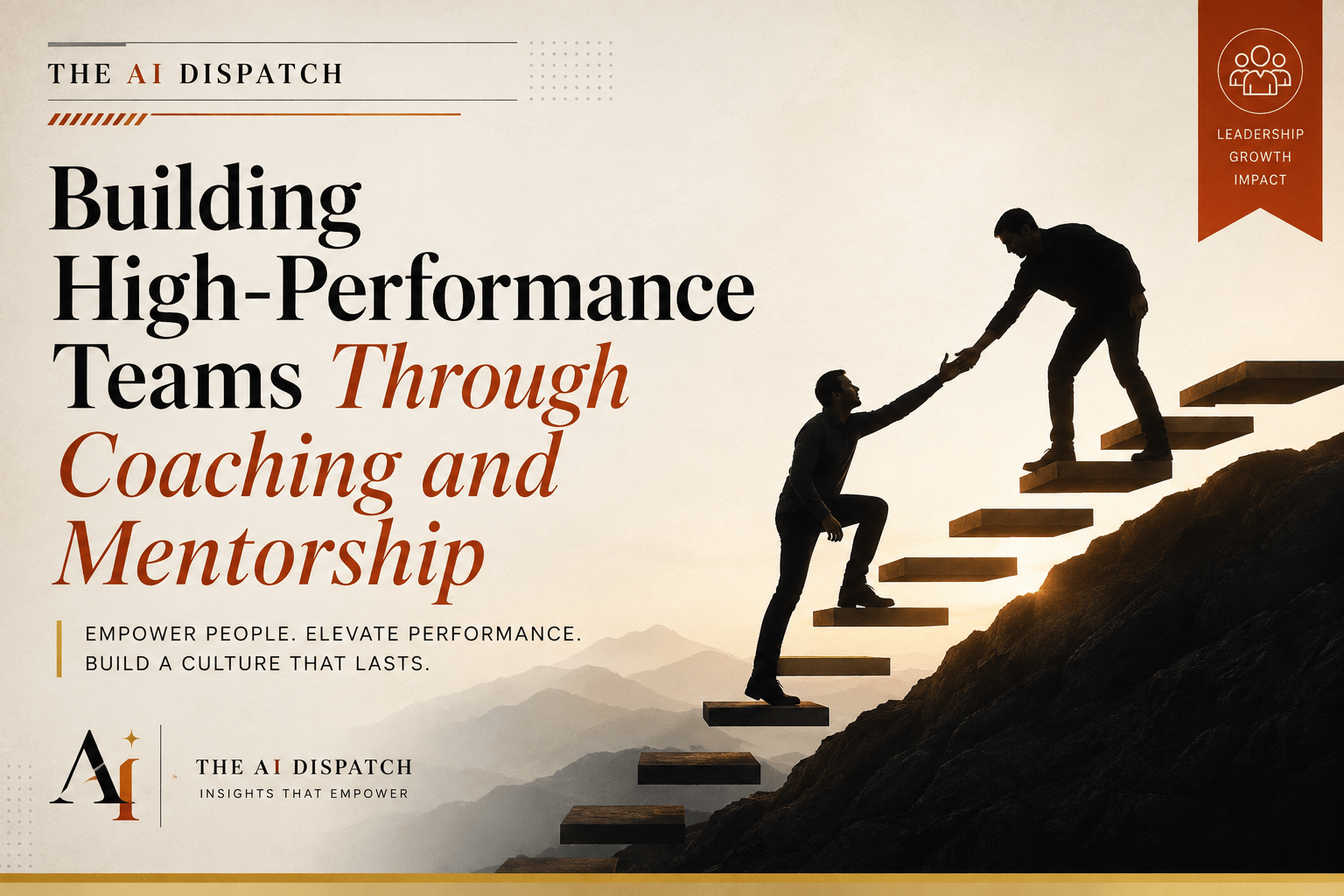
Building High-Performance
Teams Through
Coaching & Mentorship
The highest-performing teams in the world share one trait that rarely appears in a strategy document: someone invested in their people before the pressure arrived. Coaching and mentorship are not HR benefits. They are the infrastructure of sustained team excellence.
Employees in structured mentorship programs are six times more likely to be promoted — and organisations with strong coaching cultures report 21% higher profitability than those without.
Source: Chief Learning Officer (2024) · Gallup State of the Global Workplace Report 2025Ask any leader about their most significant professional turning point and they will almost never describe a training course. They will describe a person — someone who saw something in them before they saw it in themselves, who gave honest feedback when it was uncomfortable, who made time when their schedule argued against it, and whose investment in their growth changed the direction of their career. That is coaching and mentorship at its most human and most effective. The research simply confirms what most professionals already know from lived experience: the quality of the relationships in which someone develops is the primary determinant of how far and how fast they grow.
What separates organisations that build genuinely high-performing teams from those that settle for adequately functioning ones is not the sophistication of their performance management system or the size of their L&D budget. It is the degree to which coaching and mentorship are embedded as normal, expected, structurally supported behaviours — practised by leaders at every level, not outsourced to a programme or reserved for high-potentials once a year.
Coaching vs Mentorship: Distinct Tools, Shared Purpose
The two terms are used interchangeably often enough that the distinction has become blurred — which matters, because they address different development needs and require different designs to be effective. Using one when you need the other is a reliable way to produce frustration on both sides of the relationship.
| Dimension | Coaching | Mentorship |
|---|---|---|
| Focus | Specific skill or performance improvement, near-term | Long-term career trajectory, identity, and direction |
| Relationship | Structured, time-bounded, often with a defined goal | Ongoing, relationship-driven, evolves over time |
| Who leads | Coach asks questions; coachee does the thinking | Mentor shares experience, perspective, and wisdom |
| Expertise required | Coaching skill; not necessarily domain expertise | Relevant lived experience in the mentee’s field or path |
| Best used for | Improving a specific behaviour, skill, or performance gap | Navigating career decisions, building confidence, expanding network |
| Frequency | Regular, structured sessions over weeks or months | Periodic — monthly or quarterly often sufficient |
The most effective development programmes incorporate both — using coaching for targeted performance improvement and mentorship for broader career architecture. They are not competing approaches. They are complementary instruments that address different timescales and different kinds of questions. A team member navigating a specific challenge at work needs coaching. The same person navigating a career decision needs mentorship. Providing one when the other is required produces the right intention with the wrong tool.
The Live Example: Salesforce Ohana Coaching Culture (2024)
In 2024, Salesforce expanded its Ohana Culture coaching programme with a specific mandate: address the AI skills gap that was slowing product delivery across its engineering teams. Rather than commissioning external training, Salesforce deployed an internal mentorship model — pairing senior developers with deep AI integration expertise with junior staff who needed to apply those skills in live Salesforce projects. The programme was not theoretical. Mentors and mentees worked on real deliverables together, with the senior developer coaching the junior through AI tool selection, prompt architecture, output validation, and integration into existing workflows.
The results were measurable and direct. Teams participating in the structured mentorship model completed AI-integrated projects 40% faster than teams relying on self-directed learning or conventional training alone. Mentor engagement remained high because the framework was clear — each relationship had defined milestones, shared visibility into development goals, and regular session ratings that kept both parties accountable. The programme produced a compounding effect: junior developers who were mentored in AI skills went on to mentor peers within twelve months, creating a peer coaching layer that extended the programme’s reach without additional senior time.
The Salesforce case demonstrates something the research consistently supports but organisations consistently underestimate: the fastest route to applied capability in any new domain is not a training module. It is structured access to someone who has already built that capability and is invested in transferring it. The 40% speed improvement was not about the content of what was taught — it was about the relationship in which it was learned.
Sources: Engagedly — Inspiring Examples of Coaching and Mentoring in the Workplace (2025) · Qooper — Successful Mentoring Program Examples (Apr 2026) · HR.com Future Demands in Coaching and Mentoring Research (2025)What High-Performance Teams Actually Need From Coaching
High-performing teams are not groups of individually excellent people. They are groups of people who have learned to think together — who communicate with directness and psychological safety, who give and receive feedback without defensiveness, who know each other’s working styles and blind spots well enough to compensate for them in real time. That kind of collective intelligence does not emerge from talent alone. It is built through repeated, intentional investment in the quality of the relationships within the team — and coaching is the most direct instrument for that investment.
Individual coaching makes people better at their jobs. Team coaching makes groups better at thinking together. Organisations that do only the first are leaving most of the value on the table.
- Feedback that is honest and specific. The most common failure in team development is feedback that is so carefully softened it no longer contains information. High-performance coaching creates the conditions — psychological safety, trust, clear norms — in which honest, specific feedback can be given and received as a gift rather than a threat.
- Awareness of individual working styles. Teams operate faster and with less friction when members understand how each person thinks, decides, and communicates under pressure. Coaching surfaces these patterns — for the individual and for the team — and creates shared language for navigating them.
- Accountability without micromanagement. The coaching relationship creates a structure for accountability that does not require surveillance. When someone has made a commitment to a coach or mentor — about a goal, a behaviour, an approach — the relationship itself becomes the mechanism of follow-through. This is qualitatively different from a task management system.
- Resilience under pressure. High-performing teams fail sometimes. What distinguishes them is the speed and quality of their recovery — their ability to process what went wrong, extract the learning, and rebuild without lasting damage to trust or morale. Coaching builds the reflective capacity that makes that recovery possible.
- Development that cascades. The most powerful feature of the Salesforce model is replicability. When coaching and mentorship are embedded in how a team operates, they self-replicate — the person who was mentored becomes the mentor, extending the investment without additional cost. This is the compounding return that makes coaching culture structurally superior to event-based training.
What Leaders Can Do — Right Now
- Make feedback a weekly habit, not an annual event. Introduce a standing practice of brief, specific feedback — one observation per one-to-one, focused on a behaviour rather than a character trait. This builds the feedback muscle and creates the psychological safety that makes more substantive coaching conversations possible over time.
- Match mentors to mentees on ambition, not just seniority. The most effective mentoring relationships are built on shared interest in where the mentee is going — not just on who is most senior. When pairing, start with the mentee’s development goals and match to someone whose path is relevant. The Salesforce model works because the match is driven by a specific capability gap, not organisational hierarchy.
- Give every coaching relationship a defined structure. Unstructured mentoring conversations produce goodwill; structured ones produce development. Build each relationship around a clear goal, a session frequency, shared visibility into progress, and a simple rating after each meeting. Clarity protects the relationship and keeps both parties accountable.
- Reward the mentors, not just the mentees. High-performing coaching and mentoring programmes are more than three times as likely to reward internal coaches as average ones. Recognition does not need to be financial — it can be visibility, inclusion in leadership conversations, or explicit acknowledgement in performance reviews. What gets rewarded gets repeated.
- Measure what changes, not what happened. Track retention, promotion rates, engagement scores, and skill application — not session completion or participant counts. The Salesforce programme was measured on project delivery speed. That specificity is what made the 40% improvement visible. If you can’t name what will change as a result of the coaching, you don’t yet have a clear enough programme design.
The Team That Builds Itself
The Salesforce programme produced 40% faster delivery not because it gave people information — it gave them relationships in which information became capability. That distinction is everything. The highest-performing teams in any organisation are those in which the investment in people was made before the pressure arrived — where coaching is a weekly practice, mentorship is a structural expectation, and the person who was developed yesterday is developing someone else today. That kind of team does not just perform. It builds itself.
Ready to build a team that coaches itself?
At Reskill & Rise, we design coaching and mentorship programmes that are structured, measurable, and built to compound — so every investment in one person becomes an investment in the whole team.
Learn about our mission →