📑 Table of Contents
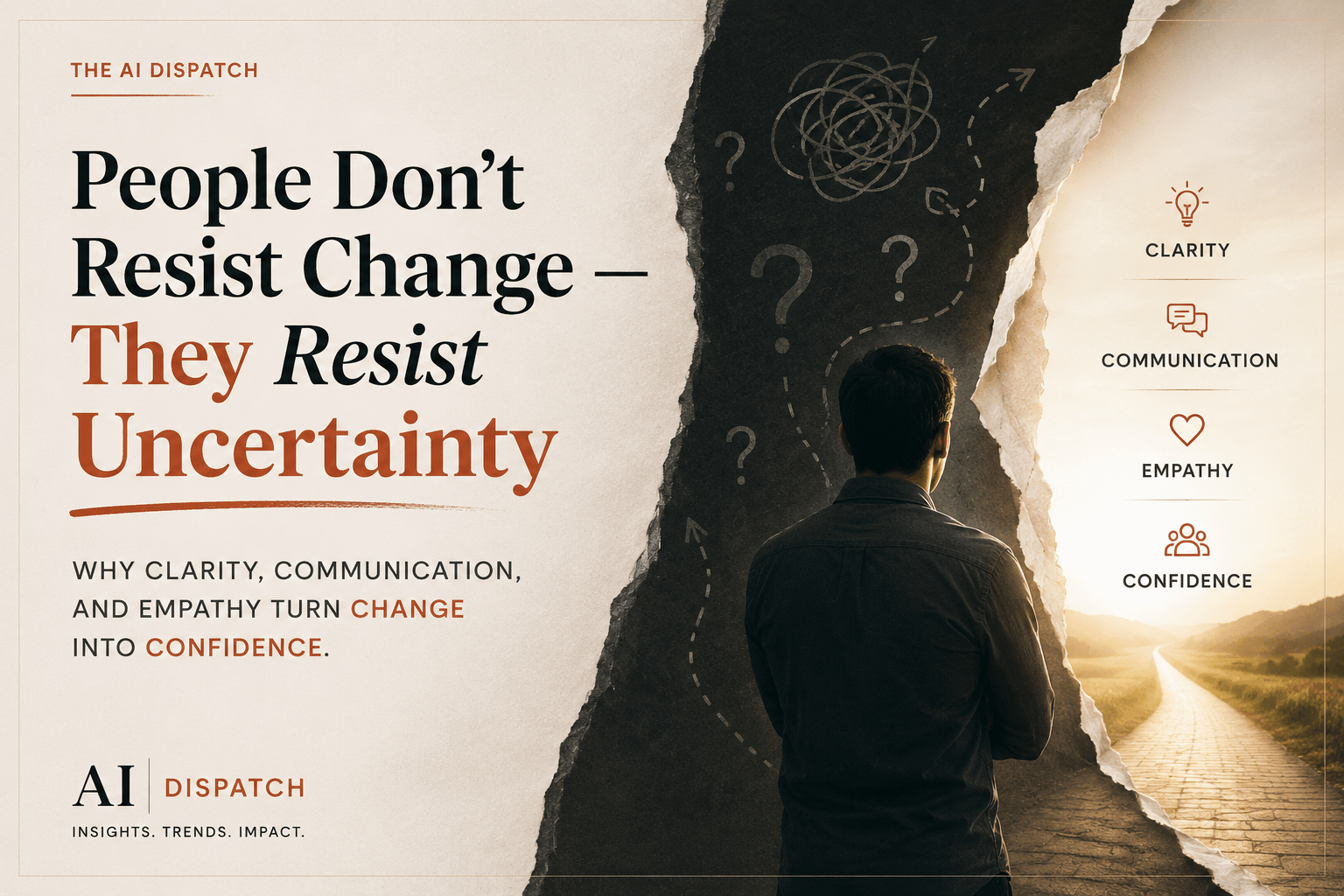
People Don’t
Resist Change —
They Resist
Uncertainty
The label “resistant to change” has ended more honest conversations about
organisational transformation than almost any other phrase in leadership.
It is almost always wrong — and the cost of that misdiagnosis is enormous.
Organisational change accelerated by 183% between 2020 and 2024 — outpacing the human brain’s capacity to process it. Meanwhile, employee support for those changes dropped from 76% to just 44% over the same period.
Source: NeuroLeadership Institute (2024) · Gartner Enterprise Change Report (2024)
Walk into any change management post-mortem and you will hear some version of the same diagnosis: the people resisted. The implementation team did everything right — the strategy was sound, the technology was ready, the business case was clear — and still, people pushed back, workarounds appeared, adoption stalled. The conclusion drawn, almost universally, is that the organisation has a change resistance problem. It almost never does. What it has is an uncertainty problem. And those two things require entirely different responses.
The distinction matters more than most leaders realise, because the intervention that works for resistance is very different from the one that works for uncertainty. Treating uncertainty as resistance produces more of it — it signals to employees that their concerns are obstacles to be overcome rather than information to be addressed. The result is a self-fulfilling cycle in which management doubles down on communication about why the change is happening, and employees grow more anxious about what it means for them. No amount of explaining the vision closes that gap. Only clarity about the specifics — the who, the what, the when, the impact on me personally — does.
Acceleration in organisational change volume 2020–2024 — NeuroLeadership Institute
Employee support for change by 2024 — down from 76% in 2016 · Gartner
More likely to be engaged — employees who strongly trust leadership during disruption · Gallup
The Neuroscience Behind the Resistance
The reason uncertainty produces such predictable and powerful resistance is not psychological weakness. It is neuroscience. Neuroscientist Dr David Rock’s SCARF model identifies certainty as one of five core domains the brain monitors as intensely as physical survival needs. When change disrupts certainty, the amygdala fires a threat response — cortisol spikes, the prefrontal cortex goes offline, and the capacity for clear thinking and sound decision-making drops. The brain is not distinguishing between a tiger and a restructuring announcement. It is responding to the disruption of a fundamental need for predictability.
This explains something that puzzles many leaders: why employees resist changes that are objectively good for them. A better system, a more efficient process, a fairer performance structure — all of these can produce resistance not because people dislike the destination but because they cannot see the path. The unknown journey activates the threat response regardless of how appealing the announced outcome is. Telling people the change is positive does not reduce the neurological response to uncertainty. Giving them specific, reliable information about what will happen, when, and to whom — does.
Uncertainty is not a soft problem requiring empathy alone. It is a neurological response requiring specific, reliable information. Leaders who understand this stop persuading and start clarifying.
The Live Example: A Scheduling System That Nearly Failed — Then Didn’t
A national retail chain rolled out a new employee scheduling system designed to reduce overtime costs and improve staffing accuracy. The system itself was not complicated. The interface was clean. The logic was sound. By every technical measure, the rollout should have been smooth.
It wasn’t. Store managers received different instructions depending on who briefed them. Training materials were inconsistent across regions. Employees were told the system was being implemented but not why. Speculation filled the gaps immediately. Some believed it was a cost-cutting measure that would reduce their hours. Others thought it was a performance monitoring tool designed to identify underperformers. A third group assumed it was the precursor to automated scheduling that would eliminate shift supervisor roles entirely. Rumours spread faster than any official communication. Adoption stalled. Workarounds multiplied. The technology worked. The rollout didn’t.
Leadership’s response was to increase communication about the benefits of the system — exactly the wrong intervention. Employees were not unconvinced of the system’s merits. They were uncertain about what it meant for them personally. Once leadership changed its approach — clarifying the purpose directly and specifically, standardising training across all locations, creating a simple FAQ that addressed the actual rumours rather than restating the rationale — adoption jumped rapidly and friction disappeared. The change itself had not changed. The uncertainty around it had.
Source: Thomas M. McCorry — Operating Truth: People Don’t Resist Change, They Resist Uncertainty (March 2026)
The retail scheduling case is not unusual. It is a precise description of how most organisational change initiatives unfold — not because leaders are careless, but because they consistently misdiagnose the problem. They see resistance and respond with persuasion. What they should see is uncertainty and respond with specificity. The gap between those two responses is where most transformation programmes stall, and where most of the budget allocated to change management disappears without measurable impact.
The Five Forms Uncertainty Takes at Work
Understanding that the problem is uncertainty rather than resistance is only useful if leaders can recognise the specific forms uncertainty takes in their organisations. These are not abstract — they are observable, predictable patterns that emerge whenever change is introduced without sufficient clarity.
- Loss of control. When people don’t know what is changing, they assume the worst — not because they are pessimistic, but because the brain defaults to threat-scanning when predictability disappears. The assumption is almost always more negative than the reality.
- Fear of hidden consequences. Ambiguity creates space for speculation, and speculation almost never trends positive. Employees fill information gaps with their most feared interpretation of what the change might mean for their role, their status, or their security.
- Cognitive overload. Ambiguity forces people to interpret, guess, and fill in gaps — all of which drain cognitive energy that would otherwise go into doing the work. This is why uncertainty produces visible drops in productivity even before a change has been implemented.
- Inconsistent signals. When different leaders communicate differently about the same change, teams lose trust in the message entirely. Inconsistency reads as concealment. The more leaders say varying things, the more employees assume the real story is being withheld.
- Lack of personal relevance. Change communications that focus on strategy, vision, and organisational benefit without addressing individual impact fail to reduce the uncertainty that matters most to the person hearing them. The question employees are always asking — and rarely hearing answered — is: what does this mean for me, specifically, in my role, on my team, next month?
What Reducing Uncertainty Actually Looks Like
Reducing uncertainty is not about over-communication. Volume of messaging is not the variable — specificity is. An organisation that sends twelve emails about why a change is happening and zero emails about what will change for each team, on what date, with what support, has communicated a great deal without reducing uncertainty at all. In some cases it has increased it, because the volume of communication signals that something significant is happening while the absence of specifics signals that the details are not yet known or not yet being shared.
The leaders who navigate change most effectively are not the most inspirational communicators. They are the most precise ones. They answer the questions employees are actually asking — not the questions that appear in the strategy presentation. They identify the rumours and address them directly, by name, without the defensiveness that signals the rumour touched something real. They create feedback channels that are genuinely used rather than performatively offered. And they maintain consistency of message across every tier of the organisation, because one inconsistent signal from a middle manager can undo weeks of careful executive communication.
What Leaders Can Do — Starting This Week
-
Answer the question employees are actually asking.
Before any communication goes out, ask: does this answer “what does this mean for me personally”? If not, rewrite it until it does. Vision statements reduce uncertainty for almost nobody. Specifics about roles, timelines, and support structures do. -
Name the rumours and address them directly.
Every change initiative produces informal speculation. Find out what the rumours are — through managers, through anonymous channels, through listening — and address them explicitly by name in your communications. “We know some of you have heard that this means redundancies in X team. Here is what is actually happening.” Specificity dissolves speculation. -
Standardise the message across every level of leadership.
The most common source of uncertainty in change programmes is not the absence of communication — it is inconsistency. Every manager in the chain needs the same information, the same language, and the same answers to likely questions before any announcement is made. One manager who says something different breaks the entire chain of clarity. -
Create a genuine feedback loop — not a performance of one.
Town halls where questions are screened and Q&A is managed increase uncertainty rather than reducing it. The employees watching know the format is controlled. Build channels where unfiltered concerns can be raised and actually addressed — even if the honest answer is “we don’t know yet, and here is when we will.” -
“We don’t know yet” is a valid — and trust-building — answer.
Leaders often avoid admitting the limits of what they know because they fear it will increase anxiety. In practice, the opposite is true. “We don’t have the answer to that yet. We will communicate it by [specific date]” reduces uncertainty more effectively than a polished non-answer. It signals that leadership is honest, that the question is legitimate, and that an answer is coming.
The Reframe That Changes Everything
The retail scheduling system didn’t fail because employees resisted change. It failed because leadership communicated the what without addressing the so-what-for-me. The moment that gap closed — through specific answers, consistent messaging, and rumours addressed by name — adoption followed. The technology had not changed. The people had not changed. The uncertainty had. And that was sufficient.
The reframe available to every leader is simple but demanding: stop asking “how do we overcome resistance?” and start asking “what are they uncertain about, and how do we close that specific gap?” The first question positions the organisation against its people. The second positions it alongside them — which is, not coincidentally, the only position from which a transformation can actually succeed.
Ready to lead change that people actually follow?
At Reskill & Rise, we help organisations build the leadership capability and communication frameworks that reduce uncertainty — so transformation becomes something people move toward, not away from.