📑 Table of Contents
Degrees vs Skills:
What Employers Are
Really Hiring For in 2026
The credential that once opened every door is losing its master-key status.
A quiet but seismic shift in how companies hire is already underway — and most candidates haven’t caught up.
For most of the twentieth century, the contract was simple: earn a degree, secure a career. The diploma was a proxy — a universally understood signal that its holder had demonstrated the capacity to learn, persist, and meet institutional standards. Employers trusted it, salary tables were built around it, and entire lives were structured in pursuit of it. That contract is not dead. But in 2026, it is visibly fraying.
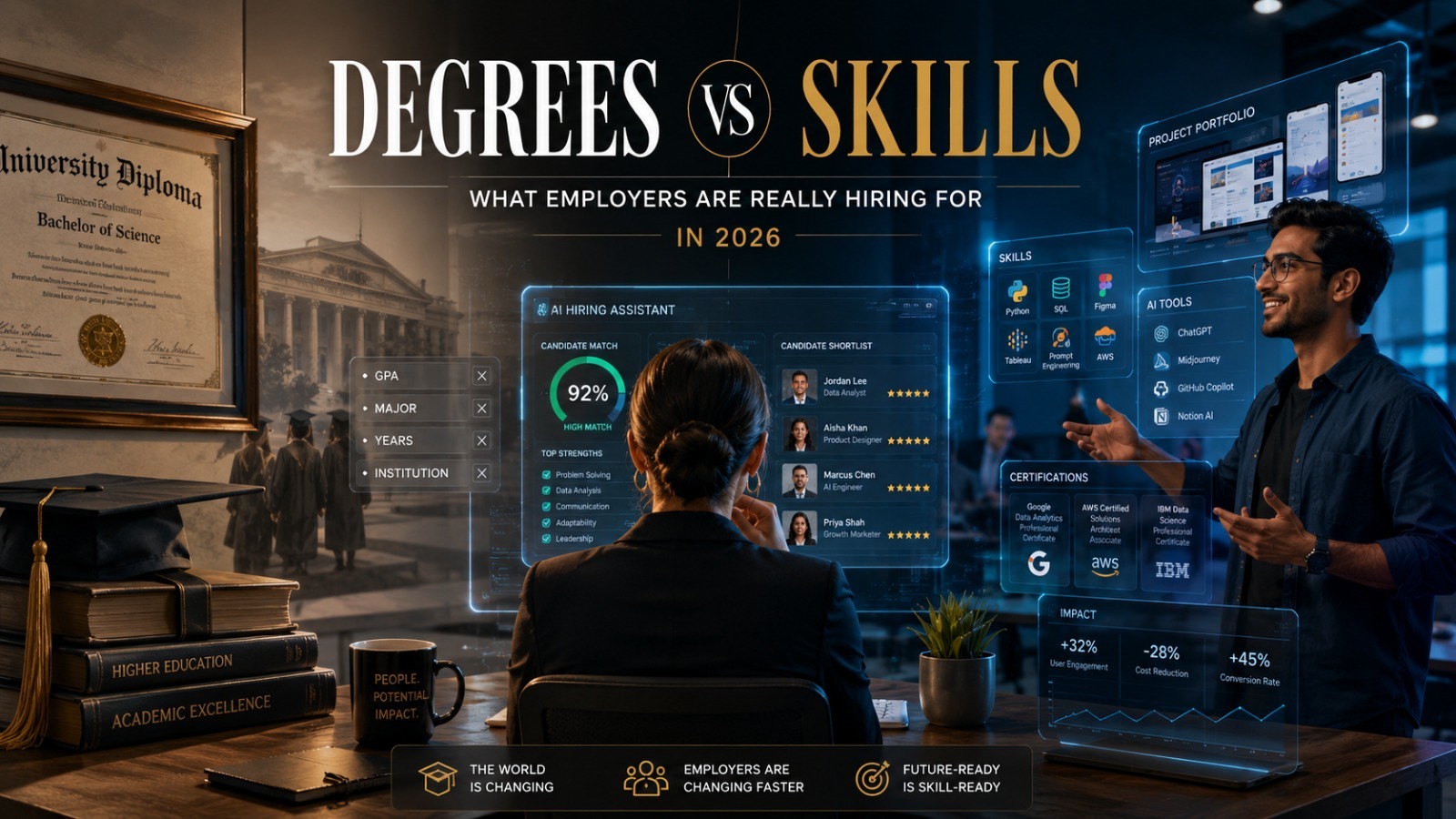
Across industries — from technology and finance to healthcare administration and creative services — a meaningful shift is underway. Hiring managers are posting roles without degree requirements. Skills-based assessments are replacing resume screens. Portfolio links are outweighing transcript GPAs. This isn’t a fringe movement driven by Silicon Valley contrarians. It is a structural realignment in how the labour market defines and measures talent.
Why the Degree Lost Its Edge
The credential inflation of the past two decades eroded much of the degree’s signal value. When a bachelor’s degree became the baseline requirement for roles that didn’t functionally need one — administrative positions, customer service leads, junior marketing coordinators — the signal became noise. Employers began noticing that degree holders weren’t necessarily better at the job. They were simply more expensive to hire and, in many cases, harder to retain because their expectations had been shaped by an institution rather than by the actual demands of the work.
Simultaneously, the explosion of alternative credentials — bootcamps, professional certifications, open-source portfolios, micro-credentials from platforms like Coursera, LinkedIn Learning, and Google Career Certificates — created a parallel pipeline of talent that was demonstrably capable, often more current in their knowledge, and significantly more affordable. When a six-month certification produces someone who can do the job on day one, the four-year degree stopped being an obvious competitive advantage.
Employers aren’t anti-degree. They’re pro-evidence. A degree used to be the best evidence available. Now it has competition.
Of US employers have removed degree requirements from roles since 2020
Skills-based job postings have grown 4× faster than traditional postings since 2022
Average half-life of a technical skill before it requires meaningful updating
What Employers Are Actually Looking For
Ask a hiring manager what they want in 2026 and you’ll hear a consistent set of answers. They want people who can demonstrate capability rather than just claim it. They want evidence of applied learning — not just theoretical exposure. They want candidates who can adapt quickly, communicate clearly, and show curiosity about the domain they’re entering. And increasingly, they want proof that a candidate is already using the tools shaping their industry — AI, automation platforms, data analysis software — not just awareness that these tools exist.
The shift is perhaps most visible in how job descriptions have changed. Where once a posting required “Bachelor’s degree in Business Administration or related field,” many now read: “Demonstrated experience with CRM platforms, data dashboards, and cross-functional project delivery.” The specification is more precise, more testable, and more directly connected to what the role actually demands. It is, in many ways, a more honest conversation.
| Hiring Signal | Degree-First Era | Skills-First Era (2026) |
|---|---|---|
| Primary screen | Educational credentials | Skills assessments & portfolios |
| Proof of capability | Transcript & GPA | Work samples & demonstrated output |
| Valued experience | Internships at named firms | Freelance, open-source, side projects |
| Learning signals | Formal degree completion | Certifications, courses, continuous upskilling |
| Interview format | Behavioural & résumé-based | Live tasks, take-home projects, case studies |
| AI literacy | Not assessed | Expected baseline in most knowledge roles |
The Skills That Are Actually Winning Interviews
Not all skills are created equal in today’s market. There is a meaningful distinction between table-stakes skills — the baseline competencies expected before a candidate is considered — and differentiating skills that actively move candidates to the top of a shortlist. In 2026, AI fluency has migrated rapidly from differentiator to table stakes in most professional roles. The candidates winning competitive interviews are those who have layered something on top of it.
- Applied AI proficiency — not just knowing tools exist, but demonstrating how you’ve used AI to produce better outcomes at speed, with examples you can speak to specifically
- Data literacy — the ability to read, interpret, and draw defensible conclusions from data without needing a data science degree; comfort with dashboards, spreadsheets, and basic analytics tools
- Clear written communication — paradoxically more valued now that AI can generate text, because the ability to edit, direct, and craft for impact is a genuinely human skill
- Cross-functional collaboration — working effectively across disciplines, time zones, and seniority levels; the ability to translate between technical and non-technical stakeholders
- Adaptive learning velocity — the demonstrable habit of picking up new tools, frameworks, and domains quickly; employers want evidence you’ve done it before, not just a claim that you can
- Project ownership — the ability to take something from ambiguous brief to delivered outcome without hand-holding; candidates who can show a complete arc of work stand out sharply
The Degree’s Remaining Strongholds
It would be misleading to suggest the degree is irrelevant. In regulated professions — medicine, law, engineering, accounting — the credential is not merely a hiring preference but a legal requirement. In research and academia, the doctorate remains the currency of credibility. In certain legacy industries and large public-sector organisations, degree requirements persist not because they predict performance but because they simplify compliance and reduce hiring liability.
And there are subtler ways in which the degree still earns its keep. For roles involving sophisticated stakeholder management — senior consulting, corporate law, investment banking — the degree from a recognisable institution still functions as a social signal, a shorthand for a certain kind of background and network. That may be uncomfortable to acknowledge, but pretending it isn’t true helps no one.
The honest picture is this: the degree has not been dethroned. It has been demoted from mandatory to contextual. For some roles and industries it remains decisive. For a growing number, it is one credential among many — and no longer the most important one in the pile.
What This Means If You’re Hiring
For organisations, the shift toward skills-based hiring isn’t just a recruitment trend — it is a talent strategy. Companies that drop degree requirements without replacing them with rigorous skills-based screening often find they’ve simply widened the funnel without improving the quality of hires. The discipline required is not less; it is different. Defining what capability actually looks like for each role, building assessments that test for it, and training hiring managers to evaluate portfolios and work samples rather than résumés — this is harder than scanning for degree checkboxes. But it accesses a dramatically larger and often more motivated talent pool.
There is also a retention argument. Candidates hired for demonstrated skills tend to have clearer job-fit expectations, lower first-year attrition, and stronger intrinsic motivation than those hired primarily on credential. When the match is built on what someone can actually do rather than what they once studied, the employment relationship starts on more honest ground.
What This Means If You’re Job-Hunting
If you hold a degree, don’t hide it — but stop leading with it. Your degree is context, not evidence. What employers want to see is what you’ve built, solved, shipped, or transformed. Curate a portfolio that shows the arc of your capability. Make your certifications visible. Document your AI tool fluency concretely. Show the outcome of projects, not just your participation in them.
If you don’t hold a degree, this moment is genuinely your opening. The barrier to building a credible professional profile has never been lower. A focused six months of targeted upskilling — in the tools and disciplines most in demand in your target industry — combined with a visible body of work, can now compete directly with a four-year qualification. That is not a consolation prize. It is a genuine structural shift in your favour, if you move decisively.
In either case, the same principle applies: in 2026, the candidates who win are those who make it easiest for an employer to say yes. A degree used to do that work. Now you have to do it yourself — and the tools to do so have never been more accessible.
Ready to build a skills-first workforce?
At Reskill & Rise, we help organisations move beyond credentials to capability — designing role-specific, skills-based programmes that identify, develop, and retain the talent you actually need.